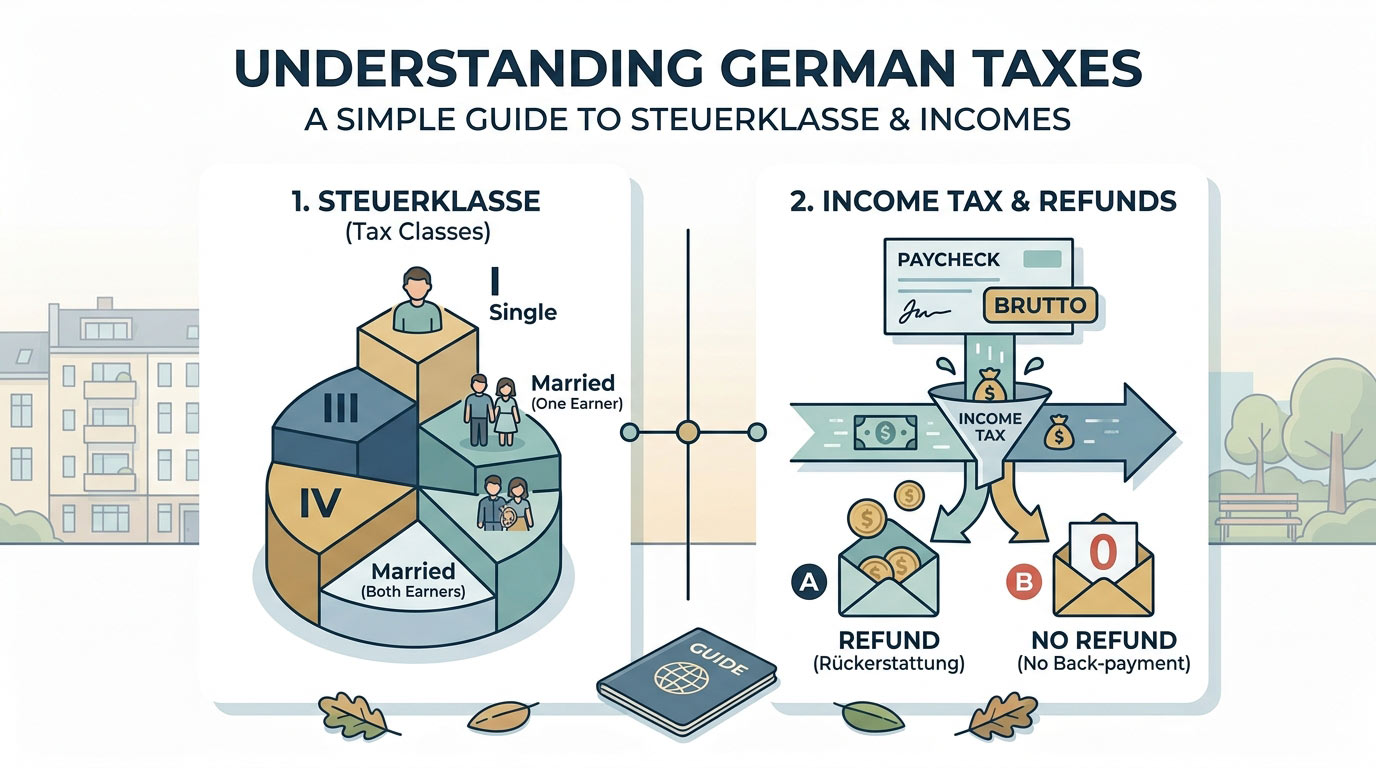
Understanding German taxes is an important part of living and working in Germany. If you have recently moved to Germany as an expat, international student, employee, researcher or skilled worker, your first payslip may contain several deductions and German terms that are difficult to understand. Words such as Steuerklasse, Einkommensteuer, Lohnsteuer, Steuer-ID and Solidaritätszuschlag can initially seem complicated.
Germany has a structured tax system in which employees normally have income tax and other contributions deducted directly from their salary. The amount you take home after these deductions can depend on your income, tax class, personal circumstances and social insurance contributions.
The good news is that you do not need to become a tax expert to understand the basics. Knowing how Steuerklasse, German income tax, payroll deductions and tax refunds work can help you read your payslip, estimate your net salary and understand whether submitting a tax return could be beneficial.
This guide explains the German tax system in simple language and is especially useful for foreigners moving to Germany for employment, university, Ausbildung or other long-term purposes.
Germany collects several different types of taxes. For employees, income tax is one of the most important. When you receive a salary, your employer generally withholds wage tax from your gross earnings and transfers it to the tax authorities.
Your gross salary is therefore not the same as the amount that reaches your bank account. The difference can include income tax and employee social insurance contributions, depending on your circumstances.
Germany also has other taxes, such as value-added tax (VAT), which is included in the price of many goods and services. However, if you are an employee, the deductions visible on your monthly payslip are usually the most relevant taxes and contributions to understand.
Steuerklasse means tax class. Germany uses different tax classes to determine how wage tax is calculated and withheld from an employee's regular salary.
Your Steuerklasse can have a significant effect on your monthly net salary. However, it is important to understand that the tax class does not necessarily determine your final annual income tax liability. Your final tax position is determined through the applicable annual tax rules and, where relevant, your tax return.
Germany has six main tax classes. Your circumstances, particularly your marital status and employment situation, determine which class applies to you.
Tax Class I generally applies to single employees and people who are not eligible for another tax class. It is commonly relevant to unmarried employees living and working in Germany.
Tax Class II is generally associated with certain single parents who meet the applicable requirements. It provides specific tax treatment related to the circumstances of eligible single parents.
Tax Class III can apply to certain married employees, particularly where spouses choose a combination involving Classes III and V. The appropriate combination depends on the spouses' circumstances and income distribution.
Tax Class IV is generally used by married couples who are taxed under the standard married-couple arrangement. Couples may also have the option of a factor procedure in certain circumstances.
Tax Class V is generally used by the spouse whose partner has Tax Class III under the III/V combination.
Tax Class VI generally applies when an employee has an additional employment subject to wage-tax withholding or when the employer does not have the necessary electronic tax information in the normal way.
Because tax class rules can have important consequences, employees with multiple jobs or changing family circumstances should check their individual situation carefully.
Not necessarily. This is one of the most important things to understand about Steuerklasse.
Your tax class primarily influences how much wage tax is withheld from your salary during the year. Your final income tax liability is calculated based on your overall taxable income and applicable deductions, allowances and other factors.
As a result, changing your tax class can change your monthly take-home pay without necessarily changing the household's ultimate annual tax burden by the same amount.
German income tax is known as Einkommensteuer. Employees generally encounter it through wage tax, known as Lohnsteuer, which their employer withholds from their salary.
The German income tax system is progressive. This means that the applicable tax burden generally increases as taxable income rises. However, it is not correct to assume that your entire salary is taxed at the highest rate applicable to part of your income.
Your taxable income can differ from your gross salary because certain deductions and allowances may apply.
Lohnsteuer is wage tax withheld from an employee's salary by the employer. It is essentially an advance collection of income tax from employment income.
Each month, your employer calculates the applicable withholding based on information such as your salary and electronic tax characteristics. The amount withheld is shown on your payslip.
At the end of the tax year, your actual tax situation can be determined through the annual tax assessment process. Depending on your circumstances, you may receive a refund or have additional tax to pay.
The Steuer-ID or tax identification number, is a unique identification number used by the German tax authorities. It is generally issued to individuals and remains associated with them for tax purposes.
Your employer may need your tax identification number to correctly process payroll. Banks, government authorities and other organizations may also request tax-related information in specific circumstances.
Keep your Steuer-ID in a safe place. It is different from your tax number (Steuernummer), which can be issued by a tax office for specific tax matters.
ELStAM stands for Elektronische LohnSteuerAbzugsMerkmale. It is the electronic system used for important wage-tax deduction information.
Employers use electronic tax characteristics to calculate wage-tax withholding. Information relevant to payroll can include your tax class and certain allowances or other applicable characteristics.
This electronic system reduces the need for employees to provide paper tax certificates to employers whenever standard tax information changes.
Your Bruttogehalt is your gross salary before deductions. Your Nettogehalt is the amount you receive after applicable taxes and employee contributions have been deducted.
For example, an employment contract may state an annual gross salary, but the amount deposited into your bank account each month will be lower.
Common deductions shown on a German payslip can include wage tax and social insurance contributions such as health insurance, pension insurance, unemployment insurance and long-term care insurance, depending on your circumstances.
Taxes are only part of the deductions from an employee's gross salary. Germany also operates a comprehensive social insurance system.
The exact amount of each deduction depends on your salary, insurance arrangements, tax characteristics and personal circumstances.
The Solidaritätszuschlag, commonly called the “Soli,” is a surcharge connected to certain taxes. It is not charged in the same way to every taxpayer and many employees do not pay it because of the applicable thresholds and rules.
Whether you pay the solidarity surcharge depends on your taxable income and circumstances. Therefore, seeing the term on a German tax guide does not automatically mean that every employee will have this deduction from their salary.
Church tax or Kirchensteuer, may apply to members of certain recognized religious communities under the relevant German rules.
If applicable, church tax is generally collected through the tax system and can appear as a deduction on your payslip.
The exact rules and rates can depend on the federal state and the religious community involved.
Expats who work and live in Germany can be subject to German taxation depending on their residence, income and individual circumstances.
German tax residency and taxation of income can be complex, particularly for people who have income, assets or employment relationships in multiple countries.
If you are moving between Germany and another country, do not assume that only your German salary matters. International tax treaties and residency rules can affect how different types of income are treated.
International students can also have tax obligations in Germany, particularly if they work while studying. Whether and how much tax you pay depends on your income and personal circumstances.
A student who has only a small amount of employment income may have a different tax situation from someone working substantial hours or holding multiple jobs.
Students should also distinguish between income tax and social insurance rules because student employment can have special provisions depending on the type and amount of work.
A German income tax return is commonly referred to as an Einkommensteuererklärung. It allows the tax authorities to determine your final tax position based on the relevant income, deductions, allowances and other information for the tax year.
Some employees are not required to submit an annual tax return, while others may have an obligation to file. In many situations, however, employees may choose to submit a voluntary tax return because they may be entitled to a refund.
Yes, many employees receive a tax refund after submitting their annual tax return. A refund can occur when the amount of tax withheld during the year is higher than the person's final tax liability.
The possibility of receiving a refund does not mean that everyone will receive money back. Your result depends on your income, withholding, eligible expenses, deductions and personal circumstances.
This is why submitting a tax return can be worthwhile for employees who had deductible expenses during the year.
Several types of expenses or circumstances can potentially affect your taxable income or tax liability. Depending on the applicable rules, examples can include employment-related expenses, commuting costs, certain professional expenses, qualifying education costs and other deductible items.
The German tax system distinguishes between different categories of deductions and expenses, so not every payment you make automatically reduces your tax.
Keep receipts, invoices and other relevant documentation throughout the year. Even when documents do not need to be submitted with the tax return, they can be useful if the tax office later requests evidence.
Employees may be able to claim certain work-related expenses through their tax return. These can include qualifying costs associated with traveling between home and the regular workplace, work equipment and other professional expenses, subject to the applicable German rules.
The exact tax treatment can vary depending on the type of expense and your circumstances. Therefore, do not assume that every work-related payment automatically qualifies for a deduction.
The general process involves preparing and submitting your income tax return to the German tax authorities. The tax office then reviews the information and calculates your final tax assessment.
If you paid more tax than ultimately required, the tax office can issue a refund. If the calculation shows that additional tax is due, you may instead need to make an additional payment.
You can generally submit your tax return electronically through the German tax administration's digital system or use an appropriate tax service or professional adviser.
The processing time for a German tax return is not identical for every taxpayer. It can depend on the tax office, the complexity of the return, the time of year and whether the authorities need additional information.
A simple employee tax return may be processed relatively quickly, while more complicated returns can take longer.
If the tax office asks for additional documents or clarification, responding promptly can help avoid unnecessary delays.
Not every employee needs a tax advisor. People with a straightforward employment situation may be able to complete their tax return themselves using the available tax administration services or suitable tax software.
Professional assistance can become more valuable when your tax situation is complicated. Examples can include multiple income sources, self-employment, rental income, international income, investments or cross-border tax issues.
If you are unsure whether you have a filing obligation or how a specific international tax issue applies to you, consulting a qualified German tax professional can be appropriate.
Newcomers often misunderstand German tax terminology or assume that their monthly payslip represents their final tax calculation. Some common mistakes include:
When you start your first job in Germany, your employer will normally ask for information needed to process your payroll. This can include your tax identification number and other personal information.
Your first payslip may contain several unfamiliar abbreviations. Take some time to understand your gross salary, tax deductions, social insurance contributions and final net salary.
If something appears incorrect, contact your employer's payroll or HR department. Tax-related information can sometimes take time to update after a person moves to Germany or experiences a change in circumstances.
Steuerklasse means tax class. It is used in Germany to determine wage-tax withholding from an employee's salary. There are six main tax classes, with the applicable class depending on circumstances such as marital status and employment situation.
Germany uses a progressive income tax system rather than one single rate for every employee. The applicable tax burden depends on taxable income and other factors.
Foreign nationals working and residing in Germany can be subject to German taxation. The exact tax position depends on residence, income and individual circumstances.
Students who have taxable employment income may be able to benefit from filing a tax return depending on their circumstances. Whether a refund is available depends on the amount withheld and eligible deductions.
Steuer-ID is the individual's tax identification number used by the German tax authorities. It is generally a permanent identification number for tax purposes.
Steuer-ID is an individual's tax identification number, while Steuernummer is a tax number issued by a tax office for particular tax matters. They serve different purposes.
Neither tax class is universally “better.” The appropriate tax-class combination depends on the circumstances of the taxpayer or married couple. Tax class mainly affects withholding during the year rather than simply determining the final annual tax burden.
If you are eligible to file a tax return, you can submit an Einkommensteuererklärung. The tax office calculates your final tax position and, if you have overpaid tax, may issue a refund.
Understanding German taxes becomes much easier once you know the meaning of the most important terms. Steuerklasse affects wage-tax withholding, while Einkommensteuer is the broader income tax system. Lohnsteuer is the tax withheld from employment income and your Steuer-ID identifies you for tax purposes.
For employees, the monthly payslip provides an overview of taxes and social contributions deducted from gross salary. Your net salary is what remains after the applicable deductions.
An annual tax return can also be important. Depending on your circumstances, filing a return may result in a tax refund, particularly when eligible expenses and deductions reduce your final tax liability compared with the amount already withheld.
If you are an expat or international student beginning your life in Germany, take time to understand your payslip, keep important financial documents and check your individual tax obligations. German tax rules can become complicated when you have multiple jobs, self-employment, international income or other unusual circumstances, so professional advice may be appropriate when necessary.
The German tax system may look complicated at first, but understanding the basics of Steuerklasse, income tax, tax ID, payroll deductions and tax refunds will give you a much clearer picture of how your finances work while living and working in Germany.

 ▼
▼
 Deutsch
  Artikel Quiz
 German Grammar