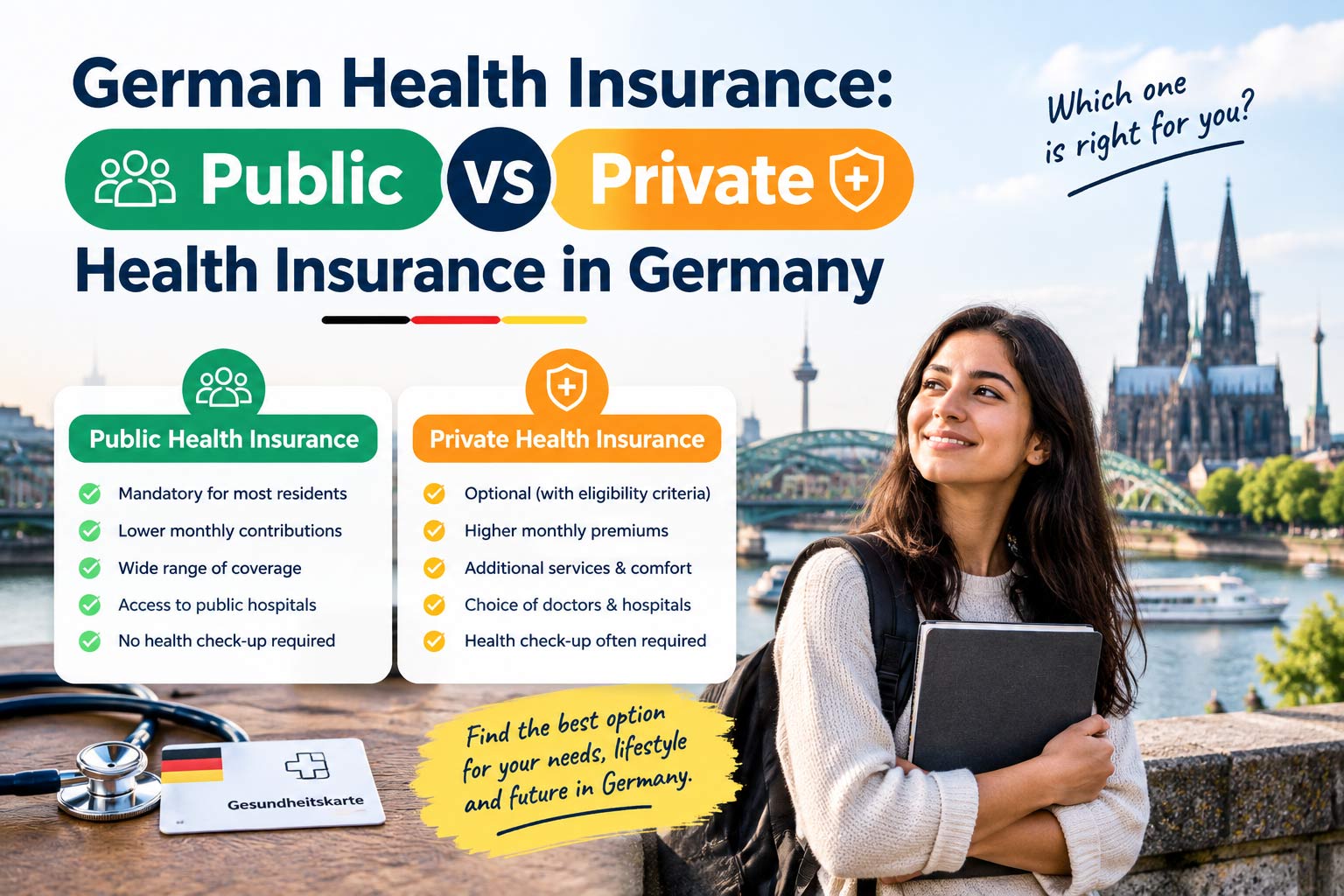
Understanding health insurance in Germany is essential for anyone planning to live, work, study or move to the country. Germany has a well-established healthcare system in which health insurance is generally a fundamental requirement for residents. The system is different from healthcare arrangements in many other countries, particularly because Germany has both statutory public health insurance and private health insurance.
For international students, employees, skilled workers, freelancers, self-employed people and families moving to Germany, choosing or obtaining the right health insurance can be confusing. Terms such as gesetzliche Krankenversicherung (GKV), private Krankenversicherung (PKV), Krankenkasse, Zusatzbeitrag, Pflegeversicherung and Versicherungspflicht frequently appear in German documents and websites.
This guide explains the German healthcare system and the difference between public and private health insurance in Germany in straightforward language. It covers how the system works, who can use public or private insurance, typical costs, what insurance covers, how to choose a health insurance provider and important considerations for international students and expats.
Germany operates a healthcare system based on mandatory health insurance arrangements, with the majority of residents covered through statutory health insurance. The public system is often referred to as gesetzliche Krankenversicherung (GKV). Instead of having one single government-operated health insurer, Germany has numerous statutory health insurance funds, commonly known as Krankenkassen.
Employees who are subject to statutory insurance contributions generally have their health insurance contributions deducted from their salary. The employer normally pays a corresponding share according to the applicable rules. This means that employees do not usually need to pay the entire statutory health insurance contribution themselves.
Germany also has a private health insurance system called private Krankenversicherung (PKV). Private insurance operates differently from statutory insurance. Eligibility depends on factors such as employment status, income and individual circumstances. Being eligible for private insurance does not necessarily mean that switching is the right choice for every person.
Public health insurance or statutory health insurance, is the main form of health coverage used by people in Germany. There are numerous public health insurance funds and eligible individuals can generally choose among available statutory providers. Examples include TK, AOK, Barmer, DAK-Gesundheit and various regional or occupational health insurance funds.
Public health insurance contributions are primarily linked to income for people who are subject to the statutory system, rather than being calculated solely according to age or individual medical history. There is also a contribution assessment ceiling, meaning that income above a defined threshold is not included indefinitely when calculating statutory health insurance contributions.
Statutory health insurance provides a broad range of medically necessary services. The exact reimbursement rules can vary by service and circumstances and patients may sometimes have additional costs or co-payments.
Public health insurance generally covers medically necessary healthcare within the statutory framework. The system is designed to provide access to doctors, hospitals and other healthcare professionals without requiring patients to purchase a separate insurance policy for every type of medical treatment.
Coverage is not unlimited. Certain treatments, dental services, glasses, medications and elective procedures may involve additional payments or may not be fully covered. Patients should check the applicable rules with their Krankenkasse before assuming that a particular treatment will be reimbursed.
Private health insurance in Germany, known as private Krankenversicherung or PKV, is provided by private insurance companies. Unlike statutory insurance, private insurance premiums are generally based on factors such as age when entering the policy, health risk assessment, selected benefits and the terms of the insurance contract.
Private insurance policies can offer different levels of coverage. Depending on the policy, a privately insured person may receive benefits that differ from those available through statutory insurance. Examples can include different accommodation arrangements during hospital treatment, broader dental benefits or other additional services.
However, private insurance should not be viewed simply as a more expensive version of public insurance. It is a different insurance model with different rules concerning premiums, eligibility, reimbursement and returning to statutory insurance. Anyone considering PKV should carefully examine the long-term financial consequences before switching.
The difference between public and private health insurance is one of the most important financial and administrative decisions some residents may face. The two systems differ in how contributions are calculated, how family members are covered, how medical bills are processed and how premiums can develop over time.
There is no universal answer to whether public or private insurance is better for every resident. The appropriate choice depends on employment status, income, age, family situation, expected length of residence in Germany and the specific insurance benefits required.
Many employees in Germany are required to participate in statutory health insurance when their employment and income fall within the applicable legal conditions. Students, pensioners and other groups may also be covered by statutory insurance under specific rules.
Employees below the applicable annual income threshold are generally subject to compulsory statutory health insurance. Certain people above the threshold may have the option of remaining voluntarily insured under the statutory system or choosing private insurance if the legal requirements are satisfied.
Self-employed people and freelancers have different rules and may have options depending on their circumstances. International residents should not assume that their employment title alone determines their insurance status. Their residence status, employment arrangement and previous insurance history can also be relevant.
Private health insurance is not available as an unrestricted alternative for everyone. Certain categories of people may qualify for private insurance, including some employees whose income exceeds the applicable statutory threshold, many self-employed people and freelancers, civil servants and other eligible groups.
Students can also face specific rules when considering private insurance. In some situations, a student may be able to obtain an exemption from compulsory statutory insurance and use private coverage. Such a decision requires particular care because the consequences of an exemption can be important for the rest of the student's studies.
Before selecting private health insurance, international residents should verify their eligibility and understand whether returning to statutory insurance would be possible later. This is particularly important for people who expect to remain in Germany for many years.
The cost of health insurance in Germany depends on the insurance system and the individual's circumstances. Public health insurance contributions are generally calculated using statutory contribution rates and the person's relevant income, subject to applicable limits. Additional contributions charged by individual Krankenkassen can also affect the final amount.
Employees normally share the relevant statutory health insurance contributions with their employer according to the applicable rules. Long-term care insurance, known as Pflegeversicherung, is also an important part of the overall social insurance system and can add to the employee's deductions.
Private health insurance does not simply use the same income-based calculation. The premium depends on the policy and factors such as age at entry, health assessment and selected benefits. Because private premiums and benefits vary substantially, comparing only the monthly price can be misleading.
Health insurance is particularly important for international students because appropriate coverage is generally needed for university enrolment and residence procedures. Students from EU/EEA countries may have different arrangements depending on their existing European health insurance status, while students arriving from countries outside Europe generally need to arrange suitable German-recognised health insurance.
Many international students use statutory student health insurance if they meet the relevant requirements. Student contributions can be more affordable than the standard contribution structure for many employed adults, but students should always check the current rates and eligibility conditions before budgeting.
International students should also be careful when selecting private insurance. A low-cost policy may not necessarily provide the same coverage or recognition as statutory student insurance. Before purchasing a policy, students should confirm that it satisfies the requirements of their university and residence authority.
For employees, health insurance is closely connected to the German social security system. When an employee is covered by statutory health insurance, the employer generally handles the contribution process through payroll. The employee sees the relevant deductions on the payslip.
Employees should understand the difference between gross salary and net salary when estimating their actual monthly income. Health insurance is one of several deductions that can reduce gross salary, alongside pension insurance, unemployment insurance, long-term care insurance and, depending on circumstances, income tax.
International employees should provide accurate insurance information to their employer when starting a job. If the employee has already selected a statutory Krankenkasse, the employer can use the necessary information for payroll and social insurance registration.
People joining statutory health insurance can generally compare available Krankenkassen. The basic statutory benefits are largely regulated, but individual funds can differ in areas such as additional contribution rates, optional benefits, bonus programmes, service channels and additional support.
International residents may also want to consider whether a Krankenkasse provides information and customer service in English or other languages. This can be particularly useful when dealing with insurance certificates, reimbursements, family coverage and changes of employment.
After obtaining health insurance, residents can generally register with doctors and medical practices. For many non-emergency health problems, patients commonly begin with a general practitioner, known in German as a Hausarzt. The doctor can provide initial treatment and, where appropriate, refer the patient to a specialist.
Some specialist practices allow patients to book appointments directly, although the process varies depending on the specialty and individual practice. Waiting times can also vary. International residents should therefore learn basic German healthcare vocabulary and keep their insurance card and important medical information accessible.
People covered by statutory health insurance generally receive an electronic health insurance card called the elektronische Gesundheitskarte (eGK). Patients normally present the card when visiting participating medical providers.
The card contains information needed for healthcare administration, while additional health information and digital healthcare services are governed by separate systems and rules. If you lose your card or change your health insurance provider, contact your Krankenkasse for instructions.
One important feature of statutory health insurance is the possibility of family insurance or Familienversicherung, for eligible dependants under specified conditions. This can be particularly important for families moving to Germany because qualifying spouses and children may be included without a separate standard contribution in certain circumstances.
Family insurance is subject to conditions concerning factors such as residence, income and employment status. A spouse who begins working, for example, may have their own insurance requirements. Families should therefore contact their Krankenkasse when their personal or employment circumstances change.
Some people who meet the legal requirements can move from statutory health insurance to private health insurance. However, switching should not be treated as a simple decision based on the cheapest current monthly premium.
Private insurance can become more complicated later in life, particularly when income changes, family circumstances change or a person wants to return to statutory insurance. The possibility of returning to the public system is subject to legal conditions and can be restricted in certain circumstances.
Anyone considering a permanent switch should therefore examine the policy carefully and, where necessary, obtain independent professional advice before cancelling existing coverage.
Instead of comparing public and private insurance only by today's monthly price, international residents should consider the complete financial and practical picture. A policy that appears inexpensive at one stage of someone's career may have different financial implications later.
Learning a few important German healthcare terms can make life much easier for international residents. Insurance letters and forms frequently use German terminology and understanding these terms can help you communicate with your Krankenkasse, doctor and employer.
Germany has emergency medical services for situations requiring immediate attention. In a life-threatening emergency, the emergency number is 112. For urgent medical problems that are not life-threatening and occur outside normal doctors' office hours, Germany also has the medical on-call service at 116117.
International residents should understand the difference between an emergency and a routine medical appointment. Emergency departments are intended for urgent situations, while non-emergency health problems can often be handled by a Hausarzt, specialist or the medical on-call service depending on the circumstances.
One common mistake is assuming that all health insurance policies provide identical coverage. This is particularly risky when comparing private insurance products. Another mistake is focusing exclusively on the lowest monthly premium without considering long-term conditions, exclusions, deductibles or family coverage.
International students sometimes choose an insurance policy before checking whether it is accepted for their specific university enrolment or residence requirements. Employees may also forget to update their insurer when their employment or personal circumstances change.
Germany generally requires residents to have appropriate health insurance coverage, although the exact rules depend on the person's circumstances and legal status. Employees, students, self-employed people and other groups can be subject to different insurance arrangements.
GKV means statutory or public health insurance, while PKV means private health insurance. GKV contributions are generally linked to income within the statutory framework, while private premiums depend on the policy and factors such as age, health assessment and selected benefits.
Many international students can use statutory student health insurance if they satisfy the relevant requirements. However, eligibility and available options depend on factors such as nationality, age, study status and previous insurance circumstances.
It can be cheaper for some individuals at a particular point in time, but there is no universal answer. Private premiums depend on individual circumstances and policy benefits and the long-term financial consequences can differ significantly from statutory insurance.
People covered by statutory health insurance can generally change Krankenkasse subject to the applicable rules and notice periods. The process and timing should be confirmed with the current and new insurer.
Eligible children may be covered through family insurance under the statutory system if the relevant conditions are met. Private insurance generally works differently because family members normally require their own policies.
A Krankenkasse is a health insurance fund. In the statutory system, Germany has numerous Krankenkassen rather than one single public health insurance organisation. Eligible residents can generally choose from available statutory funds.
The German healthcare system combines statutory public health insurance with private health insurance, giving eligible residents different insurance arrangements depending on their employment, income and personal circumstances. For most international students and many employees, statutory health insurance is an important part of everyday life in Germany.
The difference between public and private health insurance goes beyond the monthly price. Contributions, eligibility, family coverage, benefits, reimbursement procedures and long-term financial consequences can all be important. International students and expats should therefore understand their circumstances before choosing an insurance provider.
If you are moving to Germany, treat health insurance as one of the first practical matters to arrange alongside accommodation, registration, banking and residence documentation. Check the current rules and contribution rates with the relevant German authorities or insurance provider because regulations, contribution rates and eligibility conditions can change over time.

 ▼
 Deutsch
 Artikel Quiz
 German Grammar