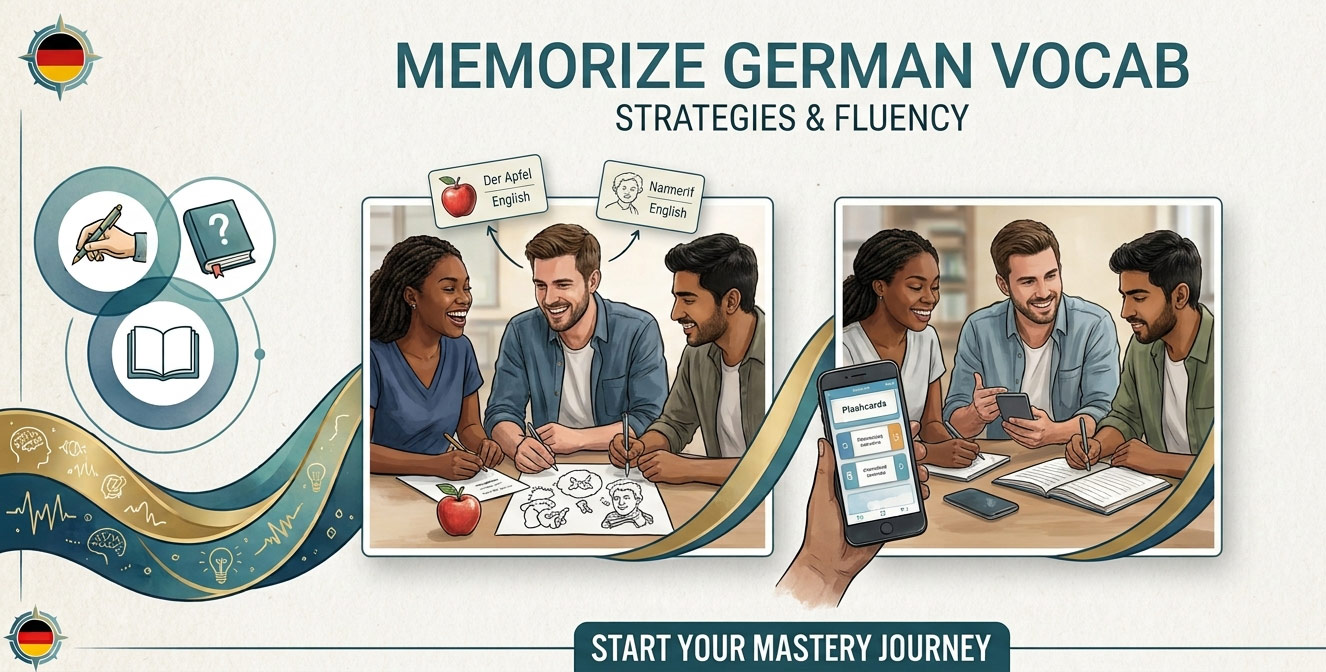
Learning German vocabulary is one of the biggest challenges for language learners. Many students remember dozens of new words today only to forget most of them a few days later. This cycle can become frustrating and slow your overall progress.
The good news is that forgetting vocabulary is completely normal. Your brain is designed to remove information that it considers unimportant. The secret is not simply reading word lists repeatedly but using learning techniques that convince your brain the information is worth keeping.
Whether you are preparing for the Goethe exams, planning to study in Germany, applying for an Ausbildung programme or simply learning German for personal growth, using the right vocabulary strategies can dramatically improve your results.
This guide explains practical methods that language learners successfully use to remember German vocabulary for the long term.
German introduces learners to several challenges that may not exist in their native language.
Instead of trying to memorize thousands of isolated words, it is far more effective to learn vocabulary in a structured and meaningful way.
Every new German word first enters your short-term memory. Unless you review and actively use that word, your brain gradually forgets it.
To move vocabulary into long-term memory, you need repeated exposure through reading, listening, speaking, writing and review over time.
The more different ways you use a word, the easier it becomes to remember it naturally.
One of the biggest mistakes learners make is memorizing vocabulary lists without context.
Instead of learning:
laufen = to run
Learn complete sentences:
Learning words inside real sentences improves grammar, pronunciation and natural usage at the same time.
Spaced repetition is one of the most effective learning techniques supported by educational research. Instead of reviewing words every day forever, you review them just before you are likely to forget them.
A simple review schedule might look like:
This approach strengthens long-term memory while reducing unnecessary repetition.
Many learners repeatedly read vocabulary lists, believing this is effective study. Unfortunately, simply rereading words creates familiarity but not lasting memory.
Instead, hide the German word and try to remember it from memory before checking the answer.
For example:
| English | Your Answer |
|---|---|
| House | ? |
| Apple | ? |
| Beautiful | ? |
This forces your brain to retrieve information rather than simply recognize it.
Flashcards remain one of the best tools for vocabulary learning.
Each flashcard should contain more than just a translation.
Include:
Well-designed flashcards become much more valuable than simple word lists.
Your brain remembers related information more easily than random words.
Organize vocabulary into categories such as:
Studying related vocabulary creates stronger memory connections.
One of the most common mistakes among German learners is memorizing nouns without their grammatical article.
Never learn:
Instead learn:
Learning the article from the beginning prevents confusion later when constructing sentences.
Reading naturally exposes you to vocabulary repeatedly. Each encounter strengthens memory without requiring deliberate memorization.
Suitable reading materials include:
Do not stop to translate every unfamiliar word. Focus first on understanding the overall meaning.
Hearing vocabulary regularly makes it easier to remember pronunciation, spelling and meaning.
Excellent listening resources include:
Combining listening with reading creates multiple memory pathways, making vocabulary much easier to retain.
Mnemonics are memory techniques that connect a new German word with an image, story or familiar idea. Your brain remembers unusual and emotional associations much better than isolated facts.
For example, imagine a giant Brot (bread) shaped like a boat floating on a river. The funny mental picture makes the word easier to recall.
The stranger and more vivid the image, the better your memory often becomes.
Turn your home into a German classroom by placing small labels on everyday objects.
Examples include:
Every time you see these objects, your brain naturally reviews the vocabulary without requiring extra study time.
Instead of writing random word lists, organize your notebook in a structured way.
| German | Meaning | Article | Example |
|---|---|---|---|
| das Buch | Book | das | Ich lese ein Buch. |
| die Arbeit | Work | die | Ich gehe zur Arbeit. |
Writing vocabulary by hand improves memory because it combines visual learning with physical movement.
Many learners only read vocabulary silently. However, saying new words aloud activates additional areas of the brain and improves pronunciation at the same time.
When learning a new word:
Speaking transforms passive vocabulary into active vocabulary.
Writing forces you to recall vocabulary without looking at your notes. This strengthens long-term memory.
For example, after learning words related to travel, write a short paragraph describing your dream trip to Germany.
Even five or six sentences each day will dramatically improve vocabulary retention.
Artificial intelligence has become an excellent language-learning companion. AI tools can generate example sentences, quizzes, conversations and vocabulary exercises tailored to your level.
You can ask AI to:
AI provides immediate feedback and allows unlimited practice at any time.
Stories provide context that makes vocabulary far easier to remember than isolated word lists.
Instead of memorizing 30 unrelated words, read a short story containing those words naturally.
Your brain remembers vocabulary better because every word becomes connected to a meaningful situation.
Research suggests that reviewing information shortly before sleep may improve memory consolidation.
Spend five to ten minutes reviewing your newest German vocabulary before going to bed.
The next morning, test yourself before looking at your notes.
The fastest way to remember new words is to use them with another person.
Try incorporating recently learned vocabulary into:
Words that you actively use become much easier to remember than words you only read.
Many learners constantly learn new words but rarely review older ones.
A balanced study routine should include both new vocabulary and revision.
An effective weekly plan might look like:
Regular review prevents the forgetting curve from erasing previously learned vocabulary.
| Activity | Time |
|---|---|
| Review Old Words | 5 Minutes |
| Learn New Vocabulary | 10 Minutes |
| Create Example Sentences | 5 Minutes |
| Speaking Practice | 5 Minutes |
| Quick Revision | 5 Minutes |
Following this routine consistently is more effective than studying for several hours only once a week.
Avoiding these mistakes will help you build a much stronger and more useful German vocabulary.
``` ```html id="q7ld9p"Many learners believe they need to memorize tens of thousands of German words before they can communicate confidently. Fortunately, that is not true.
The number of words you need depends on your goals and the situations in which you plan to use German.
| German Level | Approximate Active Vocabulary | What You Can Do |
|---|---|---|
| A1 | 500–700 words | Introduce yourself, ask simple questions, order food and handle basic daily conversations |
| A2 | 1,000–1,500 words | Talk about family, work, travel, shopping and everyday activities |
| B1 | 2,000–3,000 words | Communicate independently in most daily situations and participate in longer conversations |
| B2 | 4,000–6,000 words | Work, study and discuss more complex topics with confidence |
| C1 | 8,000+ words | Use German fluently in academic and professional environments |
Rather than trying to learn thousands of random words, focus on vocabulary that matches your daily life, studies or career goals.
Consistency matters far more than studying for long hours occasionally. The following plan can help you build a solid vocabulary foundation.
| Week | Goal |
|---|---|
| Week 1 | Learn 15–20 useful words each day with example sentences |
| Week 2 | Review previous vocabulary while adding another 15–20 words daily |
| Week 3 | Use new vocabulary in conversations, writing and reading exercises |
| Week 4 | Focus on revision, quizzes and speaking practice using all learned vocabulary |
By the end of one month, you can comfortably remember several hundred useful German words if you follow a consistent study routine.
There is a significant difference between recognizing a word and being able to use it naturally.
Passive vocabulary includes words you understand while reading or listening.
Active vocabulary includes words you can immediately use while speaking or writing.
Your goal should always be to convert passive vocabulary into active vocabulary through regular practice.
The most effective approach combines spaced repetition, active recall, complete sentences, regular speaking practice and daily revision.
Learning around 10 to 20 useful words daily is a realistic goal for most learners. Quality and consistent review are more important than quantity.
No. Vocabulary and grammar should be learned together. Understanding how words are used in sentences helps you remember both more effectively.
Reading is extremely helpful, but combining reading with listening, speaking, writing and review produces much better long-term results.
Yes. Flashcards are highly effective when they include articles, example sentences, pronunciation and regular spaced repetition.
Forgetting is part of the normal learning process. Regular review, active recall and using words in real situations help strengthen long-term memory.
Absolutely. Memorizing der, die or das together with every noun saves time and reduces grammar mistakes later.
Yes. AI tools can generate quizzes, conversations, example sentences, writing corrections and personalized vocabulary exercises that support regular practice.
The timeline depends on your study routine and consistency. Learners who practice every day generally make much faster progress than those who study only occasionally.
Learning complete sentences is usually far more effective because it teaches vocabulary, grammar, pronunciation and natural usage simultaneously.
Yes. Movies and television programmes expose you to authentic pronunciation, common expressions and everyday vocabulary, especially when combined with active study.
The biggest mistake is reading long vocabulary lists without reviewing or using the words in speaking and writing.
Learning German vocabulary does not have to be difficult. By using scientifically supported techniques such as spaced repetition, active recall, contextual learning, reading, listening and speaking practice, you can remember new words much more efficiently and use them with confidence.
Instead of chasing thousands of random words, concentrate on high-frequency vocabulary that matches your personal goals. Build a daily learning habit, review consistently and use every new word in real situations. Small improvements made every day lead to impressive long-term results.
Whether you are preparing for the Goethe exams, planning an Ausbildung, applying for university admission or moving to Germany for work, a strong vocabulary foundation will make every other aspect of learning German much easier.
Explore our vocabulary builders, interactive quizzes, grammar guides, pronunciation lessons, German article finder, fill-in-the-blank exercises, speaking practice tools and exam preparation resources. Combining structured learning with daily practice will help you become a confident German speaker faster.

 ▼
▼
 Deutsch
  Artikel Quiz
 German Grammar