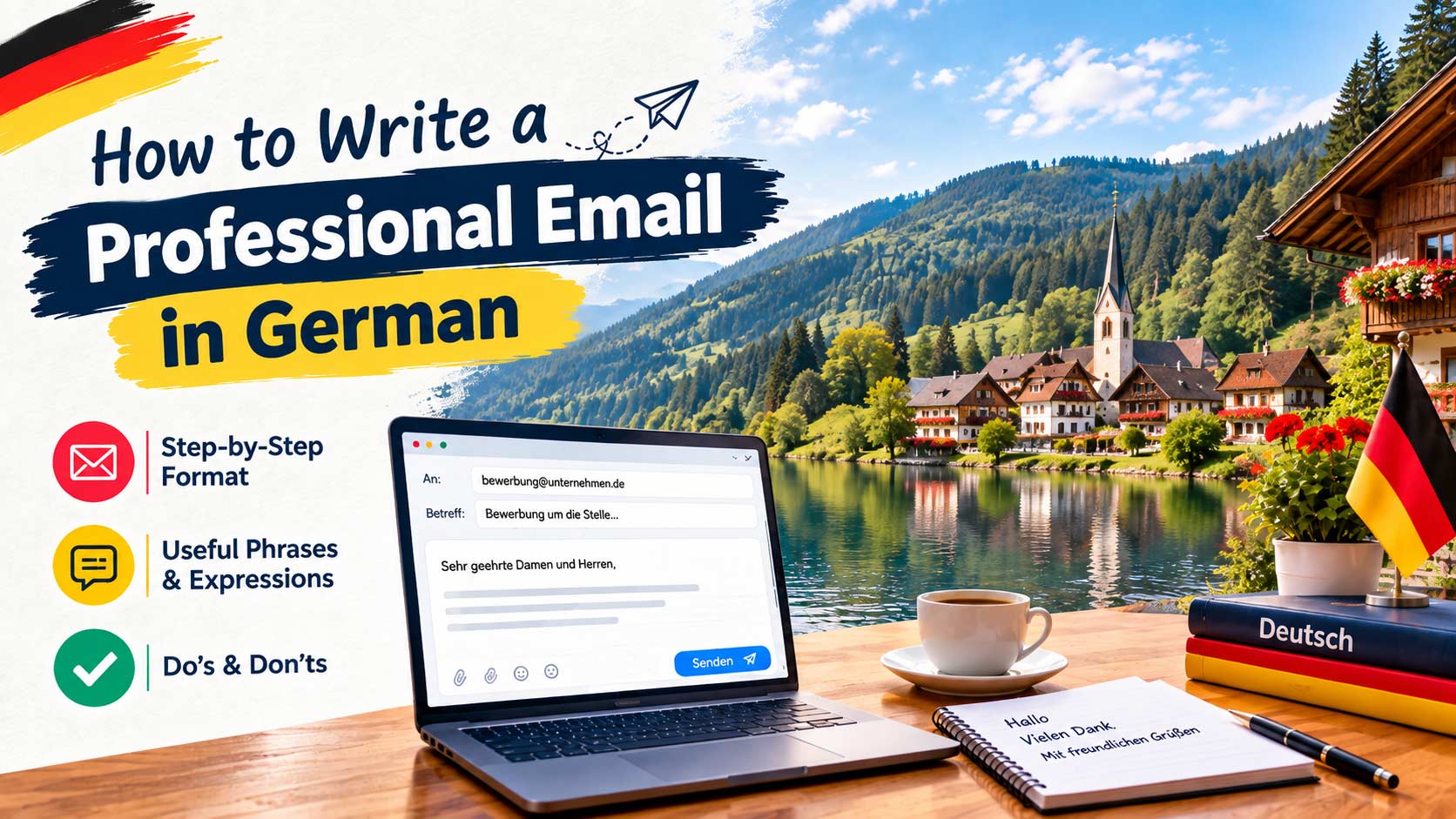
Writing a professional email in German can feel difficult if German is not your first language. Even when you know the vocabulary and grammar, you may not know whether to use Sehr geehrte Damen und Herren, Sehr geehrter Herr..., Mit freundlichen Grüßen or a less formal expression.
German professional emails generally follow a clear structure. The language is often more formal than the language used in messages to friends and choosing the correct greeting, polite expressions and closing can make your email sound much more natural.
This guide explains how to write a formal email in German, including the correct structure, greetings, useful phrases, subject lines, requests, apologies, follow-ups and email endings. It also includes practical German email templates that you can adapt for work, university, job applications, appointments, landlords and official communication.
German emails are not necessarily complicated, but German-speaking workplaces and institutions often expect clear and polite communication.
The level of formality depends on who you are writing to. An email to a close colleague can be much more relaxed than an email to a professor, employer, government office or potential customer.
Before writing, ask yourself three questions:
These three questions will help you choose the right greeting, vocabulary and closing.
A professional email in German usually follows a simple structure:
For example:
Betreff: Anfrage zum Vorstellungsgespräch
Sehr geehrte Frau Müller,
vielen Dank für Ihre Nachricht. Ich freue mich über die Einladung zum Vorstellungsgespräch.
Gerne würde ich den vorgeschlagenen Termin am Dienstag um 10:00 Uhr wahrnehmen.
Vielen Dank für Ihre Rückmeldung.
Mit freundlichen Grüßen
Max Mustermann
This structure is short, clear and appropriate for many professional situations.
The subject line is called Betreff in German.
A good German email subject should tell the recipient immediately what the email is about.
Instead of writing something vague such as:
“Question”
use a more specific subject:
Keep the subject specific rather than writing a complete sentence.
The greeting is one of the most important parts of a formal German email.
Sehr geehrte Damen und Herren means “Dear Sir or Madam” and is commonly used when you do not know the name of the person receiving the email.
Example:
Sehr geehrte Damen und Herren,
ich möchte mich gerne nach den Voraussetzungen für...
Notice that the comma is normally followed by the next sentence beginning with a lowercase letter when the greeting is formatted as part of the same written correspondence convention.
Use Sehr geehrter Herr followed by the surname when writing formally to a man.
Example:
Sehr geehrter Herr Schneider,
vielen Dank für Ihre Rückmeldung.
Use Sehr geehrte Frau followed by the surname when writing formally to a woman.
Example:
Sehr geehrte Frau Schneider,
ich möchte mich bezüglich meiner Bewerbung bei Ihnen melden.
These greetings are warmer and less formal.
They may be appropriate when you already have a familiar professional relationship with the recipient, depending on the workplace culture.
Hallo is common in less formal professional communication, particularly between colleagues or people who already communicate regularly.
However, if you are contacting a professor, government office, employer or unknown professional contact for the first time, a more formal greeting is usually safer.
After the greeting, get to the point relatively quickly.
Some useful German expressions include:
One of the most useful skills when writing professional emails is making a request without sounding too direct.
English speakers sometimes translate requests word for word and accidentally make them sound demanding in German.
Compare:
Schicken Sie mir die Unterlagen.
This means “Send me the documents.” It is grammatically correct, but it can sound quite direct depending on the context.
A more polite version is:
Könnten Sie mir bitte die Unterlagen zuschicken?
Meaning: “Could you please send me the documents?”
Other useful expressions include:
If you need information from a company, university, landlord or government office, these expressions are useful.
If you have not received a response, you can send a polite follow-up email.
Avoid immediately writing something like Warum antworten Sie nicht?, which means “Why aren't you answering?” and can sound confrontational.
Instead, use polite language.
Ich wollte mich kurz nach dem aktuellen Stand erkundigen.
This means: “I just wanted to ask about the current status.”
Another useful phrase is:
Ich möchte höflich nachfragen, ob Sie meine E-Mail vom 10. Oktober erhalten haben.
Meaning: “I would like to politely ask whether you received my email from October 10.”
Sometimes you need to apologise for a late response, missed appointment or mistake.
For a professional email, keep the apology brief and explain the relevant situation without unnecessary personal details.
The most important formal email ending to remember is:
Mit freundlichen Grüßen
This can be translated as “Kind regards” or “Yours sincerely,” depending on the context.
It is an extremely useful standard closing for formal German emails.
Example:
Mit freundlichen Grüßen
Max Mustermann
Other possible endings include:
Viele Grüße and Beste Grüße are generally less formal than Mit freundlichen Grüßen.
For an initial email to a company, government authority, university or other formal recipient, Mit freundlichen Grüßen is a safe standard choice.
A common mistake is writing:
Mit freundlichen Grüßen,
In standard German correspondence, the closing is normally written without a comma:
Mit freundlichen Grüßen
Max Mustermann
This is a small detail, but learning conventional German email formatting helps your writing look more natural.
Here is a reusable template for contacting a company, institution or organisation.
Betreff: Anfrage zu [Thema]
Sehr geehrte Damen und Herren,
ich möchte mich gerne nach [Thema] erkundigen.
Könnten Sie mir bitte weitere Informationen zu [specific question] mitteilen?
Für Ihre Unterstützung bedanke ich mich im Voraus.
Ich freue mich auf Ihre Rückmeldung.
Mit freundlichen Grüßen
[Vorname Nachname]
When applying for a job, your email should be professional and concise.
Betreff: Bewerbung als [Position]
Sehr geehrte Frau [Nachname],
hiermit möchte ich mich gerne für die Position als [Position] in Ihrem Unternehmen bewerben.
Meine Bewerbungsunterlagen habe ich dieser E-Mail beigefügt.
Für Rückfragen stehe ich Ihnen gerne zur Verfügung.
Ich freue mich über die Möglichkeit, mich persönlich bei Ihnen vorzustellen.
Mit freundlichen Grüßen
[Vorname Nachname]
Students can use this structure when contacting a university, professor or university administration.
Betreff: Frage zur Bewerbung für den Studiengang [Name]
Sehr geehrte Damen und Herren,
ich interessiere mich für den Studiengang [Name] und hätte dazu eine Frage.
Könnten Sie mir bitte mitteilen, welche Unterlagen für die Bewerbung erforderlich sind und bis wann ich diese einreichen muss?
Vielen Dank für Ihre Unterstützung.
Ich freue mich auf Ihre Rückmeldung.
Mit freundlichen Grüßen
[Vorname Nachname]
If you are contacting a landlord about an apartment, a polite and relatively concise email is appropriate.
Betreff: Interesse an der Wohnung in [Adresse/Ort]
Sehr geehrte Frau [Nachname],
ich interessiere mich sehr für die von Ihnen angebotene Wohnung in [Ort].
Gerne würde ich einen Besichtigungstermin vereinbaren.
Könnten Sie mir bitte mitteilen, wann eine Besichtigung möglich wäre?
Vielen Dank im Voraus.
Mit freundlichen Grüßen
[Vorname Nachname]
Use this format when requesting an appointment with a company, university, doctor, adviser or other professional contact.
Betreff: Anfrage für einen Termin
Sehr geehrte Frau [Nachname],
ich würde gerne einen Termin mit Ihnen vereinbaren.
Wäre ein Termin am [Datum] oder am [Datum] möglich?
Gerne richte ich mich auch nach Ihren verfügbaren Terminen.
Vielen Dank für Ihre Rückmeldung.
Mit freundlichen Grüßen
[Vorname Nachname]
When attaching documents, clearly mention them in the email.
Betreff: Übersendung der angeforderten Unterlagen
Sehr geehrte Damen und Herren,
anbei übersende ich Ihnen die angeforderten Unterlagen.
Bitte teilen Sie mir mit, falls Sie weitere Dokumente oder Informationen benötigen.
Vielen Dank für Ihre Unterstützung.
Mit freundlichen Grüßen
[Vorname Nachname]
If you regularly communicate in German, learning complete phrases is often more useful than memorising individual words.
Hallo is not wrong, but it is not appropriate for every recipient. When writing to an unknown company, government authority or formal professional contact, choose a more formal greeting.
German distinguishes between informal du and formal Sie. In a professional relationship, do not automatically use du unless the other person has invited you to do so or the workplace convention clearly uses it.
Literal translation can make an email grammatically correct but unnatural. It is better to learn common German email phrases as complete expressions.
Professional emails are usually easier to understand when they have a clear purpose. Avoid unnecessary background information unless it is relevant.
If your email says Im Anhang finden Sie... but you do not actually attach the document, you may create unnecessary back-and-forth communication.
Professional German emails generally do not need multiple exclamation marks. Keep the tone calm, clear and professional.
The same message can be written differently depending on your relationship with the recipient.
Formal:
Sehr geehrte Frau Weber,
könnten Sie mir bitte die Unterlagen zuschicken?
Less formal:
Hallo Frau Weber,
könnten Sie mir bitte die Unterlagen schicken?
Informal:
Hallo Anna,
kannst du mir bitte die Unterlagen schicken?
The important difference is not only vocabulary. The pronouns and verb forms also change.
Before sending your email, quickly check the following:
For a formal email, common openings include Sehr geehrte Damen und Herren, Sehr geehrter Herr [surname] or Sehr geehrte Frau [surname].
The standard formal closing is Mit freundlichen Grüßen, followed by your name.
The subject line is called Betreff in German.
The standard formal expression is Sehr geehrte Damen und Herren.
Mit freundlichen Grüßen is the standard formal expression. Viele Grüße and Beste Grüße are common in less formal situations.
Yes, depending on the relationship and workplace culture. However, when contacting an unknown person or formal institution for the first time, a more formal greeting is generally appropriate.
Expressions such as Könnten Sie mir bitte... and Ich wäre Ihnen dankbar, wenn... are useful for making polite professional requests.
Anbei means “attached” or “enclosed” and is commonly used when sending documents with an email. For example, Anbei sende ich Ihnen die angeforderten Unterlagen.
Rückmeldung means feedback, response or reply, depending on the context. Ich freue mich auf Ihre Rückmeldung means “I look forward to your response.”
A professional German email does not need to be complicated. The most important thing is to be clear, polite and appropriate for the situation.
Start with a suitable greeting, explain why you are writing, make your request clearly, provide the necessary information and finish with an appropriate closing.
If you are learning German, do not try to memorise hundreds of individual sentences. Instead, learn a small collection of useful email phrases such as Vielen Dank für Ihre Rückmeldung, Könnten Sie mir bitte..., Ich möchte mich gerne nach... and Ich freue mich auf Ihre Rückmeldung.
Once you know these patterns, you can adapt them to emails for universities, employers, landlords, government offices, colleagues and other professional contacts.
The goal is not to make every email sound extremely formal. The goal is to choose the right level of formality for the person and situation while communicating your message clearly.

 ▼
 Deutsch
 Artikel Quiz
 German Grammar