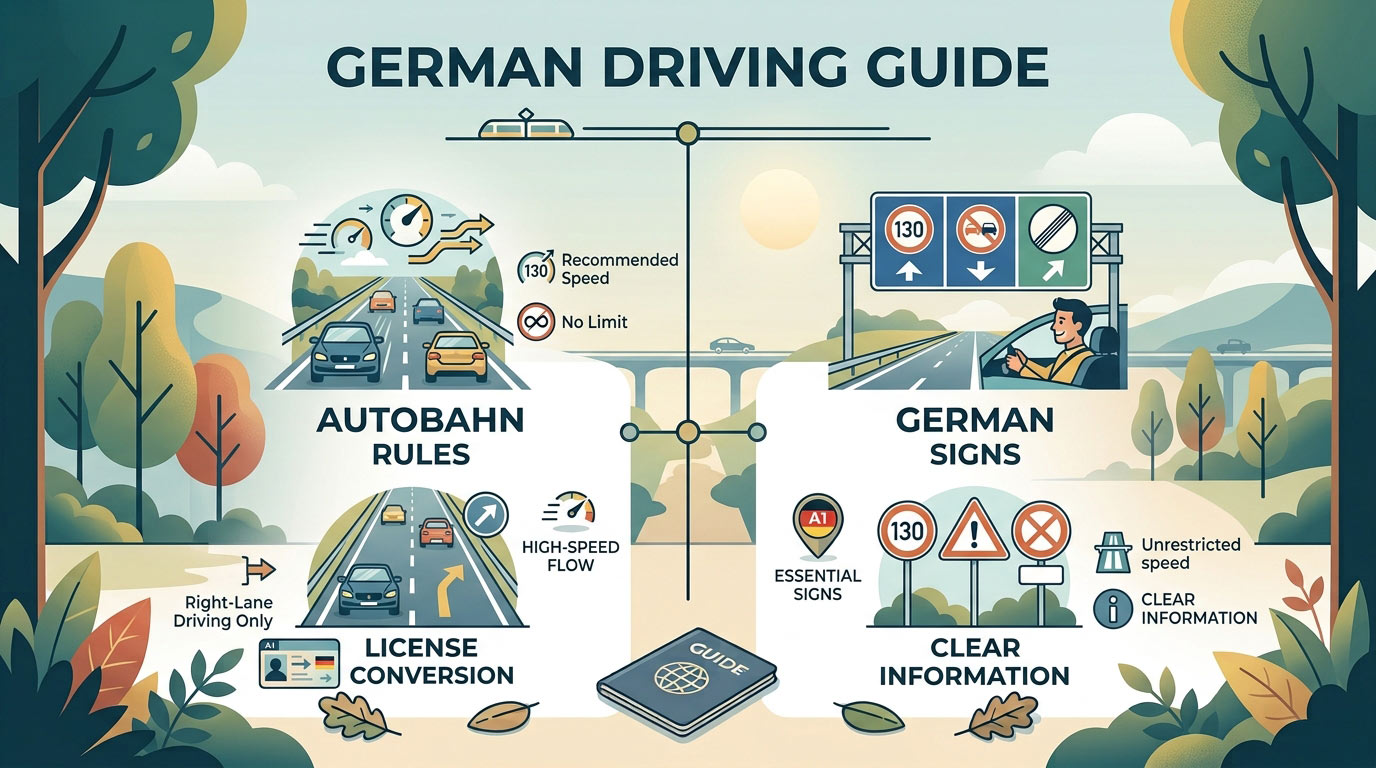
Driving in Germany can be an excellent way for expats, international students, workers and families to explore the country. Germany has an extensive road network connecting major cities, smaller towns, airports and neighboring European countries. However, driving in Germany can be different from driving in other countries, particularly because of the German Autobahn, strict road rules, speed regulations, priority rules and distinctive road signs.
For foreigners living in Germany, one of the most important questions is whether their existing driving license can be used in Germany and, if so, for how long. The answer depends on where the license was issued and the driver's residence status. Some foreign licenses can be exchanged relatively easily, while others may require theoretical or practical tests before a German driving license is issued.
Understanding the rules before getting behind the wheel is essential. German drivers are generally expected to follow lane discipline, right-of-way rules, speed restrictions and parking regulations carefully. The famous Autobahn may have sections without a general speed limit, but that does not mean drivers can drive at any speed everywhere.
This guide explains the most important things you should know about driving in Germany, including Autobahn rules, speed limits, converting a foreign driving license, German road signs, parking, safety requirements and practical advice for expat drivers.
Foreigners can drive in Germany if they hold a valid driving license that is recognized for driving in Germany and meet the applicable legal requirements. The rules can differ depending on whether the license was issued in an EU or EEA country, another country or a country with specific exchange arrangements with Germany.
If you move to Germany and establish your normal residence there, your foreign driving license may only remain valid for a limited period depending on the country that issued it and the applicable German rules. Therefore, simply having a valid license from your home country does not necessarily mean you can use it indefinitely after becoming a resident.
Before driving regularly, especially if you plan to stay in Germany long term, check the requirements applicable to your specific license. The local Fahrerlaubnisbehörde or driving license authority, can provide information about recognition, validity and exchange procedures.
Driving licenses issued by EU and EEA countries are generally treated differently from licenses issued by many non-EU countries. A valid EU or EEA driving license can normally be used in Germany while it remains valid, subject to the applicable rules.
In many ordinary cases, holders of EU or EEA licenses do not need to immediately exchange their license simply because they move to Germany. However, there are exceptions and special rules for particular license categories and circumstances.
If you intend to live in Germany permanently, it can still be useful to understand when an exchange becomes necessary or advantageous. Always check the current requirements with the competent German authority rather than relying only on general information found online.
The rules can be more complicated for drivers holding a license issued outside the EU or EEA. Depending on the issuing country, a foreign license may be recognized for a limited period after establishing residence in Germany.
After the applicable period ends, you may need to obtain a German driving license or exchange your foreign license. Whether you must take a theory test, practical driving test or both depends largely on the country where your original license was issued and the relevant German recognition arrangements.
Some countries have agreements or arrangements that make exchanging a license easier. Others may require applicants to go through significant parts of the German licensing process. This is why it is important to check your specific country rather than assuming that the rules are identical for all foreign licenses.
Converting a foreign driving license into a German license is often referred to as Umschreibung. The process is handled by the relevant local driving license authority.
The exact procedure varies according to the issuing country, license category and individual circumstances. You should begin the process early if you are approaching the end of the period during which your foreign license can be used.
Not every applicant will need to complete every step. Requirements can depend on the country of origin and the applicable exchange agreement.
Documentation requirements vary by authority and individual circumstances, but applicants may be asked for several documents.
Do not arrange unnecessary documents without checking the requirements first. The local licensing authority can tell you which documents apply to your particular situation.
The Autobahn is Germany's motorway network and is one of the country's most famous transportation features. It connects cities and regions across Germany and also provides important routes into neighboring European countries.
The Autobahn is often associated with unrestricted speed. However, the reality is more nuanced. Some motorway sections do not have a posted general maximum speed for cars, while other sections have permanent or temporary speed limits.
Drivers should always follow the posted speed signs and temporary restrictions. Speed limits can be introduced because of construction, traffic, weather, road conditions, accident risks or environmental regulations.
There is no universal maximum speed limit for passenger cars on every section of the German Autobahn. On sections without a posted maximum limit, Germany has a recommended speed of 130 km/h, commonly known as the Richtgeschwindigkeit.
This does not mean that every Autobahn section allows unlimited-speed driving. Posted speed limits must always be followed. A motorway may have limits such as 80 km/h, 100 km/h, 120 km/h or 130 km/h depending on local conditions.
Weather conditions are also important. Drivers must adapt their speed to the circumstances even where a specific maximum speed is not posted. Driving too fast for rain, snow, fog, congestion or poor visibility can still create legal and safety problems.
The Autobahn can feel intimidating to someone who has never driven on a German motorway. Cars may approach quickly from behind and traffic can move at significantly different speeds between lanes.
New drivers should focus on predictable driving rather than trying to drive at very high speeds. Maintain a safe following distance, check mirrors frequently and move between lanes only when it is safe.
Germany drives on the right-hand side of the road. This is important for visitors from countries where vehicles drive on the left.
On multi-lane roads, the general principle is to use the right lane when possible and move to the left when overtaking. Continuously remaining in the left lane when the right lane is available can be contrary to German lane-discipline rules.
On entering a motorway, use the acceleration lane to build up an appropriate speed and merge safely. Drivers already on the motorway have priority, so joining traffic must carefully find a safe gap.
One of the most important German motorway rules is the Rettungsgasse or emergency corridor. When traffic on a motorway or multi-lane road becomes congested and vehicles slow down or stop, drivers must create a corridor for emergency vehicles.
On a road with two lanes in the same direction, vehicles in the left lane move toward the left side, while vehicles in the lane to the right move toward the right side. On roads with more lanes, the emergency corridor is created between the leftmost lane and the lane immediately to its right.
Drivers should create the corridor early rather than waiting until an ambulance, police vehicle or fire engine is visible. Blocking an emergency corridor can delay lifesaving assistance and can result in serious consequences.
Understanding German road signs is essential for anyone planning to drive in Germany. Many signs use symbols rather than words, making them easier for international drivers to understand once they learn the basic system.
A circular sign with a red border and a number normally indicates the maximum permitted speed. For example, a sign displaying “100” generally means the maximum speed is 100 km/h until another rule or sign changes it.
Signs showing a previous restriction crossed out indicate the end of that specific restriction. Drivers should still pay attention to other applicable speed rules.
The German stop sign is the familiar red octagonal sign displaying “STOP.” Drivers must stop at the designated stopping point and proceed only when it is safe.
A triangular sign with a red border and white center indicates that you must give way to traffic with priority.
A red circular sign with a horizontal white bar indicates no entry. Drivers should never enter a road displaying this sign.
Pedestrian crossing signs indicate areas where drivers must pay particular attention to people crossing the road. Drivers should reduce speed and be prepared to stop when required.
Germany has specific right-of-way rules that can surprise drivers from other countries. Unless signs, traffic lights or road markings establish another arrangement, the right-before-left rule, known as “rechts vor links,” can apply.
Under this principle, traffic approaching from the right may have priority. However, the rule does not apply in every situation. Priority roads, traffic signals, roundabouts and other signs can change the right-of-way arrangement.
Drivers should therefore look carefully for signs and road markings rather than assuming that the larger or faster road automatically has priority.
Roundabouts are common in Germany. Drivers entering a roundabout should pay attention to the signs indicating priority.
At many standard roundabouts, traffic already inside the roundabout has priority. However, road signs determine the actual right-of-way, so drivers should always check before entering.
Indicating correctly when exiting a roundabout is also important. New drivers should practice this carefully because signaling expectations can differ from what they are accustomed to in their home country.
Parking regulations in Germany are strictly enforced in many cities. You should never assume that an apparently empty space is automatically available for parking.
Look for parking signs, restrictions, meters, resident zones and road markings. Some areas require a parking ticket, while others use digital parking systems.
Parking on sidewalks, blocking driveways, stopping near intersections or parking in restricted areas can result in fines or, in some circumstances, the vehicle being towed.
Germany has rules requiring appropriate tires in winter road conditions. Rather than simply being based on a fixed calendar period, the requirement is connected to conditions such as snow, ice, slush or frost.
Drivers should therefore use suitable winter or all-season tires with the legally required characteristics when winter conditions exist. If you are living in Germany and regularly driving during winter, choosing appropriate tires is an important safety consideration.
Germany has strict laws concerning driving under the influence of alcohol or drugs. The safest approach for any driver is simple: do not drink alcohol before driving.
Legal consequences can depend on factors such as the driver's alcohol concentration, driving behavior, age, experience and whether an accident occurred. Penalties can include fines, driving bans and other consequences.
New drivers and young drivers can be subject to particularly strict rules. If you plan to drink, arrange alternative transportation rather than trying to calculate whether you are “under the limit.”
Drivers should not use a handheld mobile phone while driving. This includes activities that distract the driver from controlling the vehicle.
If you need navigation, set the route before starting your journey or use a properly mounted system that can be operated legally without taking your attention away from driving.
Drivers should make sure they have the required vehicle and personal documents and equipment before beginning a journey. Requirements can vary depending on the vehicle and circumstances.
It is sensible to keep your driving license, vehicle registration documentation and insurance-related information available. Vehicles also need legally required safety equipment.
If you are renting a car, check the rental company's documentation and equipment before leaving the parking area.
Driving in cities such as Berlin, Munich, Hamburg, Frankfurt or Cologne can be considerably different from driving on the Autobahn. Urban areas may have cyclists, pedestrians, trams, buses, restricted traffic zones and complicated intersections.
Pay particular attention to cyclists when turning. Check mirrors and blind spots carefully, especially when crossing bicycle lanes. Pedestrians and cyclists can sometimes be difficult to see in heavy traffic.
Public transportation also has priority-related considerations in some situations. Trams, buses and bicycles require additional awareness from drivers unfamiliar with German urban roads.
If you have recently moved to Germany, give yourself time to become familiar with local driving habits. German roads can be highly organized, but the combination of signs, lane rules and traffic behavior can initially feel demanding.
In many circumstances, foreign visitors and residents can drive using a valid foreign license for a certain period or under specific conditions. The exact rules depend on where the license was issued and whether you have established residence in Germany.
The period and conditions depend on the issuing country and the driver's circumstances. Non-EU licenses may be subject to limited recognition after establishing residence, while EU and EEA licenses generally have different rules.
Some foreign licenses can be exchanged with relatively simple procedures, while others may require examinations. Whether conversion is required and what tests apply depends on the country that issued the license and the applicable German regulations.
No. Although some Autobahn sections have no general maximum speed for cars, many sections have posted speed limits. Drivers must always obey displayed limits and adjust their speed to road and weather conditions.
Germany's general recommended speed for cars on Autobahn sections without a posted maximum limit is 130 km/h. This is a recommendation rather than a universal maximum speed.
“Rechts vor links” means “right before left.” Where the rule applies and there is no overriding traffic sign or signal, traffic approaching from the right has priority.
A Rettungsgasse is an emergency corridor created by drivers in congested traffic so that ambulances, police, fire services and other emergency vehicles can pass quickly.
Most German road signs use internationally familiar shapes and symbols. Learning the most common speed, priority, parking, warning and restriction signs before driving can make the transition much easier.
Driving in Germany can be an enjoyable and convenient experience once you understand the country's road system. The German Autobahn is internationally famous, but successful driving in Germany involves much more than knowing where speed limits do or do not apply.
Expat drivers should understand their foreign driving license requirements, especially if they are becoming residents. Depending on the country that issued the license, conversion may be straightforward or may involve theory and practical examinations.
It is equally important to learn German road signs, right-of-way rules, lane discipline, parking regulations and the Rettungsgasse emergency corridor. These rules are particularly important for drivers who are accustomed to a different road system.
Before driving regularly in Germany, check the rules applicable to your individual license and location. Once you understand the basics and spend some time driving defensively and predictably, Germany's extensive road network can make traveling around the country much easier.

 ▼
▼
 Deutsch
  Artikel Quiz
 German Grammar