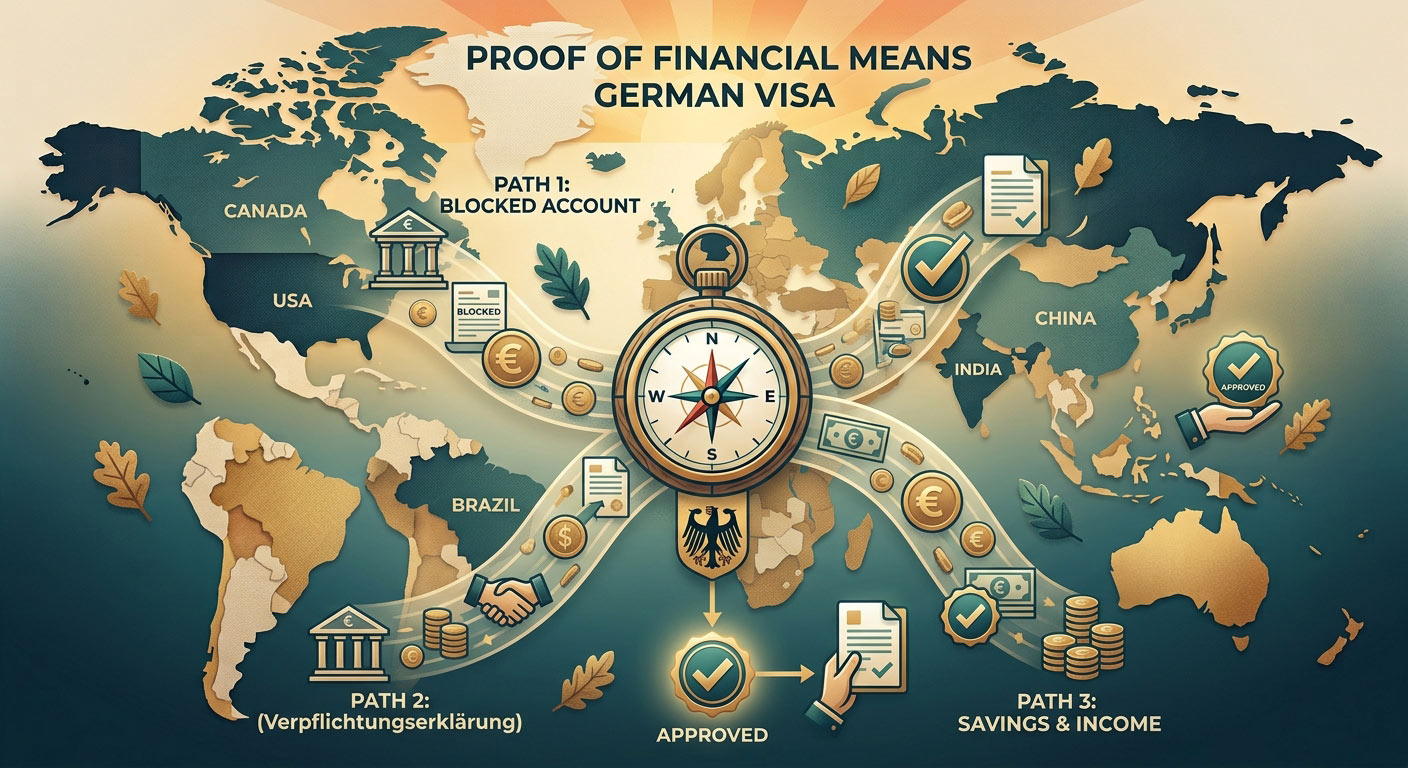
Proof of financial means for German visas is one of the most important requirements for many people planning to travel, study, work or stay in Germany for an extended period. German authorities generally need evidence that applicants can support themselves financially during their intended stay without becoming dependent on public funds. The exact amount and type of financial proof required can vary depending on the visa category, purpose of stay, duration and individual circumstances.
For international students, financial proof is particularly important because applicants usually need to demonstrate that they have enough money to cover living expenses in Germany. A blocked account is one of the most commonly used methods, but it is not the only possible form of financial evidence. Depending on the circumstances, applicants may also use a scholarship, a formal sponsorship commitment, personal financial resources or other documents accepted by the German authorities.
Financial requirements can be confusing because the amount required by German authorities can change over time. In addition, different visa categories can have different financial rules. Someone applying for a student visa may therefore face different requirements from someone applying for a family reunification visa, job-seeking visa, vocational training visa or another residence-related visa.
This guide explains proof of financial means for German visas, the main methods of demonstrating sufficient funds, how blocked accounts work, what bank statements and sponsorship documents may mean, common mistakes applicants make and how to prepare financial documentation for a German visa application.
Proof of financial means is documentation showing that you have sufficient financial resources to support yourself during your stay in Germany. Depending on the visa category, the authorities may want to see evidence covering living costs, accommodation, health insurance and other expected expenses.
The purpose of this requirement is to demonstrate that you have a realistic financial plan for your stay. The authorities may consider whether the funds are actually available to you and whether the source and structure of the financial support are credible.
Importantly, there is no single financial document that applies to every German visa. The appropriate evidence depends on the purpose of your stay and the requirements applicable to your particular application.
Moving to another country involves significant living expenses. Applicants may need to pay for accommodation, food, transportation, health insurance, education-related expenses and other daily costs. German authorities therefore need to assess whether an applicant has sufficient resources.
For long-term visas, financial resources can be an important part of determining whether the applicant satisfies the conditions for the intended stay. Financial evidence can also help demonstrate that an applicant has prepared realistically for living in Germany.
This does not mean that applicants must necessarily have a large amount of money sitting in an ordinary savings account. Germany recognizes several mechanisms for demonstrating financial support, depending on the visa category and individual circumstances.
The required amount depends on the type of German visa or residence permit you are applying for. For certain categories, authorities use officially defined or regularly updated minimum amounts for living expenses. These figures can change, so applicants should always verify the current amount applicable to their specific visa before transferring money or submitting their application.
Student visa applicants, for example, commonly use a blocked account to demonstrate that sufficient funds are available for their living expenses. The required blocked-account amount is based on the applicable monthly living-cost requirement and can change when official regulations are updated.
Applicants should therefore avoid relying on old blog posts, social media posts or information provided to another applicant several years ago. A financial amount that was correct in the past may no longer be sufficient for a current visa application.
A blocked account (Sperrkonto) is one of the best-known methods of providing financial proof for certain German visa applications, especially applications involving study, vocational training or other long-term stays.
The basic concept is straightforward. The applicant deposits the required amount into a specialized account before traveling to Germany. The money is subject to withdrawal restrictions, usually allowing only a specified amount to be accessed each month.
This arrangement is designed to demonstrate that the applicant has secured funds for living expenses rather than having unrestricted access to a large amount of money immediately after arrival.
The applicant normally opens a blocked account with an approved or recognized provider and transfers the required amount. After the necessary steps are completed, the provider issues documentation that can be submitted as part of the visa application.
Once the applicant arrives in Germany and satisfies the provider's activation requirements, monthly funds can generally be made available according to the applicable withdrawal limit.
Applicants should carefully check the current requirements of their chosen blocked-account provider, including fees, processing times, identification procedures, refund policies and requirements for activating the account after arrival.
A blocked account is not automatically the only way to prove financial means for every German visa. Whether it is required depends on the visa category and the applicant's circumstances.
Other forms of financial proof can sometimes be accepted, such as a scholarship or a formal sponsorship commitment. However, applicants should not assume that any ordinary bank balance or informal promise from a relative will automatically satisfy the financial requirement.
The correct approach is to identify the financial-proof options specifically accepted for your visa category by the relevant German mission or immigration authority.
A scholarship can be an important form of financial evidence for students and researchers. If a recognized organization, university or institution provides financial support, the scholarship documentation may demonstrate that the applicant has funds available for their stay.
The scholarship letter should clearly state relevant information such as the recipient, duration of the award and amount of financial support where applicable. If the scholarship covers only part of the required living expenses, the applicant may need to demonstrate how the remaining expenses will be covered.
Applicants should carefully compare the scholarship amount and duration with the financial requirements applicable to their visa. Receiving a scholarship does not necessarily mean that no additional financial evidence will be required.
Another possible mechanism in certain circumstances is a Verpflichtungserklärung or formal declaration of commitment. This involves a person in Germany formally undertaking certain financial responsibilities for a foreign visitor or resident, subject to the applicable legal requirements.
A Verpflichtungserklärung is different from simply writing a letter saying that you will financially support someone. It is a formal process involving the competent German authority and has legal consequences for the person making the commitment.
Whether a Verpflichtungserklärung can be used for your specific visa application depends on the applicable rules. Applicants should therefore check with the relevant German authority before relying on it as their financial evidence.
Many international students receive financial support from their parents. However, simply showing that parents have money in their bank account does not necessarily satisfy every German visa financial requirement.
The important question is not only whether the money exists but whether the financial arrangement is recognized as acceptable proof for the particular visa category. Depending on the circumstances, the applicant may need a blocked account, formal sponsorship or another recognized method.
Applicants should therefore distinguish between the source of the money and the method used to prove financial means. Parents can be the source of funds without their ordinary bank statement necessarily being the final proof accepted by the authorities.
Bank statements can be useful supporting documents, but whether they are sufficient as the primary financial proof depends on the visa category and the instructions of the responsible German authority.
A bank statement can show account ownership, available funds and financial activity. Authorities may also consider whether the financial situation appears credible and whether the applicant has genuine access to the funds.
Applicants should not assume that depositing a large amount of money into an account immediately before a visa appointment will automatically solve the financial requirement. Large unexplained transactions can raise questions about the source and availability of the funds.
Good financial documentation should be clear, consistent and relevant to the visa application. The documents should demonstrate a credible ability to meet the applicable financial requirement.
Depending on the situation, useful supporting evidence may include:
The strongest application is not necessarily the one with the largest bank balance. It is the one where the financial situation is properly documented and consistent with the requirements of the intended visa.
Financial proof is particularly important for international students applying for a German student visa. Students generally need to demonstrate that they can support themselves during their stay in Germany.
A blocked account is commonly used because it provides a structured way of demonstrating access to living funds. However, scholarships and other recognized financial arrangements may also be relevant depending on the circumstances.
Students should prepare their financial evidence early. Waiting until shortly before the visa appointment can create problems if the account opening, international transfer or document issuance takes longer than expected.
People applying for a job-seeking residence route may also need to demonstrate that they can support themselves during the period in Germany when they are searching for employment.
The financial requirement and acceptable evidence depend on the specific legal route being used. Applicants should therefore verify the current requirements rather than assuming that the same blocked-account amount or documentation used by students automatically applies.
Applicants coming to Germany for vocational training may need to demonstrate sufficient financial resources depending on their training arrangement, remuneration and residence status.
If the Ausbildung provides a salary, the amount may be relevant when assessing whether the applicant has sufficient means. If the salary does not cover the applicable financial requirement, additional proof may be necessary.
Because Ausbildung situations vary significantly, applicants should check the financial requirements for their specific residence category and individual training contract.
Financial requirements can also arise in family reunification cases, although the rules can be different from those applicable to students. In some circumstances, the financial situation of the family member already living in Germany can be relevant.
The assessment may depend on the relationship, residence status, household situation and applicable exemptions or special rules. Applicants should therefore avoid applying general student-visa financial rules to family reunification applications.
The answer depends on the financial-proof method and visa category. Some arrangements are specifically designed to demonstrate funds that the applicant can access, while others involve formal financial responsibility from another person or institution.
This is why applicants should focus on the recognized proof mechanism rather than simply asking whether a parent, spouse or relative has enough money. The relevant authority needs to see evidence that satisfies the applicable legal and administrative requirements.
The validity of financial documentation depends on the type of document and the instructions applicable to your visa application. Bank statements, scholarship letters and other documents may have different freshness requirements.
Applicants should check the current checklist provided by the German embassy, consulate or other responsible authority. Do not assume that a document prepared many months earlier will automatically be accepted.
Financial documentation is one area where small misunderstandings can create significant problems. Applicants should carefully review the requirements before submitting their application.
If your available financial resources do not satisfy the applicable requirement, do not submit incomplete or misleading evidence. Instead, determine whether another permitted method of financial support is available.
Depending on the visa category, this might involve additional personal funds, a scholarship, a qualifying sponsorship arrangement or another recognized form of financial evidence.
The correct solution depends on the individual circumstances. Applicants should verify their options with the relevant German mission or immigration authority before making significant financial arrangements.
Preparing financial documentation systematically can make the visa process easier. Start by identifying your exact visa category and the authority responsible for processing your application.
Meeting the minimum financial requirement should not necessarily be treated as the same thing as having a comfortable budget for living in Germany. Actual living costs vary significantly depending on the city, accommodation, lifestyle and personal circumstances.
Rent can be substantially higher in cities such as Munich, Frankfurt, Berlin or Hamburg than in some smaller towns. Students may also need to budget for semester-related costs, transportation, study materials, deposits and other expenses.
Therefore, applicants should create a realistic personal budget in addition to meeting the formal visa requirement. Having some additional savings can provide a useful financial buffer for unexpected expenses after arrival.
Financial proof is only one part of preparing for a German visa. Depending on the visa category, applicants may also need appropriate health insurance coverage and other supporting documentation.
Applicants should consider their financial planning as a complete package. Accommodation, insurance, travel, deposits and initial living expenses can all affect how much money they actually need after arriving in Germany.
It is documentation demonstrating that an applicant has sufficient financial resources to support themselves during their intended stay in Germany. The required amount and acceptable documents depend on the visa category and individual circumstances.
A blocked account is a commonly used method of demonstrating financial resources for German student visa applications, but it is not necessarily the only possible form of proof in every circumstance. Applicants should follow the current requirements of the responsible German mission.
The required amount depends on the current financial requirement applicable to your visa category and intended period of stay. Because these amounts can change, check the current official requirement before opening and funding the account.
Parents can provide financial support, but the method of demonstrating that support matters. An ordinary parental bank statement may not automatically replace a recognized financial-proof method. Check the current requirements for your specific application.
In appropriate circumstances, a scholarship can provide financial evidence. Whether it completely replaces another form of financial proof depends on the amount, duration and conditions of the scholarship and the requirements applicable to the visa.
Bank statements can be relevant supporting evidence, but whether they are sufficient as the primary proof depends on the visa category and current instructions. Do not assume that a particular bank statement format will be accepted for every type of German visa.
A Verpflichtungserklärung is a formal declaration of commitment in which an eligible person can undertake certain financial responsibilities for a foreign national under the applicable German rules. It is different from an informal sponsorship letter.
Applicants should not create misleading financial evidence or temporarily arrange funds in a way that misrepresents their actual financial situation. Financial documents should accurately demonstrate the resources available for the intended stay.
Yes. Financial requirements can be updated over time. This is why applicants should always verify the current amount and requirements applicable to their visa rather than relying on an old application guide.
The consequences depend on the application and the reason the evidence was considered insufficient. The authorities may request additional documentation in some situations, while an application can face a negative decision in others. Applicants should respond accurately to any request for additional evidence.
Before submitting your application, review the following checklist:
Proof of financial means for German visas is a critical part of many German visa and residence applications. The purpose is to demonstrate that applicants have adequate resources to support themselves during their stay. However, the exact financial requirement and acceptable proof depend heavily on the visa category and individual circumstances.
A blocked account is one of the most common solutions, particularly for international students, but it is not automatically the only option. Scholarships, formal sponsorship arrangements and other recognized forms of financial evidence may be relevant depending on the circumstances.
The most important thing is to use the current requirements rather than relying on old information. Financial requirements can change and the rules for one visa category should not automatically be applied to another. Applicants should also distinguish between having access to money and proving those funds through a method accepted by the German authorities.
Start preparing your financial documents early, check the current requirements carefully and make sure all information is accurate and consistent. In addition to meeting the formal visa requirement, create a realistic budget for accommodation, insurance, transportation, food and unexpected expenses after arriving in Germany.
Ultimately, good financial preparation can make the German visa process much smoother. Whether you are coming to Germany to study, work, complete vocational training, join family members or pursue another approved purpose, understanding the financial requirements before submitting your application can help you avoid preventable delays and documentation problems.

 ▼
▼
 Deutsch
  Artikel Quiz
 German Grammar