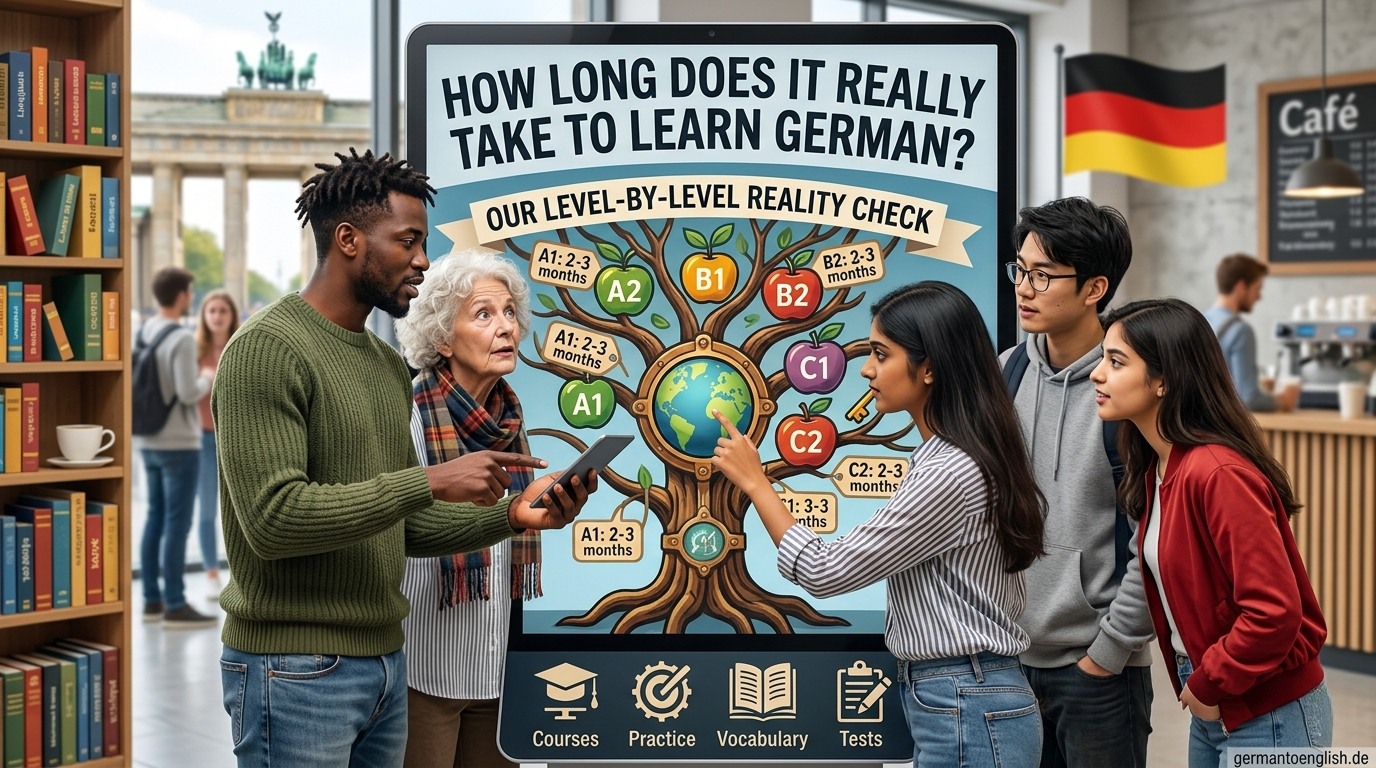
One of the most common questions asked by immigrants, international students, job seekers and language learners is simple: How long does it really take to learn German?
If you search online, you will find dozens of different answers. Some websites claim you can learn German Language in a few months. Others suggest several years. Language schools often provide estimated study hours, while YouTube videos sometimes make fluency seem easier than it actually is.
The truth lies somewhere in between.
German Language is not the hardest language in the world, but it is also not a language that most people master quickly. The amount of time required depends on many factors, including your native language, study habits, motivation, learning method, exposure to German and personal goals.
For example, someone who only wants basic survival German for daily life will reach their goal much faster than someone aiming for professional fluency, university admission or a highly skilled job in Germany.
Many learners become frustrated because they compare their progress with unrealistic expectations. They imagine that six months of studying will make them fluent, only to discover that language learning is usually a longer journey.
This article provides an honest and realistic breakdown of how long it typically takes to learn German at each level, from A1 to C2, along with practical advice that can help learners progress more efficiently.
Before discussing timelines, it is important to define what "learning German" means.
Different people use the phrase differently.
For some learners, learning German means:
For others, learning German means:
And for a smaller group, learning German means reaching near-native fluency.
Because these goals are completely different, the required learning time also varies significantly.
Germany and most language institutions use the Common European Framework of Reference for Languages (CEFR), which divides language proficiency into six levels:
Each level represents a significant increase in language ability and communication skills.
A1 is the first step in learning German and usually represents basic survival communication.
At this level, learners can:
Most learners can reach A1 within approximately 80 to 150 hours of focused study.
If someone studies one hour per day consistently, reaching A1 often takes between two and four months.
People living in Germany may progress faster because they encounter the language daily in supermarkets, public transport, workplaces and government offices.
A1 is enough for basic interactions, but it is far from real fluency. Many newcomers in Germany quickly realize that everyday life remains challenging at this stage.
A2 represents a stronger foundation and allows learners to handle more practical situations independently.
At A2 level, learners can:
Most learners require an additional 150 to 200 study hours after A1 to reach this stage.
For someone studying consistently, A2 often takes around six months from the beginning of their German learning journey.
At this level, daily life in Germany becomes noticeably easier. However, professional communication and complex discussions remain difficult.
Many immigrants can survive at A2 level, but they still face limitations when dealing with bureaucracy, healthcare, employment opportunities and deeper social interactions.
B1 is often considered the first truly useful milestone for immigrants living in Germany.
Many residence permits, integration programs and long-term immigration goals involve B1 German as an important requirement.
At B1 level, learners can:
Reaching B1 usually requires around 350 to 450 total study hours from complete beginner level.
For most people, achieving B1 takes approximately one year of regular study.
This is also the stage where many learners experience frustration because progress feels slower compared to beginner levels. Grammar becomes more complex, vocabulary expands rapidly and learners start noticing how much they still do not know.
Despite these challenges, B1 is often the point where learners begin feeling more confident and independent in Germany.
B2 is the level many employers in Germany prefer, especially outside international companies.
At B2 level, learners can:
Reaching B2 typically requires around 600 to 800 total study hours.
For most learners, this means approximately 18 months to 2 years of serious and consistent effort.
B2 often feels like a major breakthrough because conversations become much more natural. Learners can express nuanced opinions, understand workplace discussions and interact more comfortably with native speakers.
Many immigrants aiming for long-term careers in Germany view B2 as the minimum practical target for professional success.
C1 represents advanced German proficiency.
This level is often required for:
At C1 level, learners can:
Most learners require approximately 1,000 to 1,200 total study hours to reach C1.
For many people, this means two to three years of consistent learning.
C1 is where German begins feeling less like a foreign language and more like a practical communication tool. However, mistakes still happen and learners may continue noticing gaps in vocabulary or cultural understanding.
C2 is the highest CEFR level and is often described as near-native proficiency.
At this stage, learners can:
Reaching C2 usually requires several years of intensive exposure and practice.
Even highly motivated learners often spend four to six years or more reaching this level.
For many immigrants, C2 is not necessary unless their career or academic goals specifically require it.
Not everyone learns German at the same speed.
Several factors influence learning progress:
Someone living in Germany and using German daily will usually progress much faster than someone studying only through textbooks abroad.
Likewise, learners who actively speak German regularly often improve faster than those focusing only on grammar exercises.
One of the most common mistakes learners make is focusing entirely on grammar while avoiding real communication.
Many students spend months memorizing grammar rules but rarely speak German aloud.
As a result, they may pass written exercises but struggle during actual conversations.
Successful learners usually combine multiple approaches:
Language learning improves most effectively when all major skills develop together.
This question is extremely common among immigrants planning to move to Germany.
The honest answer is yes—but it depends on your definition of learning German.
With serious effort, many learners can reach B1 or even B2 within one year.
However, this usually requires:
Learning German casually for a few minutes occasionally will rarely produce such results.
Language progress generally reflects the amount of meaningful effort invested over time.
Many immigrants arrive in Germany expecting rapid language progress simply because they live in the country.
While immersion helps significantly, living in Germany alone does not automatically create fluency.
People who actively study, speak, read and engage with German culture usually progress much faster than those who rely solely on passive exposure.
A realistic goal for many immigrants is:
These timelines vary, but they provide a reasonable expectation for many motivated learners.
So, how long does it really take to learn German?
The honest answer depends on what level you want to reach and how consistently you study.
Basic communication may take only a few months. Functional independence often requires around a year. Professional fluency usually takes several years of regular practice and exposure.
German is not a language that most people master overnight, but it is absolutely achievable with patience and consistency.
Many learners become discouraged because they focus too much on how far they still need to go. A better approach is to celebrate steady progress at each stage. Every new word learned, every successful conversation and every grammar concept understood brings you closer to your goal.
Whether you are learning German for immigration, work, study or personal growth, the most important factor is not speed. It is consistency. Small daily improvements often lead to remarkable results over time.
The good news is that millions of people have successfully learned German before you. With realistic expectations and regular effort, you can do it too.

 ▼
▼
 Deutsch
  Artikel Quiz
 German Grammar