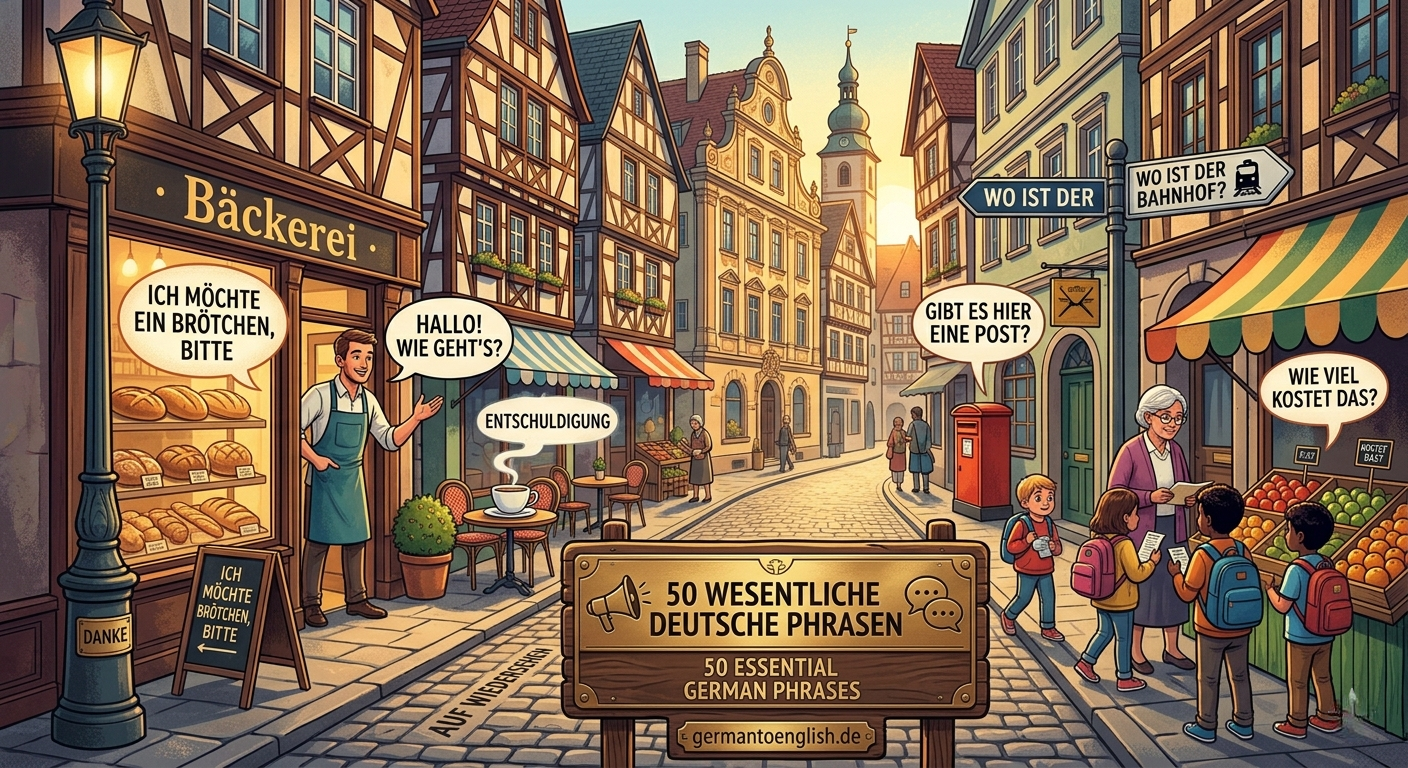
If you are planning to move to Germany, study at a German university, work for a German company or simply visit the country, learning a few practical German phrases can make your daily life much easier. While many Germans speak English, especially in larger cities, knowing basic German expressions helps you communicate confidently, integrate more quickly and show respect for the local culture.
One of the biggest mistakes newcomers make is focusing only on grammar and vocabulary lists while ignoring the phrases that Germans actually use every day. In reality, mastering a few useful expressions can help you navigate supermarkets, public transport, restaurants, government offices, workplaces and social situations far more effectively than memorizing hundreds of isolated words.
This guide covers 50 essential German phrases that are commonly used in everyday life. Whether you are a complete beginner or looking to improve your practical German skills, these expressions will help you feel more comfortable and confident in Germany.
Many language learners start by memorizing vocabulary. While vocabulary is important, learning complete phrases allows you to communicate immediately. Phrases provide context, improve pronunciation and help you understand how German is naturally spoken.
For example, knowing the word "Bahnhof" means "train station" is useful, but knowing the phrase "Wo ist der Bahnhof?" (Where is the train station?) is much more practical.
Learning phrases also helps build confidence because you can start using German in real situations from day one.
English: Good morning
English: Good day / Hello
English: Good evening
English: Hello
English: Bye
English: Goodbye
English: Please / You're welcome
English: Thank you
English: Thank you very much
English: Excuse me / Sorry
English: My name is ...
English: What is your name?
English: I come from ...
English: I live in ...
English: I speak a little German
English: Can you speak English?
English: How are you?
English: I am doing well
English: And you?
English: Everything okay?
English: Yes, of course
English: No, thank you
English: No problem
English: I understand
English: I do not understand
English: How much does this cost?
English: Do you have a cheaper one?
English: Can I pay by card?
English: Where can I find ...?
English: I would like to buy this
English: The menu, please
English: I would like ...
English: What do you recommend?
English: The bill, please
English: It tastes very good
English: Where is the train station?
English: When does the train leave?
English: Where can I buy a ticket?
English: Is this seat free?
English: I am lost
English: I have an appointment
English: Can you help me?
English: I work in Germany
English: Can you repeat that?
English: More slowly, please
English: I need help
English: Call the police
English: I need a doctor
English: Where is the hospital?
English: Can you help me?
Learning phrases becomes easier when you use them regularly. Instead of trying to memorize all 50 phrases at once, focus on five to ten expressions each day. Repeat them aloud, write them down and use them in real conversations whenever possible.
You can also create flashcards, practice with language-learning apps or label everyday objects around your home using German words and phrases. Consistent daily exposure is far more effective than occasional intensive study sessions.
Another useful strategy is to group phrases by situation. Learn shopping phrases together, transportation phrases together and workplace phrases together. This helps your brain associate language with real-life contexts.
Even though many Germans understand English, speaking basic German can significantly improve your experience in the country. It helps when dealing with government offices, landlords, healthcare providers, local businesses and neighbors. It also demonstrates respect for the local culture and often leads to more positive interactions.
For immigrants, students and job seekers, basic German skills can improve employment opportunities and make daily life less stressful. You do not need perfect grammar to communicate effectively. Knowing useful phrases is often enough to get started.
Learning German may seem challenging at first, but mastering a small collection of practical phrases can dramatically improve your confidence and independence. The 50 expressions in this guide cover many of the situations that newcomers encounter in Germany, from introducing themselves and shopping to using public transportation and visiting restaurants.
The key is consistency. Practice these phrases regularly, listen to native speakers and use German whenever you have the opportunity. Over time, these simple expressions will become second nature and form the foundation for more advanced language skills.
If you are planning to live, study or work in Germany, learning these essential German phrases is one of the best investments you can make in your language-learning journey.

 ▼
▼
 Deutsch
  Artikel Quiz
 German Grammar