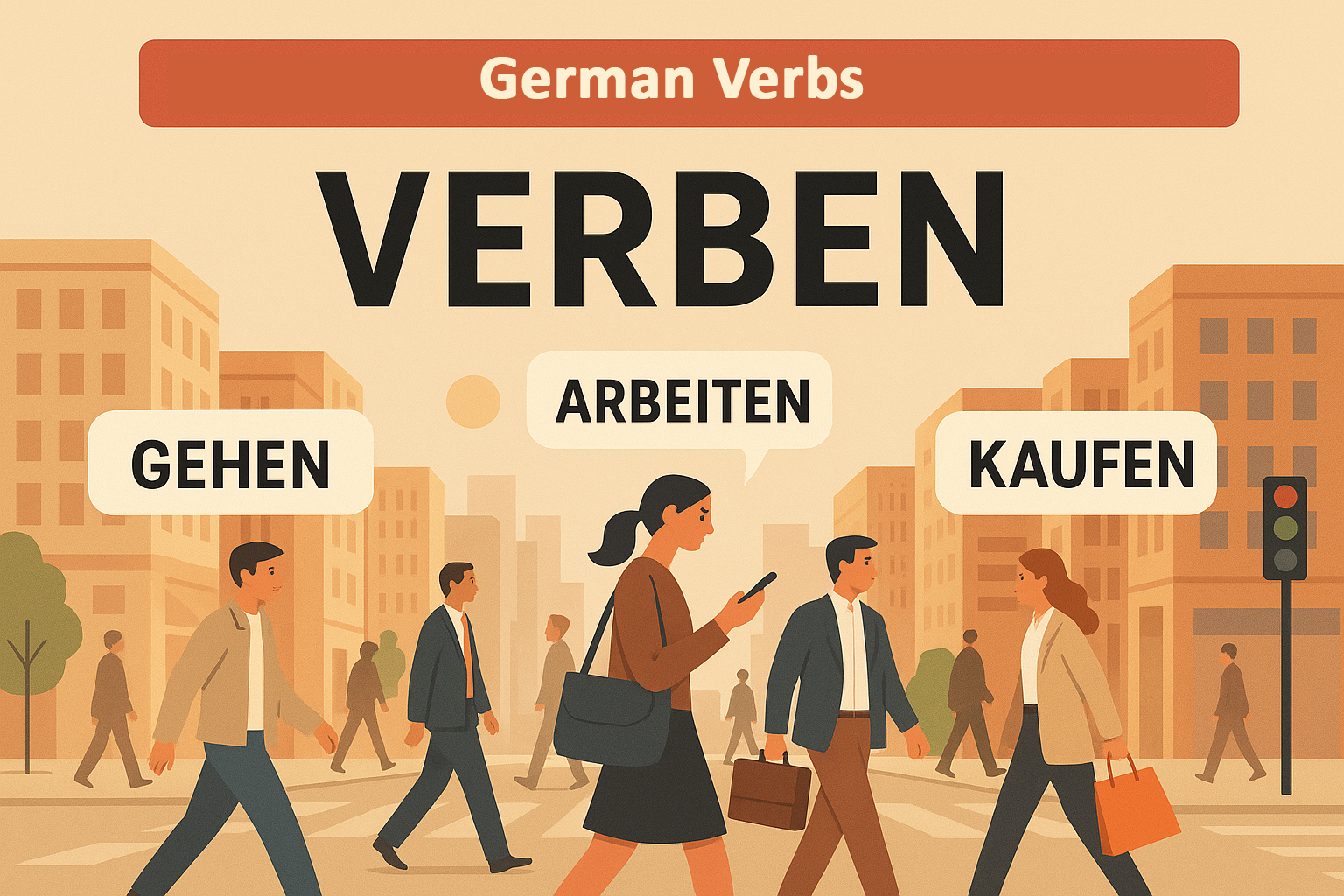
Verbs (Verben) are the backbone of German sentences. They indicate actions, events or states. In German, verbs change depending on person, number, tense and mood. This page will guide you through regular, irregular, separable and reflexive verbs with examples.
German verbs express what someone does or what happens. Each verb has a stem and an ending that changes according to person, number and tense.
Example:
German verbs are categorized as:
Regular verbs follow a predictable pattern when conjugated.
| Pronoun | Conjugation (lernen) |
|---|---|
| ich | lerne |
| du | lernst |
| er/sie/es | lernt |
| wir | lernen |
| ihr | lernt |
| sie/Sie | lernen |
Example: Wir lernen Deutsch. → We learn German.
Irregular verbs change their stem vowel in some forms. Common irregular verbs include sein, haben, gehen, sehen.
| Pronoun | Conjugation (sein) |
|---|---|
| ich | bin |
| du | bist |
| er/sie/es | ist |
| wir | sind |
| ihr | seid |
| sie/Sie | sind |
Example: Ich bin müde. → I am tired.
Separable verbs have a prefix that moves to the end in main clauses.
Reflexive verbs indicate that the subject performs an action on itself. They are used with reflexive pronouns.
German has several tenses:
Used for actions happening now or in the near future.
Used mainly in writing or storytelling.
Used in spoken German for past actions.
At germantoenglish.de, you can:
Mastering German verbs is key to forming correct sentences. Understanding conjugation, tenses and verb types will improve both your spoken and written German dramatically.

 ▼
▼
 Deutsch
  Artikel Quiz
 German Grammar