Opening a bank account in Germany is one of the most important practical steps for international students, expats, employees and other newcomers. A German bank account can make everyday life considerably easier because salaries, rent, utility bills, insurance payments and many other transactions are commonly handled through bank accounts.
If you are moving to Germany for university, work, an Ausbildung, research or another long-term stay, choosing the right bank can be confusing. Germany has traditional banks with physical branches, cooperative banks, savings banks and modern digital banks that allow customers to manage most of their finances through a mobile application.
This guide explains how to open a bank account in Germany, which documents you may need, what types of accounts are available, how traditional banks compare with online banks and what expats and students should consider before choosing a German bank account.
For many people living in Germany, having a local bank account is extremely useful. Although some payments can be made using international cards or other financial services, a German bank account can simplify regular financial transactions.
If you are employed in Germany, your employer may normally transfer your salary directly to your bank account. Tenants may also need an account for rent payments, while insurance companies, telecommunications providers and other service providers may use direct debit arrangements.
Students can also benefit from having a German bank account for receiving funds, paying accommodation expenses, managing monthly living costs and handling everyday purchases.
Yes, foreigners can generally open bank accounts in Germany, although the exact requirements depend on the bank, the type of account and the applicant's circumstances.
International students, EU citizens, non-EU residents, employees and other foreign nationals may all have different documentation requirements. Some banks are more accustomed to serving international customers than others, particularly digital banks and banks located in large university cities.
Before applying, check the bank's current requirements carefully. A bank may ask for proof of identity, proof of address, tax information and, depending on the circumstances, evidence of your residence status or purpose of stay.
The exact documentation varies between banks and individual circumstances. However, newcomers should normally be prepared to provide several basic documents.
Not every bank requires every document. Some digital banks can complete identification remotely, while traditional banks may invite you to a branch or use a video identification process.
The Anmeldung is the process of registering your residential address with the local German authorities. After completing the registration, you normally receive a Meldebescheinigung confirming your registered address.
Proof of address can be important when opening a bank account because banks need to establish and verify customer information. However, requirements vary considerably between banks and account types.
If you have recently arrived in Germany, it is therefore useful to check the bank's requirements before applying. Some banks may accept alternative address documentation in particular circumstances, while others may require German address registration.
Germany offers several types of bank accounts. For most expats and students, the most relevant option is a Girokonto, which is a current account designed for everyday banking.
A Girokonto is the standard current account used for everyday financial transactions. You can generally use it to receive salary payments, transfer money, pay bills and manage regular expenses.
Some banks offer accounts specifically designed for students. These accounts may have reduced or waived monthly fees subject to eligibility conditions.
If you are an international student, check whether the bank requires proof of enrolment and whether the benefits continue for the entire duration of your studies.
A basic payment account can provide essential banking services to eligible consumers. It can be particularly relevant for people who have difficulty opening a standard current account.
A blocked account or Sperrkonto, is different from an ordinary current account. It is commonly used by certain international students and visa applicants to demonstrate access to sufficient funds for living expenses in Germany.
A blocked account should therefore not be confused with the everyday Girokonto you use for rent, shopping and receiving salary payments.
One of the biggest decisions for newcomers is whether to choose a traditional German bank with physical branches or a modern online bank.
Traditional banks can be attractive if you prefer face-to-face customer service and physical branches. This can be particularly helpful if you are not yet comfortable communicating in German or if you occasionally need assistance with complex banking matters.
Traditional banks may also provide a wider range of financial products, including loans, mortgages, investment products and other services.
Digital banks can be convenient for international residents because account opening and everyday banking can often be completed through an app or website.
Many digital banks offer modern mobile applications, real-time notifications and convenient card management. Some also provide English-language interfaces, which can be useful for expats and international students.
However, online banks may have fewer or no physical branches. If you prefer speaking to a bank employee in person, a traditional bank may be more suitable.
There is no single best bank for every expat. The right choice depends on factors such as monthly fees, English-language support, ATM access, branch availability, mobile banking features and international transfer options.
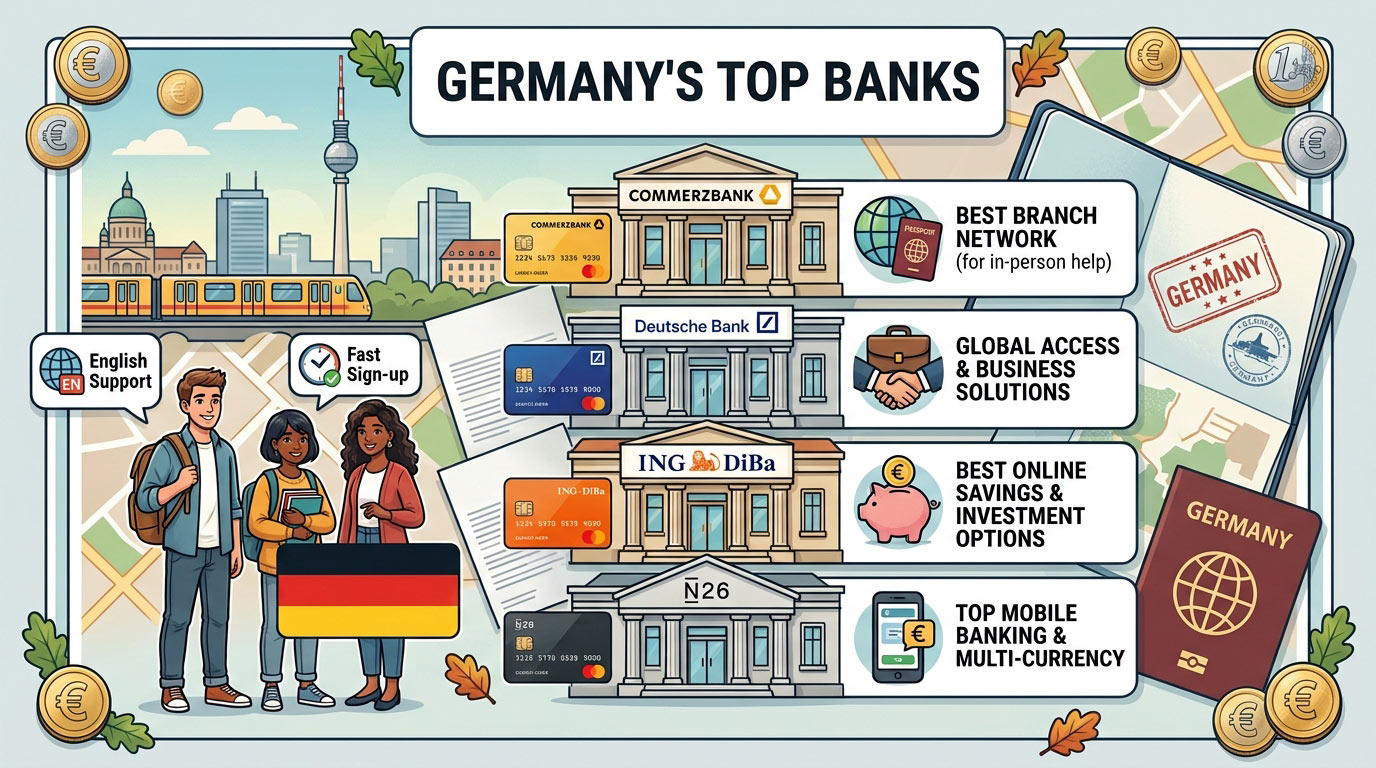
Some well-known banking options available to people in Germany include large nationwide banks, savings banks, cooperative banks and digital banking providers. Major traditional banking groups include Deutsche Bank, Commerzbank and HypoVereinsbank, while Germany also has a large network of Sparkassen and Volksbanken Raiffeisenbanken.
Digital options can be attractive for customers who want app-based banking and straightforward account management. Availability, eligibility and pricing can change, so compare the current terms directly with the bank before applying.
Students generally have different priorities from established professionals. A student may care more about low fees, convenient mobile banking, ATM access and simple account opening than mortgages or investment products.
When comparing student bank accounts in Germany, consider whether the account has a monthly maintenance fee, whether there is a minimum age requirement, whether proof of university enrolment is required and what happens when your student status ends.
International students should also check whether customer support and banking applications are available in English. This can make everyday banking easier, especially during the first few months in Germany.
The account-opening process is generally straightforward if you have the required documents. The exact procedure varies depending on the bank.
Start by comparing banks based on fees, ATM availability, branch access, digital banking features, international transfers and customer support.
Decide whether you need a standard Girokonto, student account or another type of account. Make sure you meet the eligibility conditions.
Depending on the bank, you may be able to apply online, through a mobile application or directly at a branch.
German banks need to verify the identity of their customers. This may involve video identification, an online identification process or verification at a branch or authorized location.
Provide any requested proof of address, residence information, student status, employment information or tax details.
Once your application is approved, the bank will provide your account information. You may receive an IBAN, debit card and other account-related information separately.
An IBAN is an International Bank Account Number used to identify a bank account for electronic payments and transfers. German IBANs begin with the country code DE.
Your IBAN is important for receiving salary payments, making transfers and setting up direct debits. Keep your banking information secure and only provide it to legitimate organizations that need it for a payment or account-related purpose.
Bank account costs vary significantly depending on the bank and account type. Some accounts have no monthly maintenance fee if certain conditions are met, while other accounts charge a regular fee.
You should look beyond the headline monthly fee. Other costs can include ATM withdrawal fees, foreign currency charges, international transfer fees, replacement card fees and charges for specific banking services.
Students should particularly check whether a free student account remains free after graduation or when they reach a specified age.
Choosing a bank should be based on how you expect to use the account rather than simply choosing the bank with the largest name.
This depends on the bank and your circumstances. Some banks may allow customers to begin an application from outside Germany, while others require German residence or additional documentation.
International students should not assume that every German bank allows non-residents to open a standard current account remotely. If you are still abroad, check the bank's current eligibility requirements before relying on the account for your move.
International students should generally separate two different financial needs: demonstrating sufficient funds for immigration purposes and managing everyday expenses.
If your visa process requires a blocked account, the blocked account serves a specific purpose. Once you are living in Germany, you may also want a regular current account for everyday transactions.
Before choosing a student bank account, compare fees, card availability, ATM access, English support, digital banking features and the documents required to open the account.
Opening a German bank account becomes easier when you prepare in advance. Keep digital and physical copies of important documents and make sure your personal details are consistent across your passport, registration documents and bank application.
Do not choose a bank solely because someone calls it the “best bank in Germany.” The best account for you depends on your location, income, student status, frequency of international transfers and whether you need branch-based support.
It is also worth checking the current price list and account conditions before signing up. Banking fees and eligibility rules can change over time.
There is no universally best bank for every expat. Traditional banks can be useful if you want branches and face-to-face support, while digital banks may be attractive if you prefer mobile banking and convenient online account management.
The best student account depends on fees, eligibility, ATM access, customer service and digital banking features. Students should compare current student-account conditions before applying.
Yes. International students can generally open bank accounts in Germany, subject to the bank's identification and eligibility requirements. The bank may request proof of identity, address and student status.
Many banks may ask for proof of German address and some may require address registration. However, requirements vary by bank and account type. Check the current requirements of the bank you intend to use.
Online banking is widely used in Germany. Customers should nevertheless follow basic security practices, including using strong authentication, keeping banking applications updated and never sharing passwords, PINs or authentication codes with other people.
It is possible to have accounts with different banks, subject to each bank's terms and eligibility requirements. Some people maintain one main account and another account for specific purposes such as international transactions or savings.
Opening a bank account in Germany is an important step for expats, international students and other newcomers who plan to live in the country. A suitable German bank account can simplify salary payments, rent, bills, transfers and everyday spending.
When choosing among the best banks for expats and students, do not focus only on the bank's reputation. Compare account fees, ATM access, branch availability, English-language support, mobile banking, international transfer costs and eligibility requirements.
If you are moving to Germany as a student or expat, preparing documents such as your passport, proof of address and relevant residence or student documents can make the account-opening process much smoother. Most importantly, check the bank's current terms before applying because requirements and fees can change.

 ▼
▼
 Deutsch
  Artikel Quiz
 German Grammar