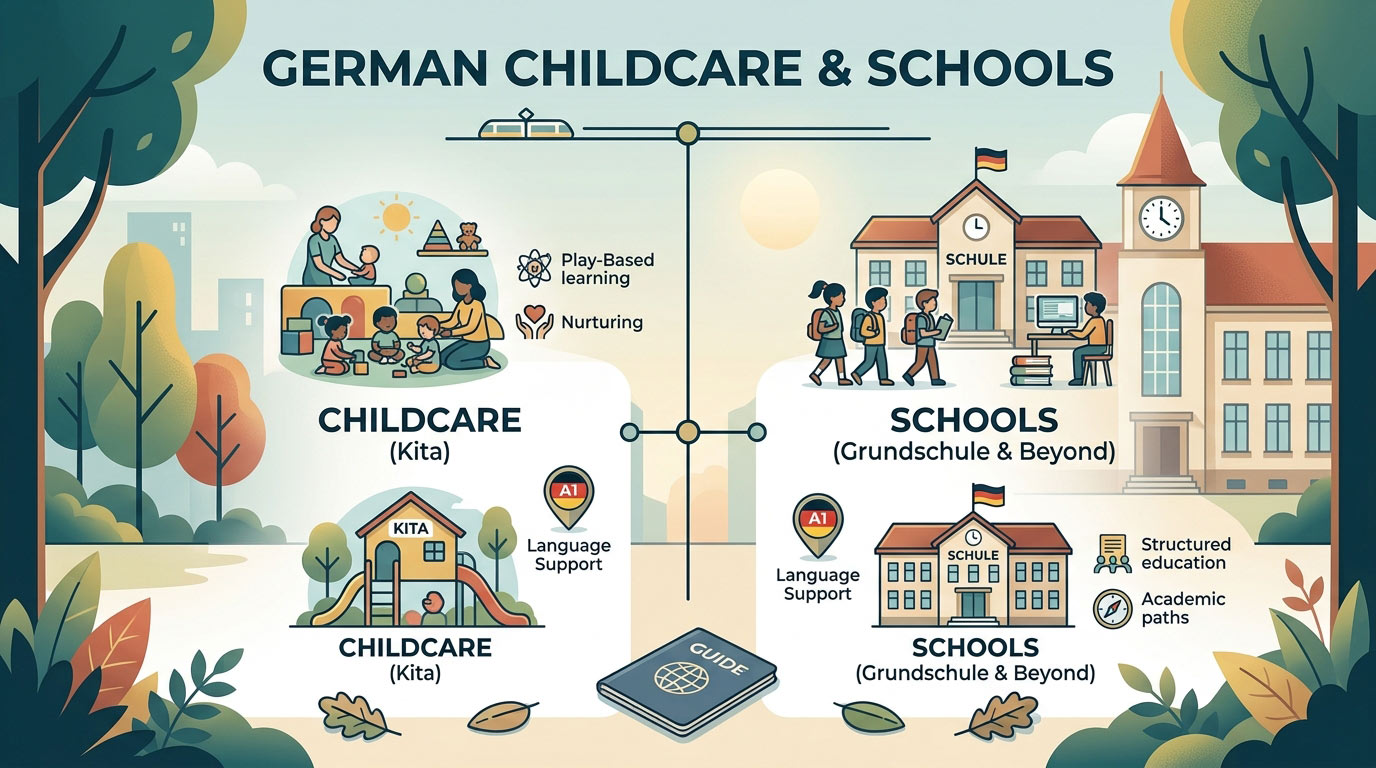
Moving to Germany with children involves much more than finding a home and arranging your residence documents. For expat families, one of the biggest priorities is understanding childcare and schools in Germany. Parents need to know how the German education system works, when children can start school, how kindergarten and Kita places are arranged, what types of schools are available and whether international children can attend German-language schools.
Germany offers a well-developed education and childcare system, but the structure can initially seem complicated to families arriving from another country. Terms such as Kita, Kindergarten, Grundschule, Gymnasium, Realschule and Gesamtschule may be unfamiliar. In addition, education is largely organized at the federal state level, so rules and procedures can differ depending on where your family lives.
The good news is that expat families have several options. Depending on the child's age, location, language skills and your family's long-term plans, you may consider public childcare, German public schools, international schools, bilingual schools or other educational options.
This guide explains childcare and schools in Germany for expat families, including how the German school system works, childcare options, school enrollment, language support, costs and practical tips for parents moving to Germany.
Education in Germany is primarily the responsibility of the individual federal states, known as Bundesländer. This means that education policies, school structures and enrollment procedures can vary between states.
Despite these regional differences, the overall structure is relatively similar across Germany. Children generally attend primary school first and then move into different types of secondary education.
School education at public schools is generally free of tuition fees, although parents may still have expenses for school supplies, meals, trips, transportation and other activities.
Childcare is an important part of everyday life for families with young children. The term Kita is commonly used for childcare facilities and comes from “Kindertageseinrichtung.”
A Kita can provide care and early education for children before they reach compulsory school age. The exact age groups and services vary between facilities.
You may also hear the word Kindergarten. Traditionally, Kindergarten refers to care and early education for young children before school. In everyday conversation, however, people may use Kita as a broader term for childcare facilities.
Finding a childcare place can take time, particularly in larger cities where demand is high. Expat families should therefore begin researching childcare options as early as possible.
Do not assume that you can arrive in Germany and immediately find a Kita place close to your home. Availability depends heavily on the city, neighborhood, age of the child and available capacity.
Some municipalities have central registration or application systems, while others require parents to contact individual childcare facilities. The procedure can therefore differ considerably from one location to another.
When searching for childcare, consider both the distance from your home and the distance from your workplace or school. A convenient location can make daily family life considerably easier.
Childcare costs in Germany vary depending on the federal state, municipality, childcare provider, number of hours and family circumstances.
Some regions have significantly reduced or eliminated certain childcare fees, while other municipalities may charge parents based on various factors. Additional expenses can include meals, special activities or extended care.
Because childcare costs and rules can change, expat families should check the current conditions in the specific city or municipality where they plan to live.
After early childhood education, children enter the German school system. The structure differs somewhat between federal states, but primary and secondary education form the basic framework.
Primary school is generally known as Grundschule. Children normally attend Grundschule during the first years of compulsory schooling before moving to secondary education.
Secondary education can follow different pathways. Depending on the federal state and school, children may attend institutions such as Gymnasium, Realschule, Hauptschule or Gesamtschule.
Grundschule is primary school in Germany. It provides children with foundational education before they move into secondary education.
The age at which children begin school and the exact duration of primary education can depend on the federal state. In many cases, children start school at around six years old.
For expat families, one important issue is the child's German-language ability. A child who previously attended school in another country may need additional language support after entering a German school.
After Grundschule, children move into secondary education. Germany has traditionally offered different types of secondary schools designed around different educational pathways.
Gymnasium is a secondary school pathway with an academic focus. Students can work toward the Abitur, which is an important qualification for university admission.
Realschule traditionally provides an intermediate level of secondary education. It can prepare students for vocational education, employment or further educational pathways.
Hauptschule traditionally provides a more practically oriented secondary education pathway. The structure and role of this school type vary between federal states.
Gesamtschule combines different educational pathways within one school structure. Depending on the school and federal state, students can work toward different qualifications.
Parents should not assume that exactly the same school structure exists everywhere in Germany. The organization of secondary education differs between Bundesländer.
Public school education in Germany is generally provided without tuition fees. This makes public schools an attractive option for many expat families.
However, “free school” does not mean that parents have no education-related expenses. Families may need to pay for school materials, meals, extracurricular activities, class trips, transportation or other costs.
The exact costs depend on the school and local arrangements.
Yes. Children of international families can attend German public schools when they meet the relevant residence and enrollment requirements.
One of the biggest considerations for newly arrived families is language. German is the main language of instruction at most public schools. Children who are not yet fluent in German may receive additional language support or be placed in appropriate preparatory programs depending on the federal state and school.
The earlier a child becomes comfortable with German, the easier it can become to participate fully in school life. Parents should therefore ask the local education authority or school about available language-support programs.
Moving from another country can be challenging for children, especially when they enter a school where the primary language is unfamiliar. German states and schools may offer different forms of language support for newly arrived students.
Depending on the child's age and circumstances, language-support classes or preparatory arrangements may be available before or alongside regular classroom education.
Parents should explain the child's previous education, language level and school history during the enrollment process. This information can help authorities and schools determine an appropriate educational pathway.
International schools are another option for expat families. They can be particularly attractive to families who expect to stay in Germany for a limited period or who want their children to continue studying primarily in English or another international language.
International schools may follow international curricula or offer bilingual education. Some may provide qualifications recognized across multiple countries.
The major disadvantage is cost. Unlike public schools, international schools generally charge tuition fees and these fees can be substantial.
Availability also varies significantly by city. Large international cities tend to have more international school options than smaller towns.
Choosing between a German public school and an international school depends on your family's priorities and long-term plans.
Neither option is automatically better. Consider your expected length of stay, the child's age, language ability, educational goals and family budget.
The school enrollment process depends on the federal state and municipality, but there are several common steps.
After moving to Germany, completing your residential registration may be an important first administrative step. Proof of address can be needed when dealing with local authorities and educational institutions.
If you are unsure which school your child should attend, contact the relevant local education authority. They can provide information about schools, enrollment and available support.
Keep your child's previous school reports, certificates, identification documents and other relevant educational records. Translations may sometimes be required.
Tell the school about your child's German-language level and previous language education. This can help determine which support options may be appropriate.
Once the appropriate school has been identified, complete the required registration and provide the requested documents.
Requirements vary, but expat families should generally prepare a folder containing important documents.
Do not assume every school will require exactly the same documents. Check the requirements of your local authority and school before attending an enrollment appointment.
Germany has compulsory education rules, but the exact regulations and starting age can differ between federal states.
Families moving to Germany with school-age children should therefore make school enrollment a priority after arrival. Parents should not simply assume that an overseas school arrangement automatically satisfies German compulsory education requirements.
Contact the appropriate local education authority if you are uncertain about when your child needs to begin attending school.
Germany has comparatively strict rules concerning compulsory school attendance. Traditional homeschooling is generally not treated as a freely available alternative to attending school.
Families considering education outside the regular school system should obtain professional advice and check the rules applicable in their federal state rather than assuming that homeschooling is permitted in the same way as in another country.
Language is one of the most important considerations for international families. Young children often adapt quickly to a new language, especially when they are regularly exposed to German at childcare and school.
Older children who arrive with little German may initially face greater challenges. Parents can support the transition by encouraging German-language practice outside school, using age-appropriate learning resources and maintaining communication with teachers.
At the same time, parents should not necessarily abandon the child's first language. Maintaining the family language can help children stay connected with relatives and preserve their multilingual abilities.
Location should be one of the first factors you consider. A childcare center or school close to home can reduce daily commuting time and make family routines easier.
Parents should also consider opening hours, language environment, educational philosophy, extracurricular activities, meals, transportation and available places.
If you are still choosing where to live in Germany, it can be worthwhile to research schools and childcare availability before signing a long-term rental agreement.
Moving countries is a major change for children as well as parents. Planning ahead can make the transition smoother.
Childcare costs vary by federal state, municipality, provider and family circumstances. Some areas provide heavily subsidized or free childcare, while others charge fees. Parents should check the current rules in their municipality.
Kita is short for Kindertageseinrichtung and is a general term for childcare and early education facilities. The exact age groups and services depend on the facility.
Children commonly start primary school at around six years old, but the exact school-start rules and cutoff dates depend on the federal state and individual circumstances.
Public school education is generally provided without tuition fees. However, families may still have costs for books or supplies, meals, trips, activities and other expenses.
Yes. Children from international families can attend German schools subject to the applicable enrollment and residence requirements. Children who do not yet speak German may receive language support depending on the state and school.
Yes. Germany has international and bilingual schools, particularly in larger cities. These schools can offer education in English or other languages, but availability and tuition fees vary.
International schools generally charge tuition fees and the cost can be significantly higher than attending a public school. Fees vary considerably between schools and locations.
Kindergarten or Kita attendance is generally different from compulsory school attendance. Children are not normally required to attend kindergarten simply because they have reached a particular age. The rules concerning compulsory education apply to school-age children.
Yes. Many international children learn German after moving to Germany. Schools and local authorities may provide language-support programs, while regular exposure through school, childcare and daily life can help children develop their language skills.
Understanding childcare and schools in Germany is an essential part of planning a successful move with children. Germany offers a broad range of options, from Kitas and public schools to bilingual and international schools.
The best choice depends on your child's age, German-language ability, educational background, family budget and plans for the future. Families who intend to stay in Germany long term may find that German-language public education provides an excellent opportunity for integration, while internationally mobile families may prefer bilingual or international education.
Because education is organized largely by the individual federal states, procedures and requirements can vary. Start your research early, particularly when looking for a Kita place and contact the relevant local authority when you are unsure about school enrollment.
Most importantly, give your child time to adjust. Moving to another country can be challenging, but Germany's education system provides many opportunities for children to develop academically, learn German and become part of their new community.

 ▼
▼
 Deutsch
  Artikel Quiz
 German Grammar