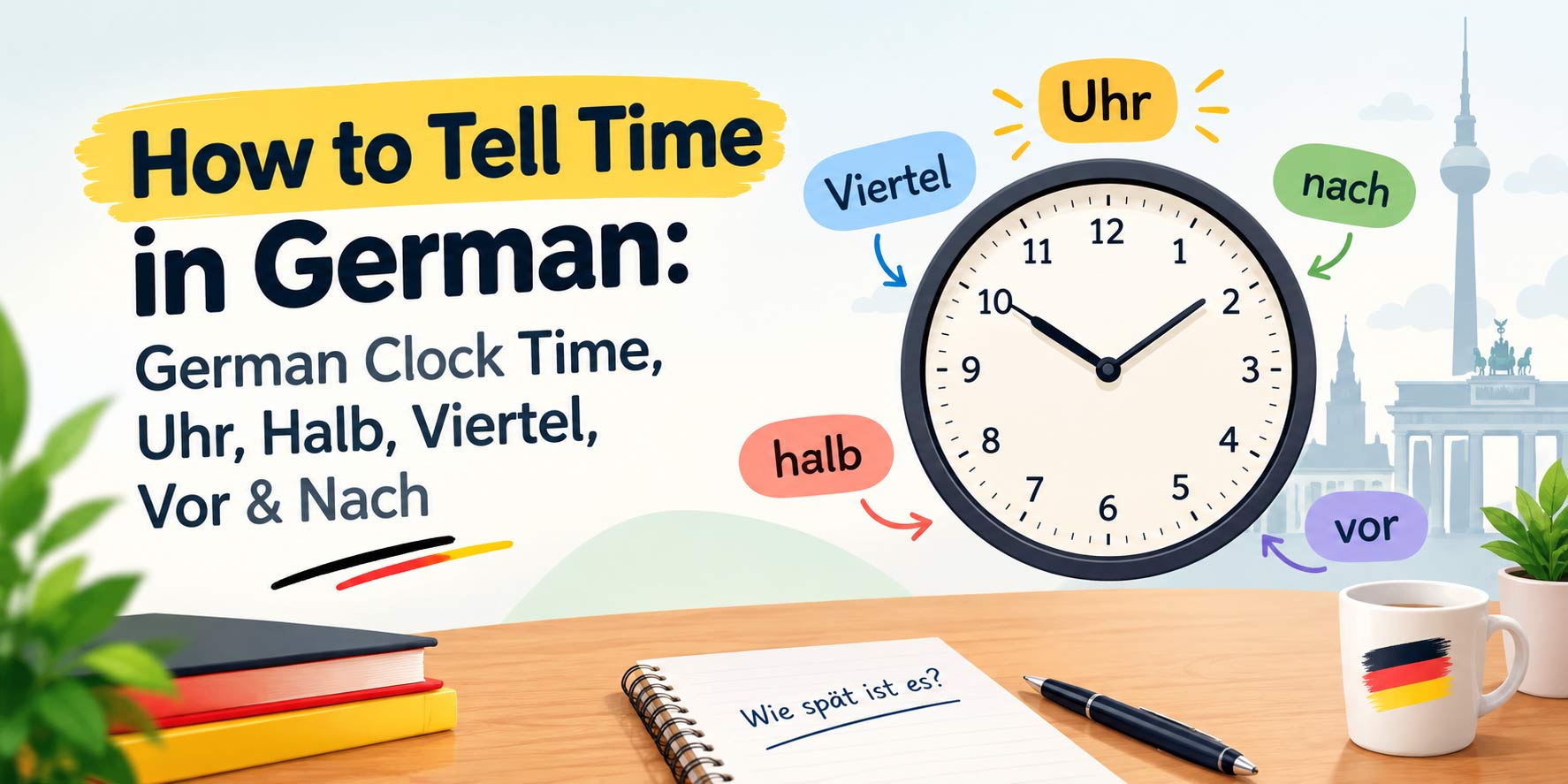
Learning how to tell time in German is one of the first practical skills every German learner needs. You will use German time expressions when making appointments, catching trains, attending classes, arranging meetings, talking about work schedules and making plans with friends. Fortunately, the basic system is quite logical once you understand a few important words such as Uhr, nach, vor, halb and Viertel.
The main challenge for English speakers is that German sometimes describes the time differently from English. The most famous example is halb drei. In German, this means 2:30, not 3:30. German speakers are thinking about being halfway to the next hour. This is one of the first expressions you should master if you want to understand everyday German conversations.
This practical guide explains German time expressions for beginners, including how to ask what time it is, how to say full hours and minutes, when to use nach and vor, how halb and Viertel work, how the 12-hour and 24-hour systems differ and how to understand regional expressions you may hear in Germany, Austria and Switzerland.
The most common question beginners should learn is Wie spät ist es?, which literally asks something like “How late is it?” and means “What time is it?” Another common question is Wie viel Uhr ist es?, meaning “What time is it?” or literally “How many o'clock is it?” Both expressions are useful in everyday German.
You can use these questions in everyday situations such as asking someone on the street, checking the time before a class or talking to a friend. When someone asks you Wie spät ist es?, you can normally answer with Es ist ... followed by the appropriate time expression.
The German word Uhr means “clock” or “o'clock,” depending on context. When stating an exact hour, you normally put Uhr after the number. For example, Es ist zwei Uhr means “It is two o'clock.”
One small detail is important for beginners: when telling the time, use ein Uhr, not eins Uhr. The form eins is used when the number stands alone, while ein is used before the noun Uhr.
For a full hour, the structure is therefore very simple: Es ist + number + Uhr. Once you know the German numbers from one to twelve, you can already tell many basic times.
The German word nach means “after” or “past.” When a time is a certain number of minutes after the hour, German commonly places the minutes before nach, followed by the hour.
The basic pattern is:
minutes + nach + hour
For example, if the clock shows 8:10, you can say Es ist zehn nach acht. Literally, this means “It is ten after eight.” This is very similar to the English expression “ten past eight,” so this part is usually easy for English speakers.
In a clear direct format, German can also say the hour followed by Uhr and the minutes, such as acht Uhr zehn for 8:10. Both approaches are useful, but everyday conversation frequently uses expressions with nach, vor, halb and Viertel.
The German word vor means “before” or “to.” When you are talking about minutes before the next full hour, German commonly names the number of minutes remaining and then the coming hour.
The basic pattern is:
minutes + vor + next hour
Notice something important: after vor, German normally names the hour that is coming, not the hour that has just started. For example, 7:50 is zehn vor acht, because it is ten minutes before eight.
This concept becomes especially important when you move beyond simple digital time and begin understanding native speakers in everyday conversation. If you hear fünf vor zehn, think “five minutes before ten,” which means 9:55.
The word halb means “half,” but German uses it differently from the English expression “half past.” This is probably the most important German time rule to memorize.
In German, halb + next hour means 30 minutes before that hour. Therefore:
English speakers should avoid translating halb drei word-for-word as “half three” and then assuming it means 3:30. In German, the hour mentioned is the next hour. You can think of halb drei as “halfway to three.”
For example, if someone tells you Wir treffen uns um halb neun, the meeting is at 8:30, not 9:30. This distinction is extremely important when making appointments, because misunderstanding halb could make you arrive an hour late.
The German use of halb as a reference to the upcoming hour is consistently highlighted in beginner German resources and is one of the most common points of confusion for English-speaking learners.
The German word Viertel means “quarter.” For 15 minutes after the hour, a common expression is Viertel nach + hour.
For example, Es ist Viertel nach sieben means “It is 7:15.” This structure is relatively easy for English speakers because it corresponds closely to “quarter past seven.”
Remember that Viertel is a noun and is therefore normally written with a capital letter in German. The word nach tells you that the quarter hour has passed the named hour.
For 45 minutes past an hour, German commonly uses Viertel vor + next hour. This is equivalent to “quarter to” in English.
The same next-hour principle applies here as with vor. If the time is 6:45, you say Viertel vor sieben because seven is the upcoming hour.
A useful mental shortcut is: nach = look back, vor = look forward. If the time has passed the hour, use nach with the current hour. If you are describing how much time remains until the next hour, use vor with the next hour.
The following examples bring the most important German time expressions together in one place. Learning these patterns is more useful than memorizing individual times because you can apply the same structures to hundreds of different clock times.
The expressions involving fünf vor halb and fünf nach halb may initially look complicated. In everyday speech, German speakers can use the half-hour as a reference point. For example, fünf vor halb neun means 8:25, while fünf nach halb neun means 8:35.
Germany uses both 12-hour and 24-hour ways of expressing time, but their use depends on the situation. The 24-hour format is especially common for official schedules, transportation, appointments, timetables and other situations where clarity is important.
For example, a train departure at 17:30 can be expressed as siebzehn Uhr dreißig. A written timetable will normally show 17:30. This avoids ambiguity between morning and evening.
In everyday conversation, however, Germans frequently use the 12-hour format and rely on context or words such as morgens, nachmittags, abends and nachts when clarification is necessary.
When using the 12-hour clock, German speakers can add a time-of-day expression to make the meaning clear. This is particularly useful when an appointment could otherwise be misunderstood.
For example, acht Uhr morgens means 8 a.m., while acht Uhr abends means 8 p.m. You may also hear um acht in everyday speech when the context already makes the intended time obvious.
When saying that something happens at a particular time, German normally uses the preposition um. This is an important grammar rule to learn together with telling time.
For example, Der Kurs beginnt um neun Uhr means “The course starts at nine o'clock.” Similarly, Wir treffen uns um halb acht means “We are meeting at 7:30.”
This distinction is useful because learners sometimes use in or another English-influenced preposition when translating directly from their first language. When referring to a specific clock time, um is the key preposition to remember.
Digital time is particularly easy because you can simply read the hour and minute values. A precise style is often useful when speaking about transportation, work schedules, appointments and official information.
This direct format is particularly useful when precision matters. If you are still struggling with expressions such as halb, Viertel or fünf vor halb, you can safely use the direct hour-and-minute format in many situations.
German time expressions can vary regionally. Most learners should first master the widely understandable forms Viertel nach and Viertel vor. However, when travelling through Germany, Austria or Switzerland, you may hear other expressions.
In some regions, speakers use expressions such as Viertel drei for 2:15 and dreiviertel drei for 2:45. These forms are not used uniformly throughout the German-speaking area. Regional variation is especially noticeable in parts of eastern and southern Germany and Austria.
For example, if someone says Viertel acht using the regional system, they may mean 7:15 rather than 8:15. Similarly, dreiviertel acht can mean 7:45. This can initially be confusing for learners who have only studied Viertel nach sieben and Viertel vor acht.
You do not need to actively use these regional forms as a beginner. The safest strategy is to understand Viertel nach and Viertel vor first because they are widely understood. As your listening skills improve, you can learn the regional forms used where you live or spend time.
Most beginner mistakes are predictable. The good news is that once you know what to watch for, they are relatively easy to correct. The biggest problem is usually translating English expressions directly into German instead of learning the German system.
One of the easiest ways to avoid mistakes is to practise with an actual clock. Look at a random time and say it first using the direct format, then using the everyday form. For example, if you see 6:45, say sechs Uhr fünfundvierzig and then Viertel vor sieben.
Try to translate the following German expressions into English before checking the answers. This kind of active practice is more effective than simply reading a list of rules.
The answers are 3:05, 6:15, 9:30, 1:50, 4:45, 10:30 and 17:20 respectively. Notice again that halb zehn refers to the half-hour before ten, so it means 9:30.
The most effective way to learn German time is to practise patterns rather than memorize isolated examples. Start with the full hours, then add nach and vor. Once these feel comfortable, learn Viertel nach, Viertel vor and finally halb.
Try spending five minutes each day reading random times aloud. You can use a physical clock, a phone or random digital times. Say each time in both the direct format and the conversational format. This trains you to switch between the precise and everyday systems.
Learning a few additional words will make conversations about time much easier. These words frequently appear alongside clock times and are useful from A1 level onward.
Instead of learning clock vocabulary in isolation, practise complete sentences. This helps you understand how Germans actually use time expressions in daily communication.
The most common expressions are Wie spät ist es? and Wie viel Uhr ist es? Both mean “What time is it?” and are useful in everyday German.
Halb drei means 2:30. German uses the next hour with halb, so it can be understood as “halfway to three.” This is one of the most important German time expressions for beginners to memorize.
Viertel nach drei means 3:15 or a quarter past three.
Viertel vor vier means 3:45 or a quarter to four.
You can say halb sechs in everyday German. In a direct hour-and-minute format, you can say fünf Uhr dreißig. The first means 5:30 even though the hour mentioned is six.
Yes. The 24-hour format is very common in timetables, transportation, schedules and formal contexts. Everyday conversations also frequently use a 12-hour style, with context or words such as morgens and abends clarifying the time when necessary.
Uhr can mean “clock” as a noun and is also used like “o'clock” when stating a specific time, such as acht Uhr for 8:00.
Nach means after or past, while vor means before or to. For example, zehn nach drei is 3:10, while zehn vor vier is 3:50.
If you are just starting German, remember these six rules first. They cover a large part of everyday German clock expressions.
The most important example to remember is halb drei = 2:30. Once this becomes automatic, German time expressions become considerably easier.
Learning how to tell time in German does not require memorizing hundreds of expressions. The system is based on a small number of reusable patterns. Start with Uhr, then learn nach and vor. After that, practise Viertel and halb until you can understand them without translating mentally into English.
Remember that German often points toward the next hour when using vor, Viertel vor and halb. This is the key difference that causes the most problems for English-speaking learners. If someone says halb acht, think 7:30. If someone says Viertel vor acht, think 7:45.
Finally, practise both formal and conversational German. You should be comfortable reading 17:30 as siebzehn Uhr dreißig on a timetable, while also understanding halb sechs when a German friend says it in conversation. Once you can switch naturally between these forms, you will have mastered one of the most useful A1 German communication skills.

 ▼
 Deutsch
 Artikel Quiz
 German Grammar