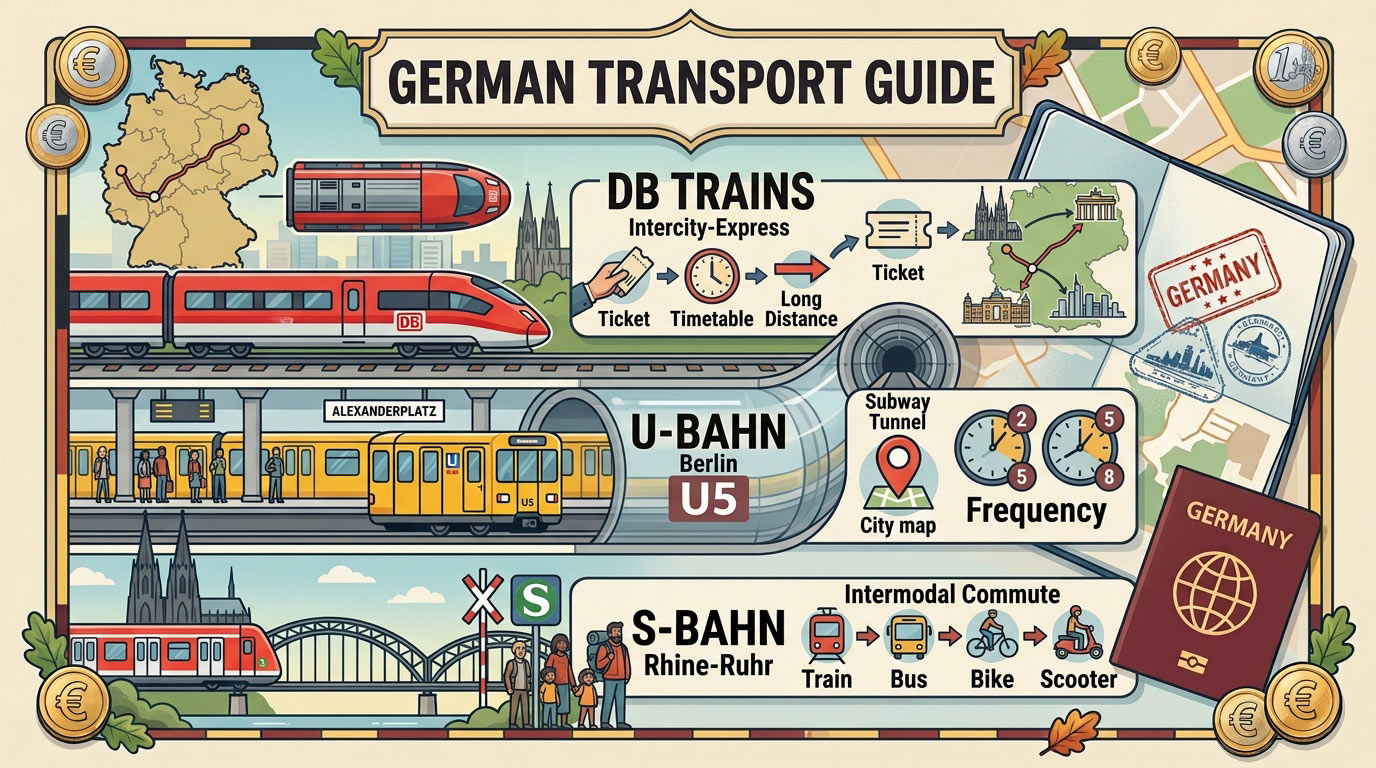
Public transportation in Germany is one of the easiest ways for students, expats, workers and tourists to travel around the country. Germany has an extensive network of trains, buses, trams and urban rail services connecting major cities, smaller towns and rural areas. For someone arriving in Germany for the first time, however, the different names and ticket systems can initially seem confusing.
You may come across terms such as Deutsche Bahn, DB, ICE, IC, RE, RB, S-Bahn and U-Bahn when planning a journey. Although all of these services are part of Germany's wider transportation network, they serve different purposes. Understanding the difference between them can help you choose the right train, buy the correct ticket and avoid unnecessary travel costs.
This guide explains public transportation in Germany in simple terms. You will learn how DB trains work, the difference between U-Bahn and S-Bahn, how regional trains differ from long-distance trains, how tickets work, what the Deutschland-Ticket is and what international students and expats should know before using public transport in Germany.
Germany has a highly developed public transportation system made up of national rail services and local or regional transportation networks. Different cities and regions operate their own local transport systems, while Deutsche Bahn operates a large part of the national railway network.
Depending on your journey, you may travel by high-speed train, regional train, S-Bahn, U-Bahn, tram or bus. These services are often connected, allowing passengers to combine different forms of transportation during one journey.
For example, someone living outside Berlin might take a regional train or S-Bahn into the city and then change to the U-Bahn or tram to reach their university or workplace. A traveler going from Berlin to Munich, on the other hand, may use an ICE long-distance train.
Deutsche Bahn, commonly abbreviated as DB, is Germany's major railway company. It operates many long-distance and regional rail services and plays a central role in the German train system.
Deutsche Bahn operates several types of trains. The most important categories for everyday travelers are ICE, IC, EC, RE and RB. The type of train you choose can affect journey time, ticket price and whether your ticket is valid on that particular service.
ICE stands for Intercity-Express. These are Germany's high-speed long-distance trains and are generally used for travel between major cities.
ICE trains are usually faster than regional trains and can connect cities such as Berlin, Hamburg, Frankfurt, Cologne and Munich. They are particularly useful when you want to travel long distances within Germany in a relatively short time.
IC means Intercity. These are long-distance trains that connect many German cities but are generally different from the high-speed ICE network.
EC stands for EuroCity. These trains provide international connections between Germany and other European countries. Depending on the route, an EC train may cross international borders and connect Germany with neighboring countries.
RE means Regional-Express. These trains connect cities and towns within a region and generally make fewer stops than slower regional services.
RE trains are particularly useful for students and residents who travel between nearby cities. They can also be significantly cheaper than long-distance trains when used with appropriate regional or nationwide tickets.
RB means Regionalbahn. Regionalbahn trains generally stop at more stations than Regional-Express services and are designed for shorter regional journeys.
If you are traveling between smaller towns or villages, an RB train may be part of your journey. RE and RB services are both important parts of Germany's regional public transportation network.
The S-Bahn is a suburban and urban rail system found in many German cities and metropolitan areas. The name is commonly associated with rapid transit connecting city centers with surrounding suburbs.
S-Bahn trains generally operate more frequently than long-distance trains and make many stops. They are useful for everyday commuting, especially if you live outside the city center.
For example, an S-Bahn may connect a residential suburb with the central railway station, where passengers can transfer to an ICE or other long-distance train.
S-Bahn systems are particularly important in large metropolitan areas such as Berlin, Munich, Hamburg, Frankfurt and Stuttgart, although the exact network and operating arrangements differ from city to city.
U-Bahn means Untergrundbahn or underground railway. U-Bahn systems are primarily urban rapid-transit networks designed for travel within cities.
Despite the name, not every section of a U-Bahn network necessarily runs underground. Depending on the city, some sections may operate above ground.
U-Bahn trains are particularly useful for traveling around large cities. They typically have frequent services and numerous stations, making them convenient for reaching universities, workplaces, shopping areas and residential neighborhoods.
One of the most common questions for newcomers is the difference between S-Bahn and U-Bahn. Both are urban rail services, but their typical roles are different.
The exact distinction depends on the city. Germany does not have one identical transportation system across every municipality, so local networks and terminology can differ.
Trams are another important part of public transportation in Germany. Many German cities operate extensive tram networks, particularly in medium-sized and eastern German cities.
Trams are often convenient for traveling through central neighborhoods and connecting areas that are not directly served by U-Bahn or S-Bahn stations.
Buses provide another essential layer of the transportation network. They connect neighborhoods, railway stations and smaller communities. In some areas, buses may be the main form of public transport.
In many cities, you can combine buses, trams, U-Bahn and S-Bahn services during the same journey.
Ticket systems in Germany can initially be confusing because local transportation networks and national rail services use different fare structures.
For local public transportation, fares are often determined by zones, distance or the local transportation association. A ticket purchased for one city or transportation network may not automatically be valid everywhere in Germany.
Long-distance DB trains generally have their own ticketing system. When purchasing a journey, carefully check the train type, route and ticket conditions.
The Deutschland-Ticket is a nationwide public transportation subscription that can be extremely useful for people who regularly use local and regional public transportation in Germany.
It is generally valid on local and regional public transportation services throughout Germany, subject to the applicable rules. This can include buses, trams, U-Bahn, S-Bahn and regional trains.
However, the Deutschland-Ticket is generally not valid on regular long-distance ICE and IC services. This distinction is very important for newcomers.
Before boarding a train, check whether the service is included in your ticket. A Deutschland-Ticket holder should not assume that every train operated by Deutsche Bahn is covered.
Students may be able to benefit from the Deutschland-Ticket, although the exact arrangement can depend on their university, semester ticket system and local transportation agreement.
Some universities have student transportation arrangements that provide regional or nationwide travel benefits. Students should check what is included in their semester contribution and whether they need to purchase a separate Deutschland-Ticket.
There are several ways to purchase public transportation tickets in Germany. Depending on the journey and local network, you may be able to buy tickets through a mobile application, website, ticket machine or customer service center.
For DB journeys, passengers commonly use Deutsche Bahn's digital booking services to search for connections and purchase tickets. Local transportation authorities may have their own apps and ticketing platforms.
If you are using a ticket machine, do not rush. Check the destination, validity period and fare carefully before purchasing.
Seat reservations depend on the type of train and ticket. On many German trains, purchasing a ticket does not automatically mean that you have a reserved seat.
Long-distance travelers may have the option to purchase a seat reservation separately. This can be useful during busy travel periods, particularly if you are traveling with family or want to sit in a specific part of the train.
Regional trains generally operate differently and are commonly used without a mandatory seat reservation.
Planning a journey becomes easier once you understand the different transportation categories. Start by entering your departure location and destination into a reliable journey planner.
Check the departure time, arrival time, platform information and any required changes. If your journey involves several trains, make sure you understand where you need to change.
Always pay attention to the train type. An ICE, IC, RE, RB or S-Bahn shown in your journey results may have different ticket rules.
Germany's public transportation system is generally convenient, but newcomers should learn a few basic habits to avoid problems.
Train delays can occur in Germany, just as they can in other countries. Weather, infrastructure problems, technical issues, operational disruptions and other factors can affect services.
If you have a connection, check the latest journey information rather than relying only on the original timetable. When a train is delayed, your journey planner may provide alternative connections.
For long-distance journeys, familiarize yourself with the conditions of your ticket and applicable passenger rights if a significant disruption affects your journey.
Public transportation can be particularly valuable for international students. Many German universities are located in or near cities with extensive public transport networks, allowing students to travel without owning a car.
Students can use public transportation to travel between their accommodation and university, visit other cities, shop for groceries, attend appointments and explore Germany during weekends.
Before choosing accommodation, it can even be useful to check nearby S-Bahn, U-Bahn, tram and bus connections. A home located close to a reliable station can significantly reduce daily commuting time.
The cost of public transportation depends on the city, distance, type of ticket and frequency of travel. Occasional travelers may prefer single or day tickets, while regular commuters may benefit from monthly subscriptions or nationwide and regional passes.
Students should investigate university transportation arrangements and available discounts. Expats who commute every day should compare the cost of individual journeys with subscription options.
If you frequently travel between German cities, compare regional transportation options with long-distance train tickets. Booking certain long-distance journeys in advance may sometimes provide better prices than buying at the last minute.
Yes, although it can take some time to become familiar with the terminology. Once you understand the difference between ICE, IC, RE, RB, S-Bahn and U-Bahn, planning journeys becomes considerably easier.
Most major German cities have journey-planning applications and digital transportation information. Major stations also provide signs and announcements that help passengers identify platforms and services.
Learning a few German transportation terms can also be useful. For example, “Bahnhof” means railway station, “Hauptbahnhof” means main railway station, “Gleis” means platform or track and “Ausgang” means exit.
Germany has a combination of trains, S-Bahn, U-Bahn, trams and buses. Deutsche Bahn operates many national and regional railway services, while local transportation authorities operate urban and regional services.
Deutsche Bahn is a major railway company operating national and regional rail services. S-Bahn refers to suburban and urban rail systems serving metropolitan areas. An S-Bahn service can be operated within a wider railway network and may be integrated with other transportation services.
U-Bahn systems primarily provide rapid transportation within cities, while S-Bahn systems generally connect city centers with suburbs and surrounding areas. The exact network structure differs between German cities.
Generally, no. The Deutschland-Ticket is designed primarily for local and regional public transportation and is generally not valid on regular ICE and IC long-distance services.
ICE trains are Germany's high-speed long-distance trains and are generally the fastest regular passenger trains used for many major intercity routes.
Students may have access to semester transportation arrangements, student discounts or nationwide and regional public transportation options. The exact benefits depend on the university and local transportation arrangements.
German trains operate according to published timetables, but delays and cancellations can occur. Travelers should check live journey information before and during important journeys, especially when they have tight connections.
Public transportation in Germany provides an extensive network for traveling within cities, between suburbs and across the country. For newcomers, the most important step is understanding the different services and knowing which ticket applies to each journey.
Deutsche Bahn and its ICE, IC, RE and RB services are important for railway travel, while S-Bahn systems connect metropolitan areas and U-Bahn systems provide rapid urban transportation. Trams and buses complete the network and are particularly useful for local journeys.
International students and expats can make excellent use of Germany's public transportation system without owning a car. By learning how the different train types work, checking ticket conditions and using journey-planning tools, you can travel around Germany efficiently and confidently.
Whether you are moving to Germany for university, an Ausbildung, work or a new life abroad, understanding the public transportation system is one of the most useful things you can learn during your first weeks in the country.

 ▼
▼
 Deutsch
  Artikel Quiz
 German Grammar