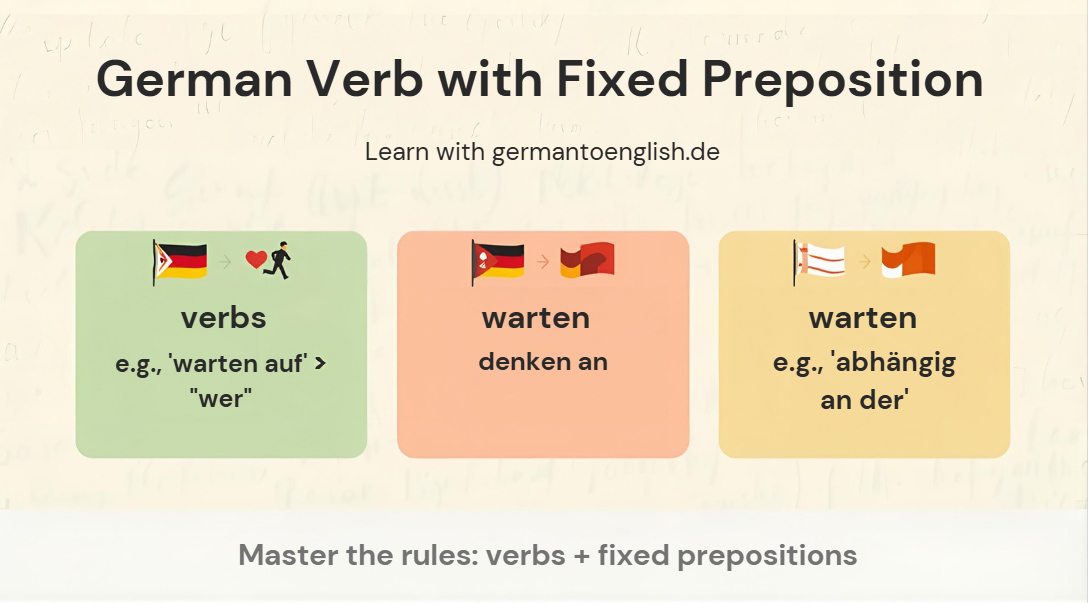
In German, some verbs always require a specific preposition to convey the correct meaning. These are called verbs with fixed prepositions (Verben mit festen Präpositionen). Knowing these combinations is essential for correct sentence construction and natural German.
These verbs cannot be used with just any preposition; they must be paired with a specific preposition. The preposition also determines the case of the object that follows.
Example: warten auf → to wait for (accusative)
| Verb + Preposition | Meaning | Case | Example |
|---|---|---|---|
| warten auf | to wait for | accusative | Wir warten auf den Lehrer. → We are waiting for the teacher. |
| denken an | to think of/about | accusative | Ich denke oft an dich. → I often think of you. |
| teilnehmen an | to participate in | dative | Er nimmt an dem Kurs teil. → He participates in the course. |
| sich freuen auf | to look forward to | accusative | Ich freue mich auf das Wochenende. → I look forward to the weekend. |
| abhängen von | to depend on | dative | Es hängt von dem Wetter ab. → It depends on the weather. |
At germantoenglish.de, you can:
Mastering German verbs with fixed prepositions is essential for fluent and correct German. Memorize the verb-preposition pairings and their cases to form accurate sentences.

 ▼
▼
 Deutsch
  Artikel Quiz
 German Grammar