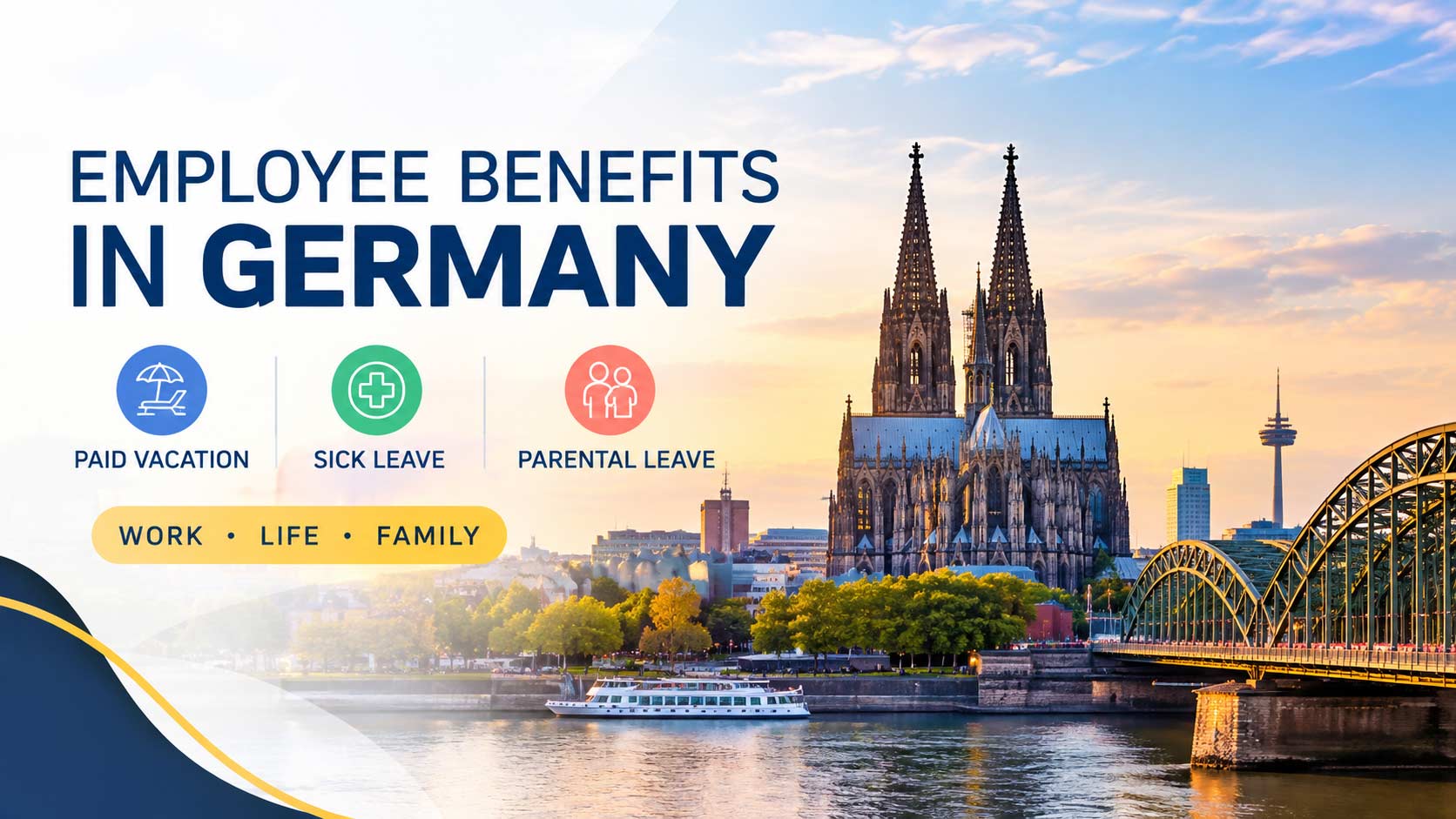
Germany is known for having a comprehensive system of employment protection and social security. For people moving to Germany for work, understanding employee benefits in Germany is just as important as understanding salary, income tax and health insurance.
Employees in Germany generally receive important statutory protections covering paid annual leave, sick leave, public holidays, maternity protection, parental leave and social insurance. In addition, many employers offer extra benefits such as company pensions, bonuses, flexible working hours, remote work, meal allowances, training budgets and additional vacation days.
For international employees, however, the German system can initially seem complicated. Terms such as Urlaub, Krankmeldung, Arbeitsunfähigkeit, Elternzeit and Elterngeld appear frequently in employment contracts and workplace communication.
This guide explains the most important employee benefits in Germany in simple English and introduces the German terms you are likely to encounter at work.
Employee benefits in Germany come from two main sources: statutory rights provided by German law and additional benefits offered voluntarily by an employer.
Statutory employment protections can include:
Germany's official “Make it in Germany” information portal specifically highlights holiday entitlement, parental leave, protection for pregnant and nursing employees, social security and other employment protections as important features of working life in Germany.
One of the most important benefits for employees is paid annual leave, known in German as bezahlter Erholungsurlaub or simply Urlaub.
German law provides a statutory minimum of 24 working days of annual leave based on a six-day working week. Because many employees work five days per week, this statutory minimum is commonly understood as the equivalent of 20 working days for a five-day working week. The Federal Vacation Act also provides rules concerning the acquisition and taking of vacation.
However, many German employment contracts provide considerably more vacation than the legal minimum. It is common to see contracts offering 25, 28, 30 or more vacation days per year, depending on the employer, industry and collective agreement.
Vacation is normally requested from the employer in advance. Employees should not simply stop working because they want to take a holiday. The vacation normally needs to be approved according to the employer's procedures.
German vacation law generally requires employers to consider employees' vacation wishes, although business requirements and the vacation needs of other employees can affect when leave is approved.
For a full-time employee working Monday to Friday, a contract offering 30 vacation days normally means approximately six working weeks of paid vacation during the year.
This is one reason why 30 Urlaubstage is an important phrase to understand when comparing German job offers.
Germany has numerous public holidays, although the exact holidays vary by federal state. A public holiday is known as a Feiertag.
When a public holiday falls on a normal working day and the employee would otherwise have worked, German law generally provides for continued payment of wages for the lost working time under the statutory conditions.
Public holidays are separate from annual vacation days. If you normally work Monday to Friday and a public holiday occurs on a weekday, you generally do not have to use one of your vacation days for that day.
Because public holidays differ between states, employees should check the calendar for their Bundesland. For example, Bavaria, North Rhine-Westphalia, Berlin and Baden-Württemberg do not necessarily have exactly the same public holidays.
Sick leave in Germany is another important employee protection. If you become ill and cannot work, you normally inform your employer that you are unable to work. This is commonly called a Krankmeldung.
Under the Continued Remuneration Act (Entgeltfortzahlungsgesetz), an employee who becomes unable to work because of illness can generally receive continued remuneration from the employer for up to six weeks, provided the legal requirements are met. The statutory entitlement normally arises after four weeks of uninterrupted employment.
This does not mean that an employee can simply take six weeks of paid leave whenever they want. The protection applies when the employee is genuinely unable to work because of illness and the legal conditions are satisfied.
If you are sick, you should follow your employer's notification procedure. Many companies require employees to inform their manager or HR department as soon as possible.
You may also need medical certification of your inability to work depending on the circumstances and the employer's rules. German law contains requirements concerning medical certification and notification of incapacity for work.
A useful German sentence is:
Ich bin krank und kann heute nicht zur Arbeit kommen.
This means: “I am sick and cannot come to work today.”
If an employee remains unable to work after the employer's statutory continued-payment period has ended, income support may in qualifying cases come through the statutory health insurance system in the form of Krankengeld. The exact rules and amount depend on the individual's circumstances and insurance status.
This is an important distinction: paid sick leave from the employer and sickness benefit from health insurance are not the same thing.
Germany provides significant parental protections for employees who want to take time away from work to care for a child.
Parental leave is called Elternzeit in German. Employees can generally take up to three years of parental leave per child. Each parent has their own entitlement, subject to the applicable rules and notification requirements.
Parental leave is important to understand because Elternzeit is generally unpaid leave from the employer. Employees may, however, be able to receive Elterngeld or parental allowance, if they satisfy the relevant conditions.
Elterngeld is a financial benefit designed to compensate for some of the income lost when parents reduce or stop their employment to care for a child.
Elterngeld is different from Elternzeit. You do not automatically receive your normal salary during Elternzeit. Instead, qualifying parents may apply for Elterngeld under the relevant family-benefit rules.
Parents receiving Elterngeld can generally work part-time, but the applicable limit is currently 32 hours per week.
Eligibility for Elterngeld depends on several factors, including caring for the child, living arrangements, employment and income. Foreign nationals can also have additional eligibility conditions depending on their residence status.
Understanding these four terms can make German employment and family paperwork much easier for international workers.
Germany also has specific legal protections for pregnant employees and mothers after childbirth.
The statutory maternity protection period (Mutterschutzfrist) normally begins six weeks before the expected birth and ends eight weeks after the birth. Special rules can apply in cases such as premature births or multiple births.
During the relevant maternity protection period, employees can receive maternity-related payments subject to the applicable conditions. For employees covered by statutory health insurance, maternity benefit and an employer contribution can form part of the income replacement arrangement.
Germany's maternity protection system also includes workplace protections intended to protect the health of the mother and child.
Another major part of the German employment system is social security. Employees who are covered by the statutory system generally contribute through payroll to several social insurance schemes.
The major areas include:
The contributions are generally handled through the payroll system, with employers and employees sharing certain contributions while some insurance costs are structured differently.
This means that an employee's gross salary is not normally the amount that reaches their bank account. Taxes and social insurance contributions are deducted before the employee receives their net salary.
Not every benefit is legally required. Employers frequently use additional benefits to attract and retain employees.
Depending on the company and job, an employment package may include:
These benefits vary considerably between employers. Therefore, when comparing two German job offers, it is useful to look beyond the gross annual salary.
International employees generally benefit from the same statutory employment protections that apply to employees in comparable employment situations. Your residence status, employment contract and insurance situation can affect individual rights and benefits, so it is important to check the rules applicable to your particular situation.
For someone moving to Germany for a skilled job, an Ausbildung position or another form of employment, the employment contract should be read carefully before signing.
Pay particular attention to:
No. It is important to distinguish between statutory employee rights and additional employer benefits.
For example, the legal minimum vacation entitlement applies broadly to employees covered by the relevant legislation, but an employer can offer more vacation days. Similarly, a company may offer a bonus, private health-related benefits, additional pension contributions or flexible working arrangements that are not part of the statutory minimum.
Collective agreements (Tarifverträge) can also provide employment conditions that are more favorable than the statutory minimum in certain industries and workplaces.
| Benefit | German Term | Basic Idea |
|---|---|---|
| Paid vacation | Urlaub | Employees have a statutory minimum entitlement, while many contracts provide more |
| Sick leave | Krankheit / Krankmeldung | Qualifying employees can generally receive continued pay for up to six weeks from the employer |
| Parental leave | Elternzeit | Up to three years per child under the applicable rules |
| Parental allowance | Elterngeld | Financial support for qualifying parents after the birth or adoption of a child |
| Maternity protection | Mutterschutz | Special employment and health protection during pregnancy and after childbirth |
| Health insurance | Krankenversicherung | Part of the German social security system for covered employees |
| Pension insurance | Rentenversicherung | Contributions toward statutory pension protection |
| Unemployment insurance | Arbeitslosenversicherung | Social insurance protection for qualifying unemployment situations |
If you are working in Germany, learning employment-related German vocabulary can make everyday communication much easier.
The statutory minimum is 24 working days based on a six-day working week, equivalent to 20 days for a five-day working week. Many employers provide more than the statutory minimum, often around 25 to 30 days or more depending on the job and employment agreement.
Yes, qualifying employees generally receive continued remuneration from their employer for up to six weeks when they are unable to work because of illness. The statutory entitlement normally begins after four weeks of uninterrupted employment.
Each parent can generally take up to three years of Elternzeit per child, subject to the applicable notification and scheduling rules. Part of the entitlement can be used during the period between the child's third and eighth birthdays.
Elternzeit itself is generally unpaid time away from work. However, qualifying parents may receive Elterngeld, which provides financial support under separate rules.
The normal statutory maternity protection period starts six weeks before the expected birth and ends eight weeks after childbirth. Different rules can apply in special circumstances.
Public holidays are generally separate from annual vacation. The exact public holidays depend on the German federal state where you work and the applicable employment arrangements.
International employees can have statutory employment rights and social insurance protection when they are employed under the relevant German rules. Individual rights can depend on the employment arrangement, residence status, insurance situation and other circumstances.
Employee benefits in Germany extend far beyond salary. Paid vacation, sick-pay protection, social insurance, maternity protection and parental leave form an important part of the German employment system.
For international workers, understanding these benefits can make it easier to evaluate job offers and understand what your German employment contract actually provides.
Remember that statutory benefits are only the starting point. A company may offer additional vacation, bonuses, pension contributions, flexible working, remote work, transportation benefits, professional development and other perks.
When comparing jobs in Germany, therefore, look at the complete employment package rather than comparing gross salary alone. Understanding terms such as Urlaub, Krankmeldung, Elternzeit, Elterngeld, Mutterschutz and Sozialversicherung can also make your transition into the German workplace much easier.
Employment laws and individual circumstances can be complex. If you are unsure about a specific employment-rights question, check the current official rules or obtain advice appropriate to your individual situation.

 ▼
 Deutsch
 Artikel Quiz
 German Grammar