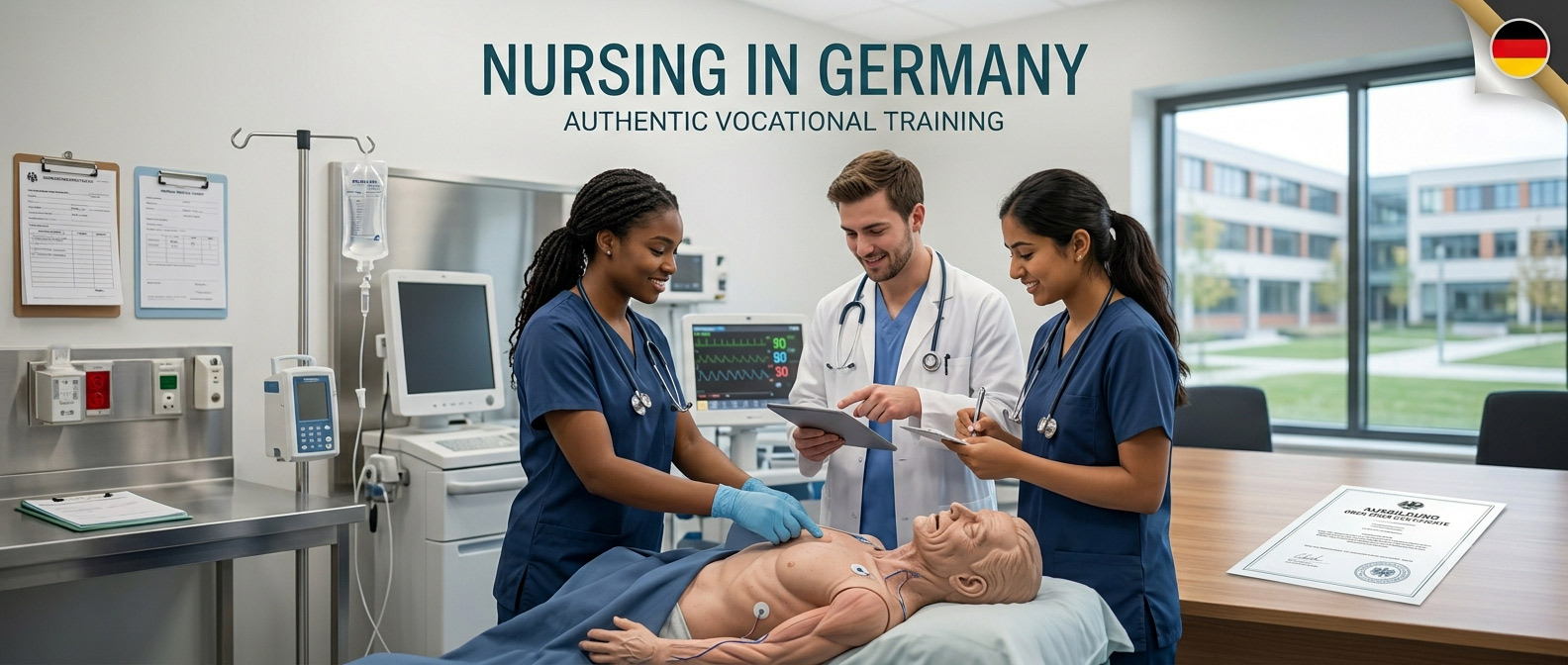
Germany is currently experiencing a significant shortage of qualified healthcare professionals, making Nursing Ausbildung Germany one of the most promising career pathways for international students. Every year, hospitals, rehabilitation centres, elderly care homes and healthcare institutions recruit thousands of nursing trainees from around the world to strengthen the country's healthcare workforce.
Unlike traditional university degree programmes, Nursing Ausbildung combines classroom education with practical hospital training. Students earn a monthly training allowance while gaining valuable hands-on experience, making it an attractive option for those who want to build a healthcare career without paying high tuition fees.
For students from India and many other countries, Nursing Ausbildung offers an opportunity to receive internationally recognised training, secure long-term employment and potentially build a future in Germany.
Nursing Ausbildung is Germany's vocational education and training programme for future nurses. It combines theoretical instruction at a nursing school with practical training in hospitals, nursing homes, rehabilitation centres, outpatient clinics and other healthcare facilities.
The programme prepares students to care for patients of all ages while developing professional medical, technical and communication skills required in modern healthcare.
During the training period, students work under experienced healthcare professionals while gradually taking on greater responsibilities as their knowledge and practical abilities improve.
Germany offers one of the strongest healthcare systems in Europe. Due to an ageing population and increasing demand for healthcare services, qualified nurses remain among the country's most sought-after professionals.
Some of the major advantages include:
International students from many countries can apply for Nursing Ausbildung provided they satisfy the admission requirements established by the training institution, employer and German immigration authorities.
Although requirements may vary slightly between employers, applicants generally need to demonstrate appropriate educational qualifications, language ability and motivation to work in healthcare.
Applicants are generally expected to meet the following conditions before beginning Nursing Ausbildung.
Individual employers may request additional documentation or specific qualifications during recruitment.
The educational requirements depend on your country of education and the policies of the nursing school or employer.
Many international applicants apply after completing:
Some employers may request certified translations or official recognition of educational certificates before admission.
German language skills are essential because nurses communicate with patients, doctors, colleagues and family members every day.
Many employers expect applicants to demonstrate at least a practical level of German before beginning training, although the exact language requirement varies by institution and federal state.
Improving your German beyond the minimum requirement significantly increases your chances of receiving interview invitations and successfully completing the programme.
There is generally no single nationwide maximum age limit for Nursing Ausbildung. However, individual employers may have their own recruitment preferences.
Applicants of different age groups successfully join Nursing Ausbildung every year. Motivation, language ability, educational qualifications and interview performance are usually more important than age alone.
The Nursing Ausbildung programme generally lasts around three years and combines classroom learning with practical clinical training.
Students gradually rotate through different healthcare departments to gain experience in various medical settings.
Typical practical placements may include:
This combination of theory and practical experience prepares graduates for professional nursing careers across Germany.
The curriculum is designed to provide both scientific knowledge and practical healthcare skills.
Students commonly study:
Alongside classroom instruction, students apply these concepts during supervised clinical placements.
Monthly Salary During Nursing Ausbildung (Ausbildungsvergütung)
One of the biggest advantages of Nursing Ausbildung in Germany is that students receive a monthly training allowance while completing their vocational education. Unlike many university programmes where students pay tuition fees, nursing trainees earn an income throughout their training.
The exact amount depends on the employer, collective bargaining agreements, federal state and training year. In most cases, the monthly allowance increases each year as students gain more practical experience and responsibilities.
Applicants should always verify the latest salary information directly with the employer because training allowances are updated periodically.
After successfully completing the programme and obtaining the required professional recognition, graduates can apply for nursing positions throughout Germany.
The salary after qualification depends on several factors, including:
With additional experience, continuing education and specialization, nurses often increase their earning potential and career opportunities.
Applying for Nursing Ausbildung requires careful planning. Although recruitment procedures differ between employers, the overall process generally follows these steps.
Begin by developing your German language skills. Strong communication abilities significantly improve your chances of receiving interview invitations and successfully completing the programme.
Collect your educational certificates, passport, curriculum vitae, language certificates and any additional documents requested by employers.
Identify hospitals, nursing homes, rehabilitation centres and healthcare providers offering Nursing Ausbildung opportunities.
Apply to multiple employers to improve your chances of receiving interview invitations.
Many employers conduct interviews to evaluate your motivation, communication skills and suitability for the profession.
If selected, you will receive a training contract that can be used during the visa application process where applicable.
After receiving the required documents, you can begin the German visa application process through the appropriate German mission in your country.
The required documentation varies depending on your country and employer. However, applicants commonly prepare the following documents.
Indian students should carefully review whether an APS Certificate is required for their particular visa category or educational pathway before applying.
Visa requirements may differ depending on the nature of the programme, the German institution and current immigration regulations. Applicants should always verify the latest requirements through the responsible German Embassy or Consulate before submitting their visa application.
After receiving a training contract from a German employer, eligible applicants can begin the visa application process.
The general procedure usually includes:
Applicants should begin preparing well in advance because visa processing times vary.
One of the major attractions of Nursing Ausbildung is that students generally do not pay the high tuition fees associated with many university programmes.
However, applicants should budget for expenses such as:
Since trainees receive a monthly allowance during Ausbildung, many students can cover a significant portion of their living expenses after arriving in Germany.
Accommodation arrangements vary between employers.
Some hospitals and healthcare organisations assist trainees by providing or helping them locate accommodation, while others expect students to arrange housing independently.
Common accommodation options include:
Nursing is a practical profession and trainees experience real healthcare environments throughout their Ausbildung.
Working schedules may include:
Shift schedules depend on the hospital, department and stage of training.
Opportunities are available throughout Germany at:
Many employers begin recruiting several months before the programme starts, so early preparation increases your chances of securing a training position.
Nursing opportunities are available across Germany, although demand varies by region.
International applicants frequently explore opportunities in states such as:
Instead of focusing only on major cities, consider smaller towns and regional hospitals where demand for healthcare professionals may also be high.
``` ```html id="z4nk8r"
Completing Nursing Ausbildung opens the door to a wide range of healthcare careers in Germany. Due to the country's growing demand for qualified nurses, graduates often find excellent employment opportunities in both public and private healthcare institutions.
After successfully completing the programme and obtaining the necessary professional recognition where applicable, graduates may work in:
With experience and continuous professional development, nurses can advance into senior clinical roles, leadership positions, education, research or healthcare management.
After gaining professional experience, many nurses choose to specialize in a particular healthcare field. Specialization often leads to greater responsibilities and improved career prospects.
Popular nursing specializations include:
Continuous education and specialist training help nurses remain competitive in Germany's evolving healthcare system.
Many international graduates choose to continue working in Germany after completing their Nursing Ausbildung. Depending on the residence permit they hold and the immigration rules in force, long-term employment may create a pathway toward permanent residence.
Eligibility generally depends on factors such as:
As immigration rules may change over time, applicants should always check the latest requirements through the appropriate German authorities.
For many international professionals, Nursing Ausbildung is the first step toward building a long-term future in Germany.
After meeting the legal requirements for long-term residence and fulfilling the applicable nationality laws, some individuals may later become eligible to apply for German citizenship.
Citizenship eligibility depends on the laws in force at the time of application and individual circumstances.
Family reunification depends on your residence status and the immigration regulations applicable to your situation.
Once eligible, many international healthcare professionals are able to apply for family reunification for close family members, subject to the legal requirements in force.
Applicants should always verify the latest immigration rules before making family relocation plans.
German employers look for more than academic qualifications. Successful applicants usually demonstrate a combination of language ability, professionalism and interpersonal skills.
Developing these qualities alongside your language skills can significantly improve your chances of receiving a training offer.
Many applicants delay or weaken their applications by making avoidable mistakes.
Preparing your application carefully and applying early can improve your chances of success.
Nursing Ausbildung is a vocational training programme that combines classroom education with practical hospital experience to prepare students for professional nursing careers.
Most programmes do not charge traditional university tuition fees and trainees generally receive a monthly training allowance from their employer.
Yes. Indian students who meet the educational, language and immigration requirements can apply for Nursing Ausbildung opportunities in Germany.
Yes. Nursing requires regular communication with patients and healthcare teams, making German language skills essential for most programmes.
The Nursing Ausbildung programme generally lasts around three years and combines theoretical learning with practical clinical training.
Yes. Trainees usually receive a monthly training allowance during the programme, although the amount varies depending on the employer and training year.
Yes. Qualified graduates can apply for nursing positions throughout Germany, subject to professional recognition and immigration requirements where applicable.
Long-term qualified employment may provide a pathway toward permanent residence if all legal conditions are satisfied.
There is generally no nationwide maximum age limit, although individual employers may have their own recruitment preferences.
Family reunification depends on your residence status and the immigration rules applicable to your individual situation.
Healthcare vacancies exist across Germany. Instead of focusing only on major cities, applicants should also consider regional hospitals and healthcare providers where demand is often high.
The best option depends on your career goals. Nursing Ausbildung focuses on practical vocational training with paid work experience, while university programmes generally emphasize academic study and research.
Nursing Ausbildung Germany is one of the strongest career pathways for international students who want to build a future in Europe's healthcare sector. The combination of practical training, monthly financial support, internationally respected qualifications and excellent employment opportunities makes it an attractive option for aspiring nurses.
Success begins with careful preparation. Strengthen your German language skills, prepare a professional application, research employers thoroughly and stay informed about the latest visa and immigration requirements. Early planning can significantly improve your chances of securing a training position.
If your goal is to study, work and build a long-term career in Germany, Nursing Ausbildung offers a practical route that combines education, professional experience and the opportunity for long-term career growth.
Explore our detailed guides on Ausbildung programmes, Germany work visas, the EU Blue Card, Opportunity Card, APS Certificate, German language learning, interview preparation and career planning. Whether you are a student, skilled worker or healthcare professional, our resources are designed to help you take the next step toward living and working in Germany.

 ▼
▼
 Deutsch
  Artikel Quiz
 German Grammar