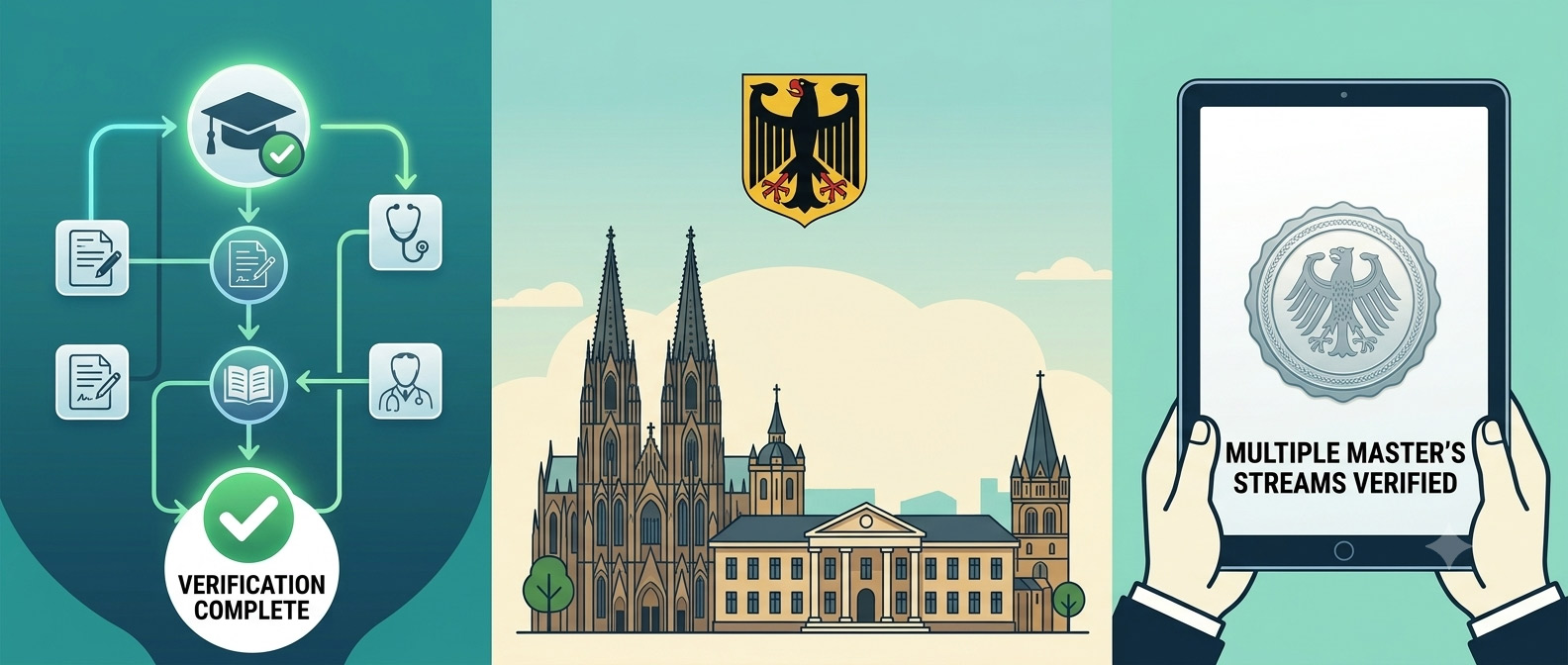
Germany has introduced a new assessment called the Digital Master Assessment Test (dMAT) for certain international students applying for Master's degree programmes. The introduction of the dMAT exam represents one of the biggest changes in Germany's admission process for Indian students in recent years.
If you are planning to pursue a Master's degree in Germany from the Summer Semester 2027 onwards, you may be required to take the dMAT examination depending on your academic background and eligibility. The assessment has been introduced alongside the Academic Evaluation Centre (APS) process to improve transparency, standardize admissions and help German universities evaluate applicants more effectively.
Many students are currently confused about questions such as:
This complete guide explains everything Indian students need to know about the newly introduced dMAT Exam for Germany, including eligibility, registration, syllabus, exam format, preparation tips, frequently asked questions and the latest admission updates.
The Digital Master Assessment Test (dMAT) is an online academic assessment introduced to evaluate the readiness of students applying for selected Master's programmes in Germany. The examination aims to provide universities with a standardized method for assessing applicants from different educational systems.
Unlike university entrance examinations that are conducted individually by institutions, the dMAT offers a common assessment framework that can support admission decisions for eligible applicants.
The examination is primarily associated with students applying through the APS process and is intended to strengthen confidence in academic preparedness while simplifying the evaluation process for German universities.
Germany has become one of the world's most popular destinations for higher education. Every year, thousands of Indian students apply for Master's programmes in engineering, computer science, business, management, artificial intelligence, biotechnology and many other disciplines.
With the increasing number of applications, universities face challenges in comparing students who come from different universities, grading systems and academic backgrounds.
The dMAT examination has been introduced to address these challenges by providing a standardized assessment that measures essential academic skills required for postgraduate studies.
The main objectives include:
The dMAT is not automatically required for every international student. Its applicability depends on factors such as the applicant's educational background, country of application, programme requirements and the policies introduced by APS and participating German institutions.
Indian students planning to apply for eligible Master's degree programmes should carefully review the latest admission requirements before submitting their applications.
Students who may be required to take the dMAT include:
Since the implementation is new, applicants should always verify whether their chosen university and programme require dMAT before starting the admission process.
Not every applicant will need to appear for the dMAT. Certain students may qualify for exemptions depending on their admission cycle, educational qualifications or specific university requirements.
Possible exemptions may include:
As Germany continues to roll out the new assessment, students should regularly check official updates to confirm whether they fall under an exemption category.
One of the biggest misconceptions among students is that the APS Certificate and the dMAT Exam are the same. In reality, they serve different purposes.
The APS Certificate verifies the authenticity of your academic documents and educational qualifications, while the dMAT assesses your academic aptitude and preparedness for postgraduate studies.
Think of them as two separate stages of your journey:
Understanding this distinction helps students prepare for each stage without confusion.
Although the introduction of a new examination may initially seem challenging, it also offers several long-term advantages for applicants.
Students who prepare thoroughly and perform well on the dMAT can demonstrate their readiness for advanced studies in Germany.
The dMAT has been introduced in phases, with implementation linked to specific admission cycles. Indian students planning to begin a Master's programme from the Summer Semester 2027 onwards should closely follow APS announcements and university guidelines to determine whether the assessment applies to them.
As more universities adopt the assessment, its role in the admission process may continue to expand.
The registration process for the dMAT Exam Germany has been designed to be simple and completely online. Students should complete their registration well before university application deadlines to avoid unnecessary stress.
Before beginning the registration process, applicants should ensure they have a stable internet connection, valid identification documents, academic information and access to the email address that will be used throughout the admission process.
A typical registration process includes the following steps:
Students should carefully review every detail before submitting the application because incorrect information may delay the examination process.
Understanding the examination pattern is one of the most important parts of preparing for the dMAT. Since this assessment evaluates academic readiness for Master's studies, candidates should expect questions that measure analytical thinking rather than simple memorization.
The examination focuses on assessing a student's ability to understand information, analyse problems, interpret data and apply logical reasoning in an academic context.
The assessment generally consists of different sections designed to evaluate multiple competencies required for postgraduate education.
Applicants should always refer to the latest official examination guidelines because the structure may evolve as the assessment is further implemented.
The General Academic Module is expected to assess the fundamental abilities required for successful Master's level education regardless of the student's discipline.
This section may include questions that evaluate:
Rather than testing memorized facts, this module focuses on how effectively students analyse information and arrive at logical conclusions.
Depending on the programme and implementation guidelines, some applicants may also encounter subject-specific assessments related to their academic background.
These modules help universities evaluate whether students possess sufficient foundational knowledge for their intended Master's programme.
Examples of disciplines that may include subject-based assessment include:
The exact subject areas may differ depending on future updates and university requirements.
The dMAT examination is designed to evaluate academic competence through objective assessment methods.
Students may encounter different question formats such as:
Since the examination primarily measures reasoning ability, regular practice is more beneficial than attempting to memorize information.
The duration of the examination depends on the official assessment structure for the selected module. Candidates should carefully read the examination instructions provided during registration to understand the total time available.
Time management is an important skill during the examination. Students should avoid spending too much time on a single difficult question and instead maintain a steady pace throughout the assessment.
The dMAT has been introduced as a digital assessment, making the examination process more accessible and efficient for international applicants.
Depending on the examination session and official guidelines, candidates may take the assessment using approved digital platforms under specified examination conditions.
Students should ensure:
Reading all technical instructions before the examination date can help prevent avoidable technical issues.
Unlike traditional university examinations, the dMAT is intended to provide an additional measure of academic preparedness. Universities may use the score alongside other admission criteria rather than relying on it as the only deciding factor.
Admission committees typically consider multiple aspects of an application, including:
Students should therefore focus on building a strong overall application rather than concentrating only on the examination.
Many students ask whether there is a fixed passing mark for the dMAT. Since the assessment supports university admission decisions, score expectations may differ depending on the institution and programme.
Highly competitive Master's programmes may expect stronger overall academic performance, while other programmes may consider the examination as one component of a broader evaluation process.
Applicants should avoid focusing only on minimum scores and instead aim to achieve the highest result possible.
Applicants are generally required to pay the prescribed examination fee during registration. The fee supports examination administration and digital assessment services.
Students should verify the latest fee information before making payment because examination charges may be updated periodically.
When planning your study abroad budget, remember that the dMAT fee is separate from:
Although the dMAT is a newly introduced examination, students can prepare effectively by developing strong analytical and problem-solving skills.
Here are some useful preparation strategies:
Preparing several weeks before the examination generally produces better results than intensive last-minute study.
Since the dMAT is new, many applicants may unintentionally make avoidable mistakes during registration and preparation.
Common mistakes include:
A well-planned preparation strategy can significantly improve both confidence and performance.
Many students believe that the dMAT Exam and the APS Certificate are the same requirement. However, these two serve completely different purposes in the German admission process.
The APS Certificate verifies the authenticity of your educational qualifications, mark sheets, degree certificates and other academic documents. It confirms that your academic credentials are genuine and acceptable for higher education in Germany.
The dMAT Exam, on the other hand, is an academic assessment designed to evaluate your analytical thinking, reasoning ability and readiness for Master's level education.
Simply put:
Understanding the distinction between these requirements helps students prepare effectively and avoid confusion during their study abroad journey.
Another common question is whether the dMAT replaces international admission tests such as the GRE or GMAT.
The answer depends on the university and programme.
Many German universities have historically accepted students without requiring GRE or GMAT scores, while some competitive programmes continue to ask for them. The dMAT has been introduced as a separate assessment for eligible applicants and does not automatically replace other admission requirements.
Applicants should always check the admission criteria of their chosen university before assuming that one examination substitutes another.
| Requirement | Purpose |
|---|---|
| APS Certificate | Academic document verification |
| dMAT | Academic readiness assessment |
| GRE | Programme-specific admission requirement (selected universities) |
| GMAT | Mainly for management and business programmes |
Although the introduction of a new assessment may seem challenging at first, it also offers several advantages for students and universities.
Students who prepare thoroughly may benefit from demonstrating their academic potential through a standardized assessment.
The dMAT is expected to become an important component of the admission process for eligible Master's applicants. However, universities typically evaluate applications using multiple factors rather than relying on a single examination.
Admission committees may consider:
A strong overall application continues to play the most important role in securing admission.
The dMAT is being introduced in phases. Students planning to apply for Master's programmes should stay informed about the latest official announcements because implementation schedules may evolve over time.
Applicants should regularly monitor:
Preparing early allows students to complete every stage of the admission process without unnecessary delays.
The dMAT (Digital Master Assessment Test) is an academic assessment introduced for certain students applying to Master's programmes in Germany. It evaluates analytical and academic readiness for postgraduate studies.
No. The requirement depends on the applicant's programme, university, APS category and the applicable admission rules.
No. APS verifies academic documents, while the dMAT assesses academic ability.
The assessment is primarily associated with eligible Master's programme applicants.
If your university or programme requires the dMAT, you should complete the assessment as instructed. If it is not required, you may not need to take it.
The dMAT is designed as a digital assessment. Candidates should follow the official examination instructions provided during registration.
A good score may strengthen your application, but universities also evaluate academic records, language proficiency, SOP, recommendations and other factors.
Admission expectations may vary between universities and programmes. Applicants should aim for the best possible performance rather than focusing only on minimum scores.
Focus on analytical reasoning, logical thinking, quantitative aptitude, reading comprehension and your undergraduate subject fundamentals.
The examination is part of the admission process for eligible applicants. Student visa approval depends on meeting all visa requirements after receiving university admission.
Students should refer to the latest official examination policy regarding retake opportunities and future examination sessions.
Requirements vary depending on the institution and programme. Always verify the latest admission guidelines of your chosen university.
Work experience is generally not a mandatory requirement for the dMAT itself, although some Master's programmes may value relevant professional experience.
Register as early as possible after confirming that your intended programme requires the assessment. Early registration helps avoid scheduling issues close to application deadlines.
Students should rely on the official APS India website and the admission pages of their chosen German universities for the latest information regarding eligibility, registration, examination sessions and programme-specific requirements.
The introduction of the dMAT Exam Germany marks an important step in the evolution of Germany's international admissions process. Rather than viewing it as an additional obstacle, students should consider it an opportunity to demonstrate their academic abilities through a standardized assessment.
Successful admission to a German university depends on careful planning, strong academic preparation, accurate documentation, timely APS verification and understanding the latest admission requirements. Applicants who begin preparing early are generally in a stronger position to complete every stage of the process with confidence.
As the dMAT continues to be implemented, staying informed through official sources and maintaining a well-organized application will help you maximize your chances of securing admission to your preferred Master's programme in Germany.
If you are planning to study in Germany and need assistance with university selection, APS Certificate, dMAT guidance, admission applications, Statement of Purpose (SOP), Letters of Recommendation (LOR), education loans, blocked account, visa documentation or interview preparation, seeking expert guidance can simplify the process.
Begin your preparation early, stay updated with official announcements and build a strong application to take advantage of the excellent educational opportunities available in Germany.

 ▼
▼
 Deutsch
  Artikel Quiz
 German Grammar