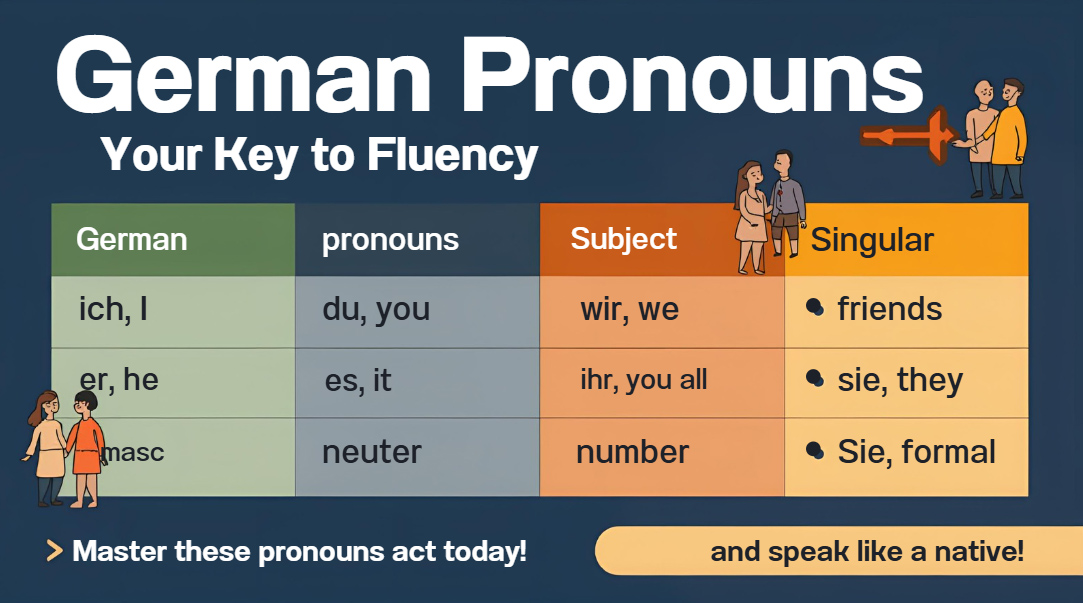
Pronouns are small but powerful words that replace nouns. In German, pronouns change depending on case (Nominative, Accusative, Dative, Genitive), gender and number. On this page, you’ll learn how to use personal, possessive, reflexive, relative and demonstrative pronouns correctly in German sentences.
A pronoun (Pronomen) replaces a noun to avoid repetition. For example:
Instead of saying Der Mann ist nett. Der Mann hilft mir. (The man is nice. The man helps me.), you can say Der Mann ist nett. Er hilft mir. → “He helps me.”
They replace a person or object and change according to the case. Here’s how they look:
| Case | English | Singular | Plural |
|---|---|---|---|
| Nominative | I, you, he/she/it | ich, du, er/sie/es | wir, ihr, sie/Sie |
| Accusative | me, you, him/her/it | mich, dich, ihn/sie/es | uns, euch, sie/Sie |
| Dative | to me, to you, to him/her/it | mir, dir, ihm/ihr/ihm | uns, euch, ihnen/Ihnen |
Examples:
They show ownership or relationship. They agree in gender, number and case with the noun they describe.
| Person | English | German |
|---|---|---|
| 1st Person Singular | my | mein |
| 2nd Person Singular | your | dein |
| 3rd Person Masculine | his | sein |
| 3rd Person Feminine | her | ihr |
| 1st Person Plural | our | unser |
| 2nd Person Plural | your (pl.) | euer |
| 3rd Person Plural / Formal | their / your (formal) | ihr / Ihr |
Examples:
Used when the subject and object are the same person — i.e., the action reflects back on the subject.
| Person | Accusative | Dative |
|---|---|---|
| ich | mich | mir |
| du | dich | dir |
| er/sie/es | sich | sich |
| wir | uns | uns |
| ihr | euch | euch |
| sie/Sie | sich | sich |
Examples:
They connect two sentences and refer to a noun mentioned before (the antecedent). They take the same gender and number as that noun, but the case depends on their function in the relative clause.
| Case | Masculine | Feminine | Neuter | Plural |
|---|---|---|---|---|
| Nominative | der | die | das | die |
| Accusative | den | die | das | die |
| Dative | dem | der | dem | denen |
| Genitive | dessen | deren | dessen | deren |
Examples:
Used to emphasize or point to something specific (similar to “this,” “that,” “these,” “those” in English).
Examples:
Used to ask questions about people or things.
| English | German |
|---|---|
| who | wer |
| whom | wen / wem |
| whose | wessen |
| what | was |
| which | welcher / welche / welches |
Examples:
They refer to people or things in a general way — not specifically identified.
| English | German |
|---|---|
| someone | jemand |
| no one | niemand |
| something | etwas |
| nothing | nichts |
| everyone | alle / jeder |
Examples:
At germantoenglish.de, you can:
German pronouns make your language more natural and fluent. Once you understand how pronouns change with cases and gender, your communication will sound more authentic and confident.

 ▼
▼
 Deutsch
  Artikel Quiz
 German Grammar