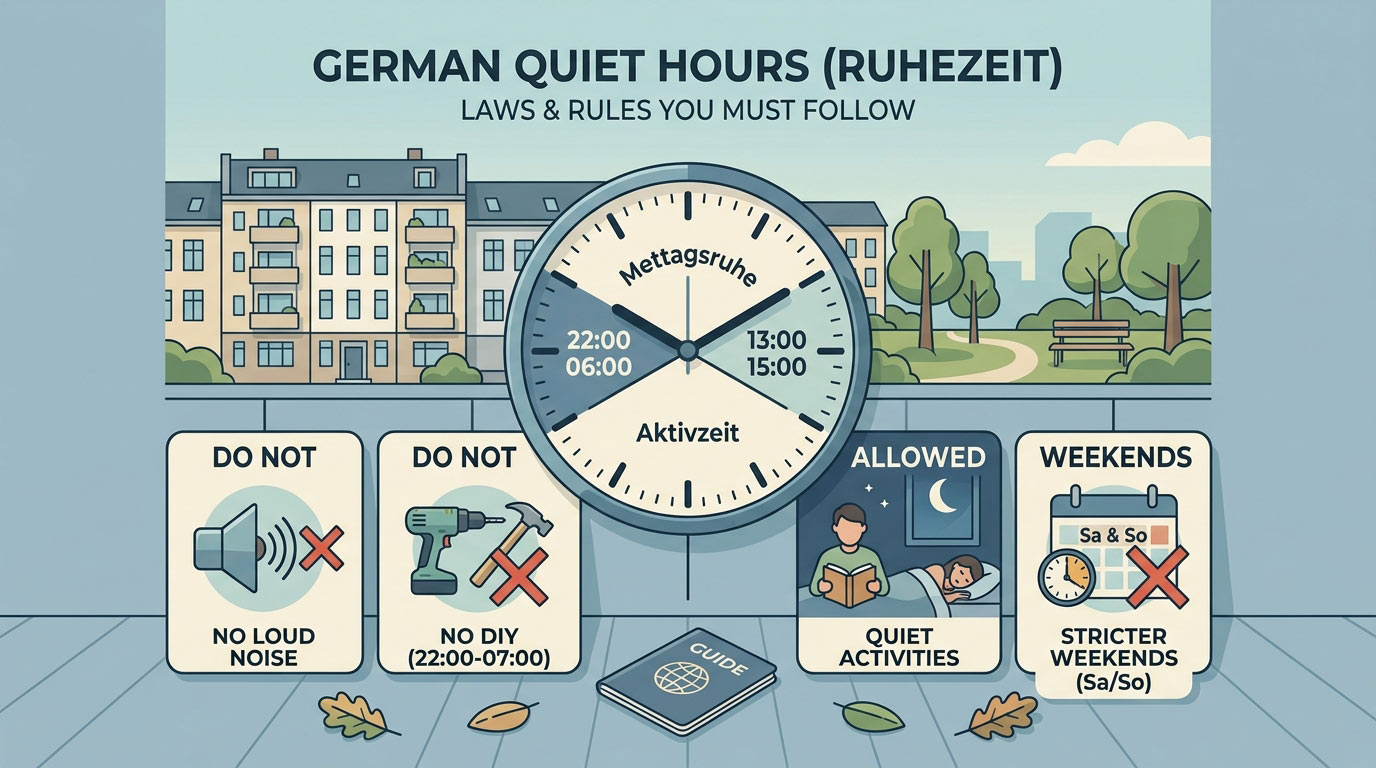
If you are moving to Germany as a student, expat, employee or long-term resident, one of the cultural and legal differences you may notice is the importance placed on quietness in residential areas. Germany is well known for having rules and social expectations concerning noise, particularly during nighttime and on Sundays and public holidays. These periods are often referred to as Ruhezeit, meaning quiet or rest periods.
Understanding German quiet hours is important if you live in an apartment, shared accommodation, student residence or residential neighborhood. Everyday activities such as playing loud music, using power tools, vacuuming, hosting parties or making excessive noise can potentially cause problems with neighbors if they disturb other residents.
However, there is an important point to understand: Germany does not have one single nationwide rule that simply says every person must remain completely silent during exactly the same hours. Different laws, municipal regulations, building rules, rental agreements and local practices can apply depending on the type of noise and location.
This guide explains German quiet hours (Ruhezeit), nighttime quiet hours (Nachtruhe), Sunday and public holiday rules, apartment noise regulations, common sources of complaints and what you should do if you have a problem with a noisy neighbor.
Ruhezeit is a German term commonly used to describe periods when people are expected to avoid unnecessary or disruptive noise. The idea is that residents should be able to rest without being disturbed by excessive noise from neighbors or nearby activities.
Quiet periods are particularly relevant in residential buildings. If you live in an apartment, your neighbors may have different working schedules, young children, elderly family members or other reasons for needing a peaceful environment.
Ruhezeit is therefore both a legal and social concept. Certain noise restrictions are established through laws and regulations, while other expectations may come from house rules, rental agreements or generally accepted standards of consideration between neighbors.
One of the most frequently asked questions by foreigners is: What time are quiet hours in Germany?
A commonly observed nighttime quiet period is approximately 10:00 PM to 6:00 AM, although the exact rules can depend on local regulations, the type of noise and the property.
During nighttime quiet hours, residents are generally expected to keep noise at a level that does not unnecessarily disturb other people. This does not necessarily mean absolute silence. Normal living sounds can still occur, but loud music, parties, shouting and other avoidable disturbances can become problematic.
Some buildings and municipalities may also have additional daytime quiet periods. For this reason, you should always check your rental agreement, building's Hausordnung and local regulations rather than assuming that one nationwide schedule applies everywhere.
Nachtruhe literally refers to nighttime rest. It is particularly important when discussing noise during the night.
The period around 10 PM to 6 AM is commonly treated as nighttime quiet time in Germany, although specific legal provisions can vary according to the situation and location.
During Nachtruhe, you should avoid activities that create significant and unnecessary noise. For example, playing loud music through speakers, having a very loud party or using noisy machinery late at night can disturb neighbors and potentially result in a complaint.
Ordinary household sounds do not automatically become illegal simply because it is nighttime. The important issue is often whether the noise is excessive, avoidable and unreasonable under the applicable rules.
This is an important distinction for anyone researching German quiet hours. There is not one universal nationwide Ruhezeit schedule covering every possible type of noise.
Noise regulation in Germany can involve federal laws, state-level regulations, municipal rules, environmental regulations, tenancy law, building rules and private agreements.
For example, the rules concerning construction noise may be different from the rules concerning loud music in an apartment. Similarly, a municipality may have specific regulations concerning certain noisy activities.
Your rental agreement and Hausordnung may also establish additional rules for your building. These rules can be particularly important for people living in rented apartments or student accommodation.
Respect for quiet periods is deeply connected with residential life in Germany. Apartment buildings can have many households living close together, meaning that noise from one apartment can easily be heard by another.
Quiet periods help residents maintain predictable times for rest. This is particularly important at night, when most people expect to sleep.
Germany also places significant emphasis on the principle of Rücksichtnahme, which can be understood as consideration for other people. Even when a particular activity is not automatically prohibited, residents are generally expected to avoid unnecessarily disturbing their neighbors.
Sundays and public holidays have special significance in Germany. Many businesses are closed and people often use these days for rest and family activities.
However, it would be inaccurate to say that every form of noise is completely prohibited throughout every Sunday in Germany. Normal household life continues and ordinary sounds are not automatically forbidden.
The important issue is unnecessary or excessive disturbance. Activities that create significant noise, particularly activities traditionally associated with work or construction, can be subject to additional restrictions on Sundays and public holidays.
If you have recently moved to Germany, checking your local rules and Hausordnung is the safest approach before carrying out a noisy activity on a Sunday.
Vacuuming is a common concern among people who have just arrived in Germany. There is no simple rule that says vacuum cleaners can never be used during a particular period.
The issue is generally whether the activity creates unreasonable disturbance. A short period of normal household cleaning is different from deliberately creating excessive noise late at night.
Nevertheless, if you live in an apartment building, it is considerate to avoid unnecessarily noisy cleaning activities late at night or very early in the morning.
Washing machines can generate vibration and noise, particularly when operating at high spin speeds. Whether you can use a washing machine during a particular period depends on the circumstances and applicable building rules.
Some apartment buildings have specific Hausordnung provisions concerning washing machines and other noisy household appliances.
If your washing machine causes significant vibration through the floor, consider placing it correctly and using suitable anti-vibration measures. This can reduce disturbance regardless of the time of day.
You can listen to music in your apartment, but the volume matters. During quiet hours, loud music that can clearly be heard by neighbors can lead to complaints.
Headphones are an easy solution if you want to listen to music late at night. If you use speakers, keep the volume at a reasonable level, particularly during nighttime quiet hours.
The same principle applies to televisions, gaming systems, musical instruments and other entertainment equipment.
Having friends over or hosting a party is not automatically prohibited in Germany. However, a party can become a problem when the noise significantly disturbs other residents.
If you are planning a party in an apartment, especially if it will continue into the evening, it is good practice to inform your immediate neighbors beforehand.
After the beginning of nighttime quiet hours, reduce music and conversation volume significantly. Keep windows and balconies in mind because noise can travel considerably farther outside.
Drilling, hammering and using power tools can produce substantially more noise than ordinary household activities. Such work may therefore be subject to stricter restrictions.
Avoid drilling walls, using heavy machinery or carrying out noisy renovation work during nighttime quiet hours. Sunday and public holiday restrictions may also apply depending on the activity and local rules.
If you are renovating a rented apartment, check the rental agreement, Hausordnung and applicable local rules before beginning noisy work.
If you rent an apartment in Germany, one of the most useful documents to understand is the Hausordnung. This is the set of house rules applicable to a residential building or property.
The Hausordnung may contain provisions about quiet periods, shared spaces, laundry rooms, staircases, balconies, waste disposal and other aspects of communal living.
The exact rules vary between buildings. Therefore, two apartments in different parts of Germany may have different house rules.
If you are a student or expat renting accommodation for the first time in Germany, ask the landlord or housing provider for the Hausordnung and read it carefully.
Most disagreements about noise arise from activities that are particularly loud or continue for a long period. Examples include:
Families with children sometimes worry about whether normal sounds from children violate German quiet-hour rules. Children's ordinary play and unavoidable everyday sounds are generally treated differently from deliberate excessive noise.
German law recognizes that children naturally make noise. Parents are not expected to guarantee complete silence in an apartment.
Nevertheless, parents and other residents should still consider their neighbors where reasonably possible. The specific circumstances matter and disputes involving children's noise can be legally and factually different from disputes involving loud music or parties.
If a neighbor complains about noise, the best first step is usually to remain calm and communicate respectfully.
If you were playing loud music, hosting guests or carrying out noisy work, reducing the volume or stopping the activity may resolve the issue immediately.
If you believe the complaint is unreasonable, review your Hausordnung and the applicable rules before escalating the situation. Keeping communication polite can often prevent a minor disagreement from becoming a serious dispute.
If another resident repeatedly creates excessive noise, start by documenting the problem. Note the date, approximate time, duration and type of disturbance.
Where appropriate, you can politely speak with the neighbor and explain how the noise is affecting you. Many disputes can be resolved without formal action.
If the problem continues, tenants can consider contacting their landlord or property management. Depending on the circumstances, further steps may involve local authorities or other dispute-resolution options.
For serious or persistent disputes, particularly where legal rights or tenancy issues are involved, professional legal advice may be appropriate.
International students living in student residences or shared apartments should pay particular attention to quiet hours. Student accommodation can have many people living in close proximity and noise can travel easily through walls and floors.
If you share accommodation, agree with your roommates about reasonable times for studying, sleeping, cooking, gaming and socializing.
Remember that not everyone has the same schedule. A roommate may have an early university lecture or an examination the next morning, while another person may prefer staying awake late.
Expats may find German quiet-hour expectations stricter than what they are accustomed to in their home country. The best approach is to learn the rules of your particular building and observe how your neighbors behave.
If you have recently moved into an apartment, ask about the Hausordnung and whether the building has additional Ruhezeit periods.
Being considerate about noise is especially important when you first move in. Good relationships with neighbors can make apartment living much easier.
You do not need to live in complete silence to be a good neighbor. A few simple habits can significantly reduce the possibility of disputes.
The statement that “everything must be completely silent after 10 PM” is an oversimplification. The commonly recognized nighttime quiet period does not mean that residents cannot make any sound whatsoever after 10 PM.
Normal living activities can continue. The important question is generally whether noise is excessive and whether it unreasonably disturbs other people.
At the same time, the 10 PM guideline should be taken seriously in residential settings. Loud parties, music, drilling and similar activities late at night are much more likely to cause problems.
Quiet hours, commonly referred to as Ruhezeit, are periods when residents are expected to avoid unnecessary or excessive noise. Nighttime quiet hours are commonly associated with approximately 10 PM to 6 AM, but specific rules vary depending on local regulations and circumstances.
Nachtruhe refers to nighttime rest. During nighttime quiet periods, residents are expected to avoid excessive noise that could disturb other people.
Sundays and public holidays receive special protection in Germany and certain noisy activities may be restricted. However, this does not mean that all household sounds are prohibited for the entire day.
There is no universal rule that every use of a vacuum cleaner after 10 PM is automatically illegal. However, because vacuum cleaners can create significant noise, it is generally considerate to avoid unnecessary vacuuming during nighttime quiet hours, particularly in an apartment building.
You can listen to music, but excessive volume that disturbs neighbors can cause problems. During nighttime quiet hours, keep music at a level that does not unreasonably disturb other residents.
Having guests or a party is not automatically prohibited. However, you remain responsible for avoiding unreasonable disturbance to neighbors. Reduce noise during nighttime quiet hours and check your building's Hausordnung.
Drilling is a particularly noisy activity and may be restricted during Sundays or public holidays depending on applicable rules. Check local regulations and your Hausordnung before doing renovation work.
If possible, start with a polite conversation. If the problem continues, document the disturbances and consider contacting your landlord or property management. Serious or persistent disputes may require further assistance.
Understanding German quiet hours (Ruhezeit) is an important part of adapting to everyday life in Germany. The most important principle is simple: avoid unnecessary and excessive noise, particularly during nighttime rest periods and on days when additional restrictions may apply.
The commonly observed nighttime quiet period around 10 PM to 6 AM is a useful guideline, but it should not be treated as a complete description of German noise law. Local regulations, state and federal rules, tenancy agreements and Hausordnung can all affect what is permitted in a particular situation.
If you are an international student, expat or newcomer, check the rules of your building when you move in. Keep music at a reasonable volume, avoid noisy renovation work during restricted periods, be considerate on Sundays and public holidays and communicate respectfully with neighbors.
Once you understand the basic concept of Ruhezeit and Nachtruhe, living in a German apartment becomes much easier. The goal is not complete silence, but consideration for the people living around you.

 ▼
▼
 Deutsch
  Artikel Quiz
 German Grammar