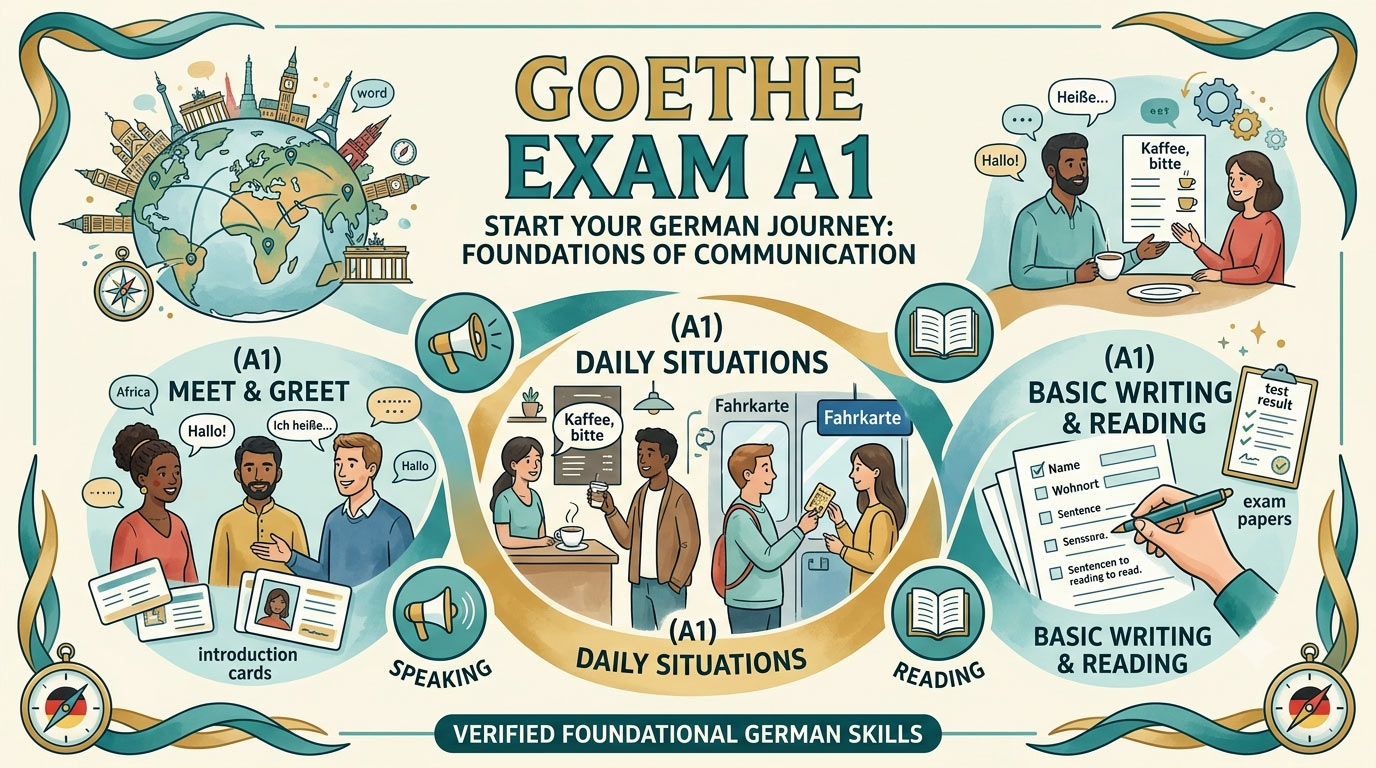
The Goethe Exam A1 is one of the most popular German language examinations for beginners. It is designed for learners who have acquired basic German language skills and can communicate in simple everyday situations.
For many students, the Goethe-Zertifikat A1 is their first official German language examination. It is particularly popular among people who are beginning their German language journey, preparing for certain visa procedures, joining family members in Germany or simply wanting to receive an internationally recognised certificate of their German language ability.
The exam tests four important language skills: listening, reading, writing and speaking. Although the A1 level is considered a beginner level, proper preparation is essential because the examination requires candidates to understand basic German and respond appropriately in different everyday situations.
This complete guide explains the Goethe Exam A1 format, sections, preparation strategy, important vocabulary, grammar topics, common mistakes and practical tips to help you prepare more effectively.
The Goethe Exam A1 is an official German language examination for beginners. The examination measures whether a learner can understand and use very basic German in familiar situations.
At A1 level, candidates are generally expected to communicate about simple topics such as:
The examination focuses on practical communication rather than advanced grammar or complex vocabulary.
The Goethe-Zertifikat A1 is a German language certificate issued after successfully completing the relevant Goethe A1 examination. It confirms that the candidate has achieved basic German language skills.
The certificate may be useful for different purposes depending on an individual's personal circumstances. Some candidates take the exam for personal development, while others may need proof of basic German language knowledge for a specific administrative or immigration-related purpose.
Because requirements can vary depending on the situation, candidates should always verify which language certificate is accepted for their specific purpose.
The Goethe A1 examination is suitable for beginners who have completed an introductory German course or have developed basic German language skills through self-study.
You may consider taking the exam if you:
You do not need to speak German fluently to take the A1 exam. The examination is specifically designed for beginners.
The examination tests four fundamental language skills:
Each section tests a different aspect of basic German communication.
The listening section tests your ability to understand simple spoken German. You may hear short conversations, announcements, telephone messages or other everyday situations.
Typical topics may include:
At A1 level, you do not need to understand every word in the audio. The most important skill is identifying the key information needed to answer the question.
Listen to simple German regularly instead of waiting until the last few weeks before the exam.
Useful practice includes:
Pay special attention to numbers because a single number can completely change the meaning of an answer.
The reading section tests your ability to understand short and simple written German.
You may encounter:
At this level, the texts are generally short and related to familiar everyday situations.
Do not try to translate every word into English. First look for important information such as names, places, times, dates, numbers and keywords.
Understanding the general meaning is often more useful than translating each sentence word by word.
The writing section tests whether you can produce short and simple written communication in German.
Typical tasks may require you to provide personal information or write a short message related to an everyday situation.
You should practise writing:
At A1 level, accuracy is important, but you do not need to write long or complicated texts. Clear and simple German is usually more useful than attempting advanced grammar that you do not understand.
The speaking section is an important part of the Goethe A1 examination. Candidates must demonstrate that they can communicate using basic spoken German.
You may need to:
Common topics include your name, age, country, city, family, hobbies, work, school and daily activities.
“Hallo! Ich heiße Anna. Ich komme aus Indien. Ich wohne in Delhi. Ich bin 22 Jahre alt. Ich lerne Deutsch und spreche Englisch und Hindi.”
This type of simple introduction is suitable for practising basic personal information.
A strong basic vocabulary is essential for passing the Goethe A1 exam. You should focus on common words that appear in everyday communication.
Important vocabulary topics include:
When learning German nouns, always learn the article together with the noun.
Learning vocabulary in this way makes it easier to develop accurate German grammar later.
You do not need to master advanced German grammar for the A1 exam. However, a strong understanding of basic grammar is important.
Important topics include:
Focus on understanding how grammar works in simple sentences rather than trying to memorise complicated rules without examples.
The time required to prepare for the Goethe A1 exam depends on your previous language learning experience, study routine and the amount of time you can dedicate to German each day.
A complete beginner may need several months of regular study to develop a strong foundation.
A consistent daily routine may include:
Regular practice is generally more effective than studying for many hours only once a week.
The most effective preparation strategy combines all four language skills. Do not focus only on vocabulary or grammar.
During your preparation:
Regular mock tests can help you become familiar with the question style and reduce exam-day anxiety.
A structured study plan can make your exam preparation much easier. Instead of studying randomly, divide your time between vocabulary, grammar, listening, reading, writing and speaking.
A simple weekly routine may look like this:
You do not need to study for many hours every day. Consistent practice is more important than spending a long time studying once or twice a week.
Memorising isolated German words can be difficult. Instead, try to learn words through short sentences and everyday situations.
For example, instead of learning only:
essen = to eat
Learn:
Ich esse gern Pizza.
Similarly, instead of memorising:
Bahnhof = train station
Learn:
Wo ist der Bahnhof?
Learning vocabulary in context helps you remember how words are actually used in real communication.
Numbers, dates, prices, telephone numbers and times are extremely important for beginner German learners.
Make sure you can understand and say:
Practise listening to numbers because they can sometimes be difficult to understand when spoken quickly.
Introducing yourself is one of the most important speaking skills at A1 level.
Prepare information about:
For example:
Ich heiße Rahul. Ich bin 24 Jahre alt. Ich komme aus Indien und wohne in Delhi. Ich spreche Hindi und Englisch. Ich lerne Deutsch. Meine Hobbys sind Musik und Fußball.
Practise your introduction until you can speak naturally without memorising every sentence word for word.
The speaking section may require you to ask or answer simple questions.
Practise questions such as:
Also practise answering these questions using complete but simple sentences.
Knowing common question words is essential for the Goethe A1 exam.
Understanding these question words can help you quickly understand what information a question requires.
Basic communication often involves making requests. Practise useful expressions that can be used in everyday situations.
These expressions are useful because they can be applied in many different situations.
Listening can be difficult for beginners because native speakers may pronounce words faster than expected.
To improve your listening:
Do not become discouraged if you do not understand everything during your first listening attempt. Repeated listening gradually improves recognition.
Reading practice should focus on short everyday texts rather than difficult German books.
Practise reading:
When reading, look for important information instead of translating every word.
Writing becomes easier when you practise common sentence structures.
Practise writing short messages about:
Always check basic details such as word order, verb position, spelling and capitalisation of German nouns.
You do not need complicated German to communicate at A1 level. The most important thing is to speak clearly and respond appropriately.
Practise speaking by:
Speaking regularly helps reduce hesitation and makes simple German sentences easier to produce.
Many beginners make the same mistakes while preparing for the examination.
A balanced preparation plan is much more effective than focusing on only one skill.
Interactive quizzes can make vocabulary and grammar practice more engaging. Instead of only reading word lists, test yourself regularly.
Useful practice activities include:
Active testing helps you identify which words and grammar topics require additional revision.
Before taking the exam, make sure you can:
If you can comfortably handle these situations, you are building the practical foundation required for the A1 level.
```htmlPractice tests are one of the best ways to prepare for the Goethe A1 examination. They help you become familiar with the structure of the exam and show you which areas require more practice.
When completing a practice test, try to follow realistic exam conditions:
Do not simply check whether an answer is correct or incorrect. Try to understand why you made the mistake. This makes your future preparation much more effective.
The day before the examination should not be spent trying to learn hundreds of new words. Instead, focus on light revision and preparation.
You can revise:
Try to get enough sleep and prepare everything you need for the examination in advance.
Staying calm can help you perform better during the examination. Read or listen to each question carefully before answering.
Useful exam-day tips include:
Remember that the A1 examination is designed for beginners. You are not expected to communicate like an advanced German speaker.
The best way to prepare for the Goethe Exam A1 is to build a balanced study routine. Many learners focus too much on vocabulary and grammar while neglecting listening, writing or speaking.
A successful preparation strategy should include:
Consistency is more important than studying a large amount of material in a short period.
There is no single exact number of vocabulary words that guarantees success in the Goethe A1 examination. However, learners should develop a basic vocabulary covering common everyday situations.
Instead of focusing only on a specific number of words, concentrate on vocabulary related to:
Learning the most useful words and knowing how to use them in simple sentences is more valuable than memorising a large list without understanding their usage.
The Goethe Exam A1 is a beginner-level German language examination that tests basic listening, reading, writing and speaking skills.
The exam is designed for beginners. With regular preparation and practice in all four language skills, many learners can develop the necessary abilities to take the examination confidently.
The preparation time depends on your previous experience, study schedule and daily practice. A complete beginner may require several months of consistent learning.
Yes. Many learners use textbooks, online resources, vocabulary tools, listening materials and practice tests to prepare independently. A teacher or course can also provide additional structure and feedback.
Yes. You need to understand basic grammar, including sentence structure, verbs, articles, pronouns, questions and simple negation.
Yes. Learning nouns together with their articles is highly recommended. For example, learn der Tisch, die Lampe and das Buch instead of memorising only the noun.
Practise introducing yourself, answering basic questions, asking for information and making simple requests. Speaking with a language partner or recording yourself can also be helpful.
Listen to simple German conversations regularly. Focus on recognising names, numbers, times, dates, places and other important information.
Focus on everyday vocabulary related to family, food, shopping, travel, work, school, home, hobbies, time, dates and personal information.
Both are important. Vocabulary allows you to understand and express ideas, while basic grammar helps you construct understandable sentences.
Yes. Apps, quizzes, flashcards, vocabulary exercises and online learning resources can supplement your preparation. However, make sure you practise all four exam skills.
Daily practice is ideal. Even 30 to 60 minutes of focused study each day can be more effective than occasional long study sessions.
Yes. Mock tests help you understand the exam format, practise time management and identify areas where you need additional preparation.
Yes. A1 is a beginner level. You are not expected to speak German fluently, but you should be able to communicate using basic words and simple sentences.
Stay calm and try to explain the idea using simpler words that you know. Basic communication is more important than using complicated vocabulary.
The Goethe Exam A1 is an important first milestone for anyone learning German. It provides a structured goal and helps learners measure their basic German language skills.
Successful preparation requires more than memorising vocabulary lists. You should practise listening, reading, writing and speaking regularly. Learn useful everyday vocabulary, understand basic grammar, practise common situations and complete mock tests before the examination.
Do not worry about making mistakes while learning. Mistakes are a natural part of language learning. With consistent practice and a well-organised study plan, you can gradually build the confidence needed to communicate in basic German.
Whether you are learning German for personal development, future study, work, travel or another purpose, the Goethe A1 level provides a strong foundation for progressing to A2, B1 and higher levels.
After preparing for the Goethe A1 exam, continue building your German skills through vocabulary practice, grammar exercises, reading activities, listening practice, interactive quizzes and speaking exercises.
Regular exposure to German will help you remember new words, understand sentence structures and gradually communicate with greater confidence.

 ▼
▼
 Deutsch
  Artikel Quiz
 German Grammar