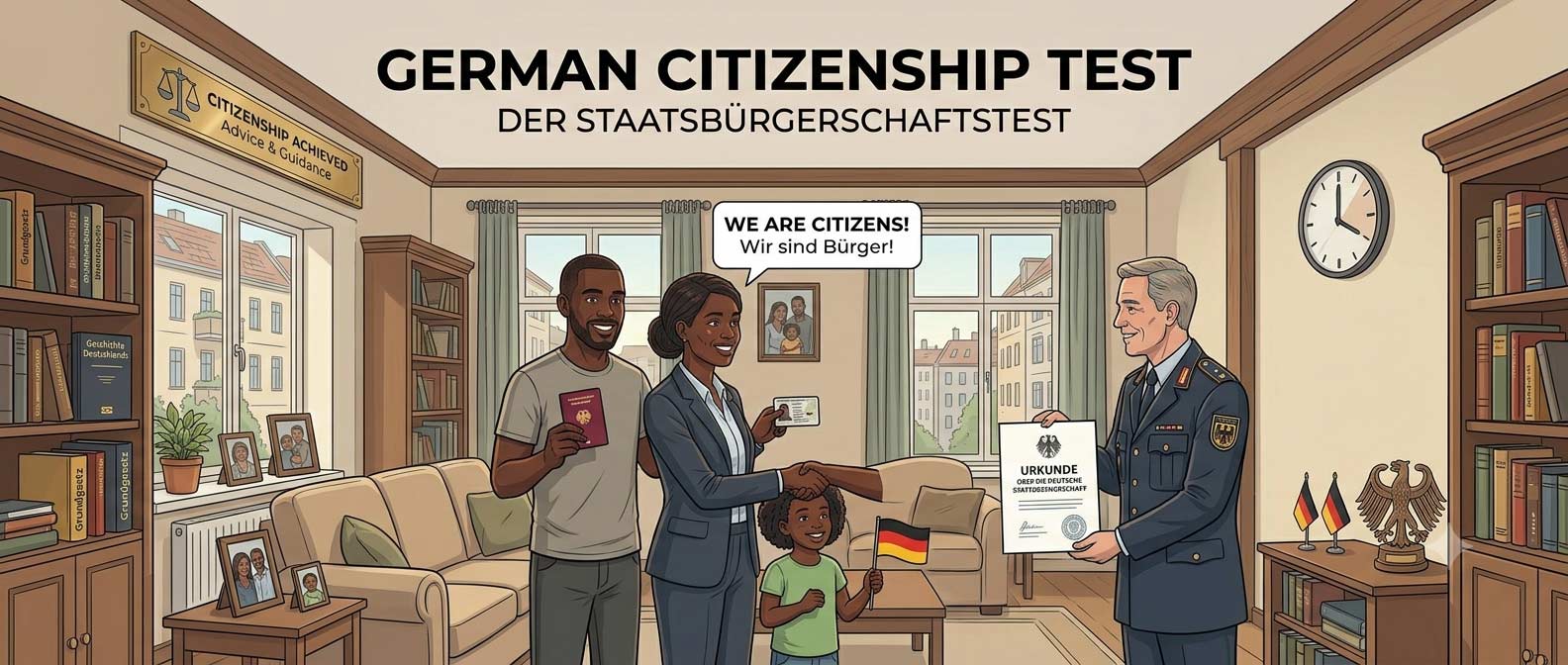
Obtaining German citizenship is a significant milestone for many international residents who have built their lives in Germany. Becoming a German citizen provides numerous benefits, including the right to vote, unrestricted access to the German labour market, visa-free travel to many countries and the ability to hold one of the world's most respected passports. One important step in the naturalization process is passing the German Citizenship Test, officially known as the Einbürgerungstest.
The test is designed to assess whether applicants have sufficient knowledge of Germany's legal system, democratic values, history and society. Contrary to what many people believe, the examination is not intended to be difficult. Instead, it ensures that future citizens understand the country's constitution, civic responsibilities and everyday social structure. With proper preparation, most applicants successfully pass the examination on their first attempt.
In this guide, you'll learn everything you need to know about the German Citizenship Test, including who must take it, the exam format, passing score, registration process, preparation strategies and practical tips to help you become a German citizen.
The German Citizenship Test, commonly called the Einbürgerungstest, is an official examination required for many applicants seeking German citizenship through naturalization. The test measures your understanding of Germany's political system, constitutional principles, rights and responsibilities of citizens, cultural values and important historical events.
The examination is administered by authorized testing centres throughout Germany and follows a standardized format nationwide. Every applicant receives a randomly selected set of questions from the official question bank published by the Federal Office for Migration and Refugees (BAMF). Successfully passing the examination demonstrates that you possess the civic knowledge expected of future German citizens.
Most foreign nationals applying for German citizenship through naturalization are required to pass the German Citizenship Test. The requirement generally applies to adults who have legally lived in Germany for the necessary qualifying period and meet the remaining naturalization requirements.
Although many applicants must complete the examination, there are exceptions. Individuals who have completed certain German school qualifications or who cannot take the examination because of medical conditions, disabilities or other legally recognized reasons may be exempt. Your local naturalization authority can determine whether an exemption applies in your particular case.
Passing the citizenship test alone does not automatically make someone eligible for German citizenship. Applicants must satisfy several legal requirements before their naturalization application can be approved. Although regulations may change over time, the authorities generally assess whether applicants have successfully integrated into German society and can support themselves financially.
Because immigration laws may change, applicants should always verify the latest requirements with the appropriate German authorities before submitting their application.
The examination follows a straightforward multiple-choice format and is designed to evaluate general civic knowledge rather than advanced academic understanding. Candidates answer questions by selecting the correct option from several possible answers.
The questions cover different aspects of German society, including constitutional law, democratic institutions, citizens' rights, elections, history, responsibilities, education, religion and everyday life. Some questions relate specifically to the federal state where the applicant lives, while the remaining questions are common across Germany.
The German Citizenship Test contains 33 multiple-choice questions. Out of these, 30 questions relate to Germany's political system, society, laws, history and democratic values, while the remaining 3 questions focus specifically on the applicant's federal state (Bundesland).
Each question has four possible answers, but only one answer is correct. Candidates simply select the option they believe is correct. The examination is paper-based or computer-based depending on the testing centre, but the question format remains the same throughout Germany.
To successfully pass the German Citizenship Test, applicants must answer at least 17 out of 33 questions correctly. This means you only need slightly more than half of the answers to be correct in order to pass the examination successfully.
Since all official questions are publicly available before the examination, candidates who spend time preparing usually find the test quite manageable. Many people practice using the official question catalogue several times before their scheduled examination date.
Candidates are generally given 60 minutes to complete the examination. Most applicants finish much earlier because the questions are relatively short and straightforward. Those who have prepared using practice questions often complete the test within 20 to 30 minutes.
Although there is sufficient time available, it is still advisable to read each question carefully before selecting an answer. Some questions appear similar but test different aspects of German law or society.
The examination requires a registration fee, which is determined by the responsible authorities. Applicants must register through an approved testing centre before taking the examination. Payment is generally made during registration and candidates receive confirmation of their examination date and location.
Because examination fees and administrative procedures may occasionally change, applicants should confirm the latest information with their selected testing centre before registering.
The German Citizenship Test is offered at numerous authorized examination centres across Germany. Adult education centres (Volkshochschulen), language institutes, educational organizations and other approved institutions regularly conduct the examination throughout the year.
Since available dates vary by location, it is advisable to register several weeks in advance. Popular testing centres in larger cities often fill quickly, particularly during periods when many applicants are preparing to submit their naturalization applications.
The questions in the Einbürgerungstest are drawn from an official question bank published by the Federal Office for Migration and Refugees (BAMF). Rather than testing advanced academic knowledge, the examination focuses on whether applicants understand the basic principles of German democracy, society and everyday civic life. Candidates who regularly follow current affairs and spend time practicing the official questions generally find the examination straightforward.
The questions are divided into several subject areas to ensure applicants possess a broad understanding of life in Germany. Some questions assess knowledge that every resident should know, while others relate specifically to the federal state (Bundesland) where the applicant lives.
Although the actual examination contains randomly selected questions, practicing sample questions helps candidates understand the format and level of difficulty. Every question has four answer choices, with only one correct answer.
Since the official question catalogue is publicly available, applicants can practice all possible questions before the examination. This greatly increases the likelihood of passing on the first attempt.
For most applicants, the German Citizenship Test is considered relatively easy compared to language examinations such as Goethe, TELC or TestDaF. The questions focus on practical civic knowledge rather than complex legal or historical analysis. Anyone who spends a few weeks reviewing the official question bank can usually pass without difficulty.
The biggest challenge is often unfamiliarity with Germany's political institutions and constitutional system rather than the questions themselves. Learning how elections work, understanding the separation of powers and becoming familiar with important historical events usually provides sufficient preparation.
Preparation is the key to success. Since every examination question comes from the official catalogue, candidates should concentrate on understanding the published questions rather than memorizing isolated facts. Studying consistently for a short period each day is generally far more effective than attempting to learn everything at once.
Many successful applicants prepare by reading about German history, watching educational videos, completing online mock tests and practicing official questions repeatedly until they become familiar with the answer patterns.
Although the examination is not particularly difficult, some applicants fail simply because they underestimate it. Skipping practice tests, relying only on general knowledge or ignoring state-specific questions can reduce your chances of passing.
Creating a simple revision schedule and practicing a few questions each day usually produces much better results than studying intensively at the last minute.
After successfully passing the German Citizenship Test, you receive an official certificate confirming that you have met the civic knowledge requirement for naturalization. This certificate becomes part of your citizenship application and should be submitted together with the other required documents.
Passing the test does not automatically grant German citizenship. The responsible naturalization authority will continue reviewing your application, including your residence status, language proficiency, financial situation and other legal requirements before making a final decision.
The examination contains 33 multiple-choice questions, including 30 general questions and 3 questions related to your federal state.
You must answer at least 17 questions correctly to pass the examination.
No. The examination is conducted in German because applicants are generally expected to demonstrate German language proficiency as part of the naturalization process.
Yes. Applicants who do not achieve the required passing score may register again and retake the examination.
No. The citizenship test measures your knowledge of Germany's legal system, history, society and democratic values, while language examinations assess your German communication skills.
The German Citizenship Test (Einbürgerungstest) is an important milestone on the journey toward becoming a German citizen. Fortunately, it is designed to assess practical civic knowledge rather than advanced academic expertise, making it achievable for well-prepared applicants. By understanding the examination format, practicing the official question catalogue and becoming familiar with Germany's democratic system and history, most candidates can pass confidently on their first attempt.
If you are planning to settle permanently in Germany, preparing for the citizenship test is only one part of your journey. Strong German language skills will help you integrate into society, communicate confidently in everyday situations and improve your career opportunities. At GermanToEnglish.de, you'll find vocabulary lists, grammar guides and practical learning resources that can strengthen your German while preparing you for life, work and eventually German citizenship.

 ▼
▼
 Deutsch
  Artikel Quiz
 German Grammar