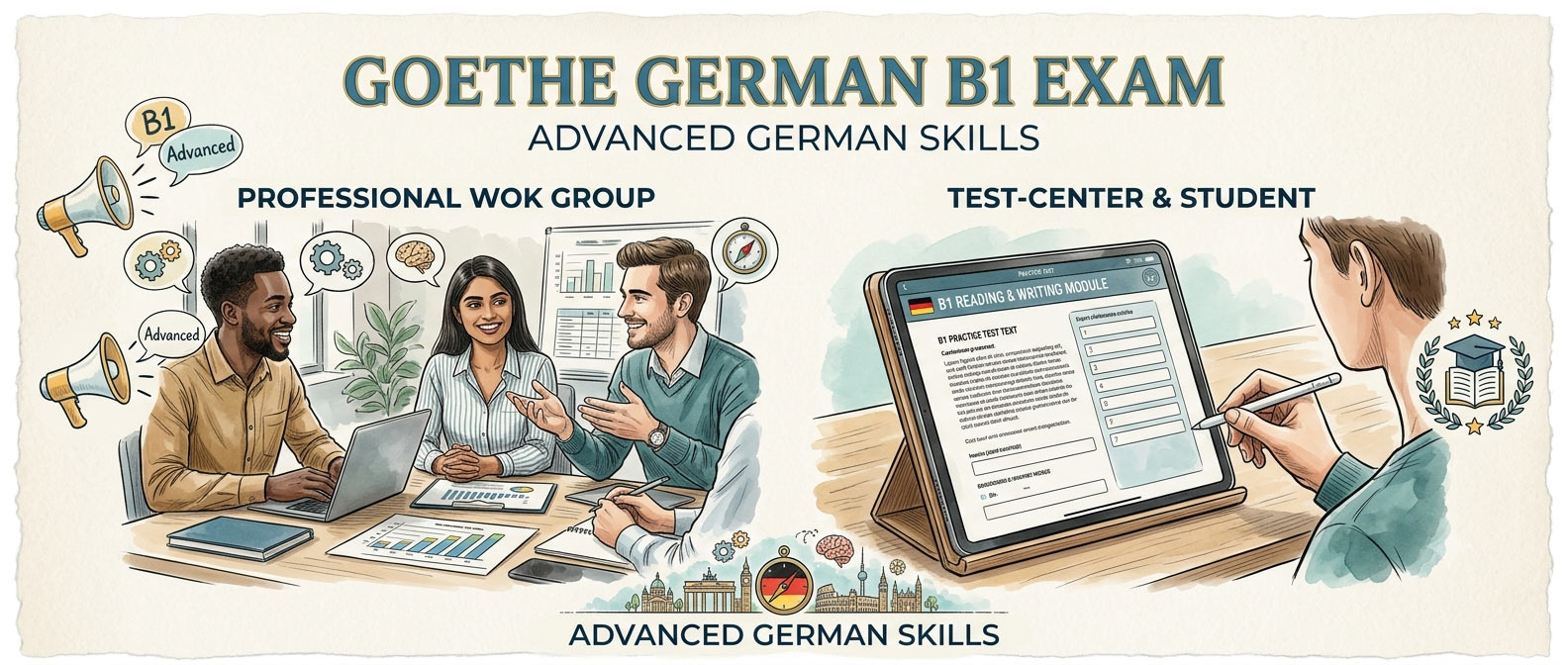
The Goethe German B1 Exam is an important milestone for learners who have progressed beyond basic German and are developing independent communication skills. The Goethe-Zertifikat B1 confirms that a learner can understand the main points of clear standard German and communicate about familiar topics in everyday, professional and personal situations.
Compared with A1 and A2, the B1 level requires a significant improvement in vocabulary, grammar, listening comprehension, reading ability, writing and speaking. Learners should be able to express their opinions, describe experiences, explain plans, understand the main ideas of longer texts and participate in conversations about familiar subjects.
The Goethe B1 examination tests four important language skills: reading, listening, writing and speaking. A successful preparation strategy should therefore develop all four skills instead of focusing only on grammar or vocabulary.
This complete guide explains the Goethe German B1 Exam, including the exam sections, important grammar topics, vocabulary areas, preparation strategies, speaking and writing practice, common mistakes and useful tips for exam preparation.
The Goethe German B1 Exam is an official German language examination for learners who have reached an intermediate level of German. It assesses whether candidates can communicate independently in familiar situations and understand the main ideas of standard German communication.
At B1 level, learners should generally be able to:
B1 represents an important transition from basic communication to more independent use of the German language.
The Goethe-Zertifikat B1 is an official German language certificate that demonstrates German language ability at the B1 level of the Common European Framework of Reference for Languages, commonly known as the CEFR.
The certificate can be an important milestone for learners who want to demonstrate their German language progress for personal, educational, professional or other purposes.
Specific language requirements can vary depending on the purpose for which a certificate is needed. Therefore, candidates should always verify the current requirements of the relevant organisation or authority.
The Goethe B1 examination is suitable for learners who have completed the A2 level and can already communicate in German about familiar everyday topics.
You may consider taking the Goethe B1 Exam if you:
Before registering for the exam, it is useful to complete practice tests and honestly evaluate your abilities in reading, listening, writing and speaking.
The Goethe B1 Exam tests four main language skills:
Each section evaluates a different aspect of your ability to understand and use German independently.
The reading section tests your ability to understand different types of written German. At B1 level, texts are generally longer and more detailed than those found in A1 and A2 examinations.
You may encounter texts such as:
You may need to identify the main idea, understand specific information, recognise opinions or match information with the correct text.
Regular reading is one of the most effective ways to prepare for the B1 level.
Practise reading:
Do not stop every time you find an unfamiliar word. Try to understand the general meaning from the context before checking a dictionary.
The listening section tests your ability to understand spoken German in everyday and familiar situations.
At B1 level, you should gradually become comfortable listening to German spoken at a natural but understandable speed.
Possible topics include:
You may need to understand the main idea of a conversation, identify specific details, recognise opinions or understand the relationship between speakers.
Listening practice should be a regular part of your study routine.
Useful activities include:
Try to listen to the same recording more than once. During the first attempt, focus on the general meaning. During the second attempt, concentrate on important details.
The writing section tests your ability to write connected German about familiar topics.
At B1 level, you should be able to:
Useful linking words include:
Using linking words helps you connect ideas and create more natural and organised writing.
Meiner Meinung nach ist es wichtig, regelmäßig Sport zu treiben, weil Sport gesund ist. Außerdem kann man sich nach dem Sport besser entspannen.
This example expresses an opinion and provides a reason using simple but connected German.
The speaking section evaluates your ability to participate in conversations and speak about familiar topics.
You may need to:
At B1 level, it is important to move beyond short answers. You should try to explain your ideas using several connected sentences.
Meiner Meinung nach ist es eine gute Idee, mehr öffentliche Verkehrsmittel zu benutzen. Dadurch kann man Geld sparen und die Umwelt schützen. Außerdem gibt es in vielen Städten gute Bus- und Bahnverbindungen.
This type of answer includes an opinion, reasons and supporting information.
A strong vocabulary is essential for success in the Goethe B1 Exam. You should be able to understand and discuss a wide range of everyday subjects.
Important vocabulary areas include:
Do not learn vocabulary only as isolated translations. Learn words with example sentences and related expressions.
For example:
Learning related words helps you express yourself more flexibly.
At B1 level, you should have a solid understanding of basic German grammar and be able to use more complex sentence structures.
Important grammar topics include:
Grammar should support communication. Try to use new grammar structures in speaking and writing instead of studying rules without practical application.
The amount of time required to prepare for the Goethe B1 Exam depends on your current level, previous study experience, daily practice and exposure to German.
A learner who has recently completed A2 may need several months of consistent preparation to develop B1-level communication skills.
A useful daily study routine may include:
The exact schedule can be adjusted according to your personal goals and available time.
Regular daily practice is generally more effective than studying intensively only shortly before the examination.
A successful preparation strategy should develop all four language skills.
During your preparation:
Do not focus only on grammar exercises. The B1 examination evaluates your ability to communicate and understand real language.
At B1 level, vocabulary learning should become more active and contextual.
Instead of memorising only:
entscheiden = to decide
Learn useful expressions such as:
Learning common word combinations can make your German sound more natural and help you communicate more confidently.
Expressing opinions is an important B1 skill. Practise giving your opinion about familiar topics.
Useful expressions include:
Try to support your opinion with a reason.
For example:
Ich denke, dass Deutschlernen wichtig ist, weil man dadurch bessere Möglichkeiten für Arbeit und Studium hat.
At B1 level, you should be able to explain why you have a particular opinion.
Practise using:
For example:
Ich fahre gern mit dem Fahrrad, weil es gesund und umweltfreundlich ist. Außerdem kann man damit Geld sparen.
Connecting ideas helps you produce more complete and natural answers.
Before taking the examination, make sure you can:
These skills form an important foundation for B1-level German communication.
Speaking is one of the most important skills to practise when preparing for the Goethe B1 Exam. At B1 level, you should be able to communicate your ideas using connected sentences rather than only short answers.
Practise speaking about:
Try to explain your ideas using a simple structure:
For example:
Meiner Meinung nach ist Sport sehr wichtig. Ich denke, dass regelmäßige Bewegung gesund ist. Zum Beispiel kann man jeden Tag spazieren gehen oder Fahrrad fahren. Deshalb sollte jeder versuchen, aktiv zu bleiben.
This type of structure helps you speak more clearly and organise your thoughts.
As part of B1 preparation, practise speaking about a familiar topic for a short period of time.
You can prepare topics such as:
A simple presentation structure can be:
Practise speaking without reading every sentence from a script. Using short notes or keywords can help you speak more naturally.
At B1 level, you should practise responding to another person's ideas. A conversation is not only about speaking; it also involves listening and responding appropriately.
Useful expressions include:
These expressions can help you participate more naturally in discussions.
Writing practice should focus on expressing ideas clearly and connecting sentences logically.
Practise writing:
Before writing, take a few moments to plan your answer. Decide what you want to say in the introduction, main part and conclusion.
A simple structure may include:
Using a clear structure can make your writing easier to understand.
Linking words help you connect your ideas and make your writing more organised.
Important expressions include:
For example:
Ich lerne Deutsch, weil ich in Deutschland studieren möchte. Außerdem interessiere ich mich für die deutsche Kultur. Deshalb versuche ich, jeden Tag Deutsch zu lernen.
Practise using these expressions in your own sentences.
Listening to German regularly is essential for B1 preparation. You should gradually become comfortable with different speakers and everyday topics.
Useful listening activities include:
Do not worry if you cannot understand every word. Focus first on the general meaning and important information.
When listening, pay attention to:
Reading regularly can significantly improve vocabulary and sentence comprehension.
Try reading:
When reading a text, first try to understand the general topic. Then look for specific information.
It is not necessary to understand every word to understand the main message of a text.
Topic-based vocabulary learning can be especially useful for B1 preparation.
For example, when studying the topic of the environment, learn related vocabulary together:
Then practise using the vocabulary in sentences.
Wir sollten mehr Energie sparen, um die Umwelt zu schützen.
This approach helps you remember words and use them actively in speaking and writing.
Practice tests are an important part of exam preparation. They help you understand the structure of the examination and practise working within a time limit.
When taking a mock test:
Do not only count your score. Analyse your mistakes and identify patterns.
For example, you may discover that you regularly make mistakes with:
Once you know your weak areas, you can focus your preparation more effectively.
Many learners make avoidable mistakes during their preparation.
Clear communication is more important than trying to use language that is far beyond your current level.
Vocabulary revision is essential because the number of words you need to understand increases significantly at B1 level.
Useful methods include:
When learning a new noun, learn its article and plural form whenever possible.
For example:
die Entscheidung – die Entscheidungen
Also learn useful combinations:
eine Entscheidung treffen
This can help you use vocabulary more naturally.
Good preparation can help you feel more confident on examination day.
Remember to:
If you forget a word while speaking, try to explain the meaning using other words. Communication does not always require perfect vocabulary.
Before taking the exam, make sure you can:
The Goethe German B1 Exam is an official examination that tests intermediate German language skills in reading, listening, writing and speaking.
The exam can be challenging for learners who have only basic German knowledge. However, consistent preparation and regular practice in all four language skills can help you prepare more effectively.
The time required varies depending on your current German level, study routine, previous learning experience and exposure to the language. Learners who have completed A2 may need several months of regular preparation.
Yes. You can use textbooks, online resources, listening materials, reading practice, vocabulary tools, mock tests and speaking practice to prepare independently.
Important areas include subordinate clauses, relative clauses, adjective endings, cases, prepositions, perfect tense, simple past of common verbs, future forms, conditional structures and other common intermediate grammar topics.
Learn vocabulary by topic and practise using new words in sentences. Active recall, spaced repetition, reading, listening and regular speaking can help you remember vocabulary more effectively.
Practise expressing opinions, giving reasons, describing experiences, making suggestions, discussing familiar topics and presenting ideas in connected sentences.
Practise writing emails, opinions, personal experiences, suggestions and short arguments. Use linking words to connect your ideas logically.
Listen to German regularly using conversations, podcasts, videos, interviews and learner-level audio. Focus on understanding the main idea and important details.
Yes. Regular reading helps improve vocabulary, comprehension, grammar awareness and familiarity with different types of written German.
Yes. Mock tests help you understand the exam format, practise time management and identify your strengths and weaknesses.
There is no single exact vocabulary number that guarantees success. You should focus on developing a broad vocabulary that allows you to communicate about familiar everyday, personal, educational, professional and social topics.
Yes. B1 is an intermediate level, not an advanced fluency level. You should be able to communicate clearly, express ideas and understand the main points of familiar communication.
Stay calm and continue communicating. Small mistakes are a normal part of language learning. If possible, correct the mistake and continue speaking.
The Goethe German B1 Exam is an important step toward independent German communication. At this level, learners move beyond simple everyday sentences and begin expressing opinions, explaining reasons, describing experiences and discussing a wider range of topics.
The best way to prepare for the Goethe-Zertifikat B1 is to practise consistently across all four language skills. Improve your vocabulary through context, read German regularly, listen to different types of spoken German, practise writing connected texts and speak about familiar topics as often as possible.
Do not focus exclusively on grammar. Although grammar is important, the goal of the B1 level is to use German for meaningful communication.
Mock tests can help you understand the examination format, while regular revision can help you identify and improve your weaknesses. With a structured study plan and consistent practice, you can gradually build the skills and confidence required for the Goethe B1 Exam.
After reaching B1 level, many learners continue toward B2 and higher levels, where they develop greater fluency, more advanced vocabulary and the ability to communicate about increasingly complex topics.
After preparing for the Goethe B1 Exam, continue improving your German through vocabulary practice, grammar exercises, reading, listening, writing, speaking and interactive quizzes.
Regular practice is the key to developing stronger German language skills and becoming more confident in real-life communication.

 ▼
▼
 Deutsch
  Artikel Quiz
 German Grammar