German Inseparable Verbs – Usage and Examples
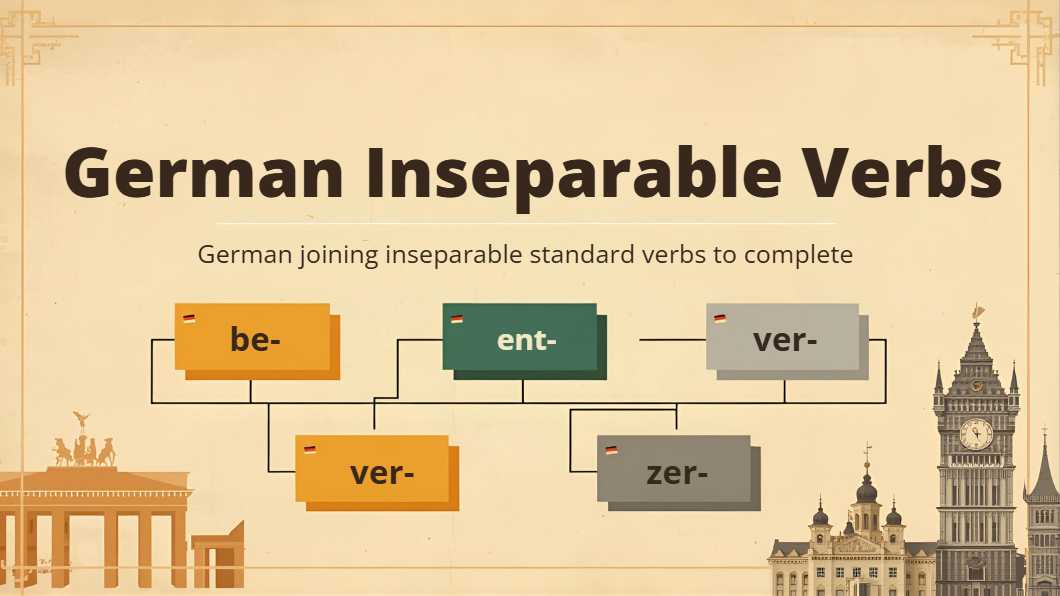
Inseparable verbs (untrennbare Verben) in German are verbs with prefixes that never separate from the verb. Unlike separable verbs, the prefix always stays attached, regardless of the sentence structure. Learning inseparable verbs is essential for correct sentence construction.
1. What Are Inseparable Verbs?
Inseparable verbs consist of a prefix and a main verb. The prefix remains with the verb in all tenses and positions in the sentence.
Common inseparable prefixes include:
- be- → often changes verb to transitive
- ent- → removal or beginning of an action
- er- → completion or result of an action
- ver- → change, mistake or transformation
- zer- → destruction or splitting
2. Examples of Inseparable Verbs
- verstehen → to understand → Ich verstehe Deutsch.
- entdecken → to discover → Wir entdecken die Stadt.
- bekommen → to receive → Er bekommt ein Geschenk.
- zerstören → to destroy → Das Feuer zerstört das Haus.
- erklären → to explain → Sie erklärt die Regeln.
3. Conjugation Rules
Inseparable verbs are conjugated like normal verbs. The prefix always stays attached to the verb stem:
- Ich verstehe, du verstehst, er/sie/es versteht
- Wir verstehen, ihr versteht, sie/Sie verstehen
4. Placement in Sentences
Unlike separable verbs, inseparable verbs never split, even in main or subordinate clauses:
- Main clause: Ich verstehe die Aufgabe. → I understand the task.
- Subordinate clause: Ich weiß, dass ich die Aufgabe verstehe. → I know that I understand the task.
5. Common Mistakes to Avoid
- Trying to separate the prefix from the verb (wrong: *Ich stehe auf verstehen*).
- Confusing separable and inseparable verbs.
- Using the wrong prefix to change the meaning of a verb.
Learn, Translate & Move with Confidence
At germantoenglish.de, you can:
- Learn German grammar step by step
- Translate words and examples instantly
- Understand real-life sentence patterns
- Prepare for A1 to B2 exams with clarity
Summary
Mastering inseparable verbs is crucial for correct German sentence structure. Remember that the prefix always stays attached and practice common verbs in context to improve fluency.

 ▼
▼
 Deutsch
  Artikel Quiz
 German Grammar