German Conjunctions – Coordinating and Subordinating
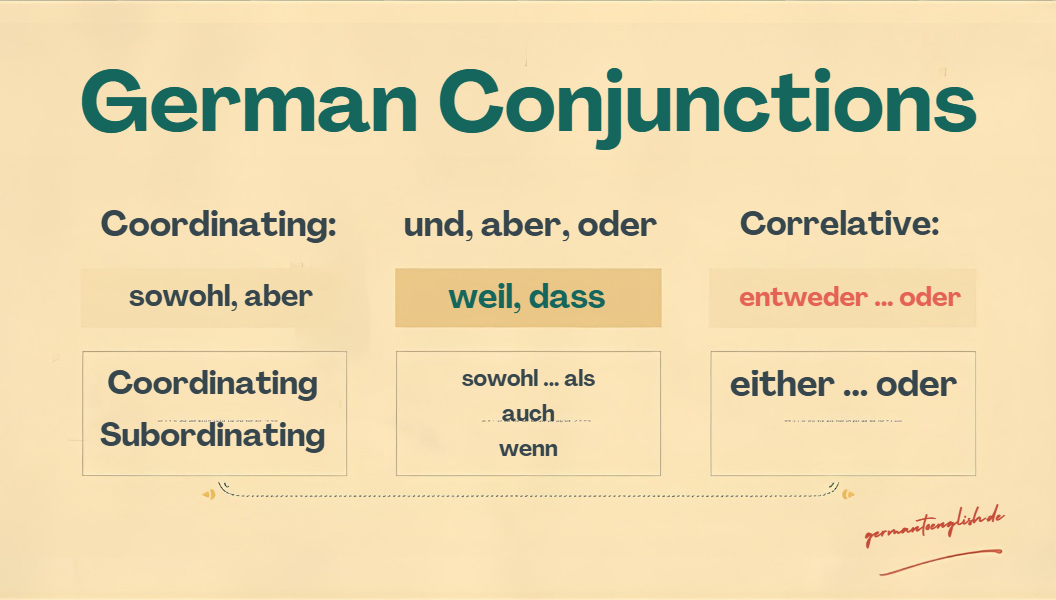
Conjunctions (Konjunktionen) are words that connect clauses, phrases or words in German. They help you form complex sentences and show relationships between ideas. On this page, you will learn about coordinating, subordinating and correlative conjunctions with examples.
1. What Are German Conjunctions?
Conjunctions connect words, phrases or sentences. They answer questions like and, but, because or although.
Example: Ich lerne Deutsch, und mein Bruder lernt Englisch. → I learn German and my brother learns English.
2. Types of German Conjunctions
2.1 Coordinating Conjunctions (Nebenordnende Konjunktionen)
These connect clauses or words of equal importance. They do not change the word order.
- und – and
- oder – or
- aber – but
- denn – because, for
- sondern – but rather
Example: Ich mag Kaffee, aber ich trinke lieber Tee. → I like coffee, but I prefer tea.
2.2 Subordinating Conjunctions (Unterordnende Konjunktionen)
These connect a dependent clause to a main clause. They send the conjugated verb to the end in the subordinate clause.
- weil – because
- dass – that
- wenn – if, when
- ob – whether
- als – when (past)
- bevor – before
- nachdem – after
- obwohl – although
Example: Ich bleibe zu Hause, weil es regnet. → I stay at home because it is raining.
2.3 Correlative Conjunctions (Korrelative Konjunktionen)
These always appear in pairs to connect two elements.
- sowohl ... als auch – both ... and
- weder ... noch – neither ... nor
- entweder ... oder – either ... or
Example: Ich mag sowohl Äpfel als auch Birnen. → I like both apples and pears.
3. Placement Rules
- Coordinating conjunctions do not change the word order.
- Subordinating conjunctions send the conjugated verb to the end of the clause.
- Correlative conjunctions must be used in pairs and correspond to the elements they connect.
4. Common Mistakes to Avoid
- Using a subordinating conjunction but keeping normal word order (wrong).
- Mixing up coordinating and subordinating conjunctions.
- Forgetting to pair correlative conjunctions correctly.
Learn, Translate & Move with Confidence
At germantoenglish.de, you can:
- Learn German grammar step by step
- Translate words and examples instantly
- Understand real-life sentence patterns
- Prepare for A1 to B2 exams with clarity
Summary
German conjunctions are essential for forming complex and coherent sentences. Mastering coordinating, subordinating and correlative conjunctions will improve both your writing and speaking skills.

 ▼
▼
 Deutsch
  Artikel Quiz
 German Grammar