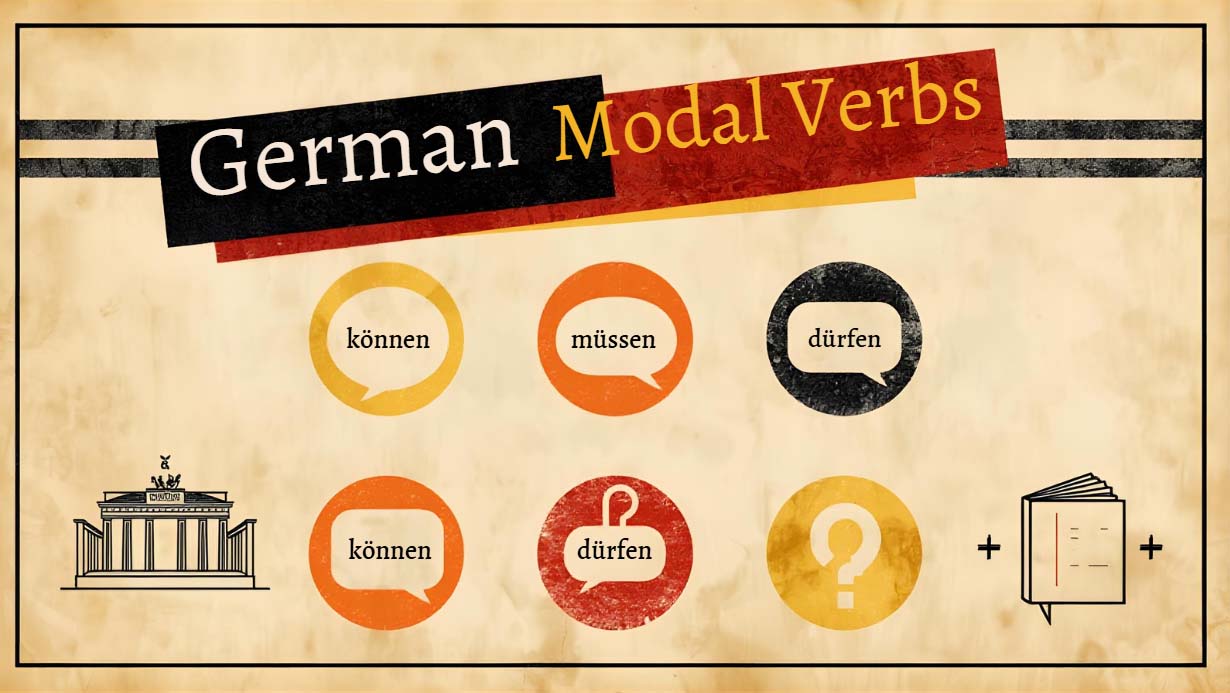
Mastering the six essential modal verbs that will transform your German speaking abilities
Modal verbs (Modalverben) are special helping verbs in German that express ability, permission, obligation, desire or possibility. Unlike regular verbs, they modify the meaning of the main verb in a sentence and follow specific conjugation patterns. The six core modal verbs are: dürfen, können, mögen, müssen, sollen, and wollen.
Think of them as the "mood setters" of German sentences—they tell us not just what happens, but how it happens: whether someone is allowed to do something, able to do it, must do it or wants to do it.
Primary Meaning: Permission, prohibition or allowance
Conjugation (Present Tense):
| Pronoun | Conjugation | English Equivalent |
|---|---|---|
| ich | darf | I may / am allowed to |
| du | darfst | you may (informal singular) |
| er/sie/es | darf | he/she/it may |
| wir | dürfen | we may |
| ihr | dürft | you may (informal plural) |
| Sie/sie | dürfen | you/they may (formal/plural) |
Usage Examples:
Common Mistakes: Don't confuse "dürfen" (permission) with "können" (ability). "Ich darf schwimmen" means "I'm allowed to swim," while "Ich kann schwimmen" means "I know how to swim."
Primary Meaning: Ability, possibility or skill
Conjugation (Present Tense):
| Pronoun | Conjugation | English Equivalent |
|---|---|---|
| ich | kann | I can |
| du | kannst | you can |
| er/sie/es | kann | he/she/it can |
| wir | können | we can |
| ihr | könnt | you can |
| Sie/sie | können | you/they can |
Usage Examples:
Special Note: "Können" is also used for polite requests: "Könnten Sie mir helfen?" (Could you help me?)
Primary Meaning: Liking something or expressing preference
Conjugation (Present Tense):
| Pronoun | Conjugation | English Equivalent |
|---|---|---|
| ich | mag | I like |
| du | magst | you like |
| er/sie/es | mag | he/she/it likes |
| wir | mögen | we like |
| ihr | mögt | you like |
| Sie/sie | mögen | you/they like |
Usage Examples:
Important: The subjunctive form "möchten" (would like) is used more frequently than "mögen" for expressing desires politely.
Primary Meaning: Necessity, obligation or requirement
Conjugation (Present Tense):
| Pronoun | Conjugation | English Equivalent |
|---|---|---|
| ich | muss | I must |
| du | musst | you must |
| er/sie/es | muss | he/she/it must |
| wir | müssen | we must |
| ihr | müsst | you must |
| Sie/sie | müssen | you/they must |
Usage Examples:
Negation: "Nicht müssen" means "don't have to" (lack of necessity), while "nicht dürfen" means "must not" (prohibition).
Primary Meaning: Obligation, duty or suggestion
Conjugation (Present Tense):
| Pronoun | Conjugation | English Equivalent |
|---|---|---|
| ich | soll | I should |
| du | sollst | you should |
| er/sie/es | soll | he/she/it should |
| wir | sollen | we should |
| ihr | sollt | you should |
| Sie/sie | sollen | you/they should |
Usage Examples:
Cultural Note: "Sollen" often implies external expectations or moral obligations, unlike "wollen" which expresses personal desires.
Primary Meaning: Intention, desire or strong want
Conjugation (Present Tense):
| Pronoun | Conjugation | English Equivalent |
|---|---|---|
| ich | will | I want |
| du | willst | you want |
| er/sie/es | will | he/she/it wants |
| wir | wollen | we want |
| ihr | wollt | you want |
| Sie/sie | wollen | you/they want |
Usage Examples:
Politeness Tip: "Wollen" can sound direct; "möchten" is more polite for requests: "Ich möchte..." instead of "Ich will..."
Modal verbs follow specific word order rules in German sentences:
| Structure Type | Pattern | Example | English Translation |
|---|---|---|---|
| Basic Statement | Subject + Modal Verb + Other Elements + Main Verb (infinitive) | Ich kann heute nicht kommen. | I cannot come today. |
| Yes/No Question | Modal Verb + Subject + Other Elements + Main Verb | Kannst du morgen arbeiten? | Can you work tomorrow? |
| Negation | Subject + Modal Verb + "nicht" + Other Elements + Main Verb | Ich darf nicht rauchen. | I am not allowed to smoke. |
| W-Question | W-Word + Modal Verb + Subject + Other Elements + Main Verb | Was willst du essen? | What do you want to eat? |
Modal verbs have two past tense forms in German:
| Tense | Usage | Formation | Example | Translation |
|---|---|---|---|---|
| Simple Past (Präteritum) | Written German, formal speech, narratives | Modal verb conjugated in past tense | Ich konnte gestern nicht kommen. | I couldn't come yesterday. |
| Present Perfect (Perfekt) | Spoken German, informal conversation | haben + Modal Verb (infinitive) + Main Verb (infinitive) | Ich habe nicht kommen können. | I couldn't come. |
Simple Past Conjugation Examples:
| Modal Verb | Simple Past (ich form) | Simple Past (wir form) |
|---|---|---|
| dürfen | durfte | durften |
| können | konnte | konnten |
| mögen | mochte | mochten |
| müssen | musste | mussten |
| sollen | sollte | sollten |
| wollen | wollte | wollten |
| Common Mistake | Correction | Explanation |
|---|---|---|
| Forgetting the infinitive at the end | Ich kann Deutsch sprechen. (not: Ich kann spreche Deutsch.) | The main verb always goes to the end in modal verb constructions |
| Confusing dürfen and können | Ich darf schwimmen. (I'm allowed to swim) Ich kann schwimmen. (I know how to swim) |
dürfen = permission, können = ability |
| Using wollen instead of möchten | Ich möchte Kaffee. (polite) Ich will Kaffee. (direct/childlike) |
möchten is more polite for requests |
| Wrong word order in questions | Kannst du mir helfen? (not: Du kannst mir helfen?) | Modal verb comes first in yes/no questions |
| Incorrect perfect tense formation | Ich habe kommen können. (not: Ich habe gekommen können) | Both modal and main verb stay infinitive in perfect tense |
| English Sentence | Required Modal Verb | German Translation |
|---|---|---|
| You must finish your homework. | müssen | Du musst deine Hausaufgaben beenden. |
| May I use your phone? | dürfen | Darf ich dein Telefon benutzen? |
| She can play the piano. | können | Sie kann Klavier spielen. |
| We would like to order. | möchten | Wir möchten bestellen. |
| They want to visit Berlin. | wollen | Sie wollen Berlin besuchen. |
| He should call his mother. | sollen | Er soll seine Mutter anrufen. |
Mastering German modal verbs is crucial for expressing yourself accurately in German. Remember that these verbs not only have specific meanings but also follow particular grammatical patterns. The key to mastery is practice—try creating your own sentences with each modal verb, pay attention to their usage in German media and don't be afraid to make mistakes. With time, using dürfen, können, mögen, müssen, sollen and wollen will become second nature.
Keep practicing and soon you'll be using German modal verbs with confidence!

 ▼
▼
 Deutsch
  Artikel Quiz
 German Grammar