German Imperative Sentences: Complete Guide to Commands and Requests
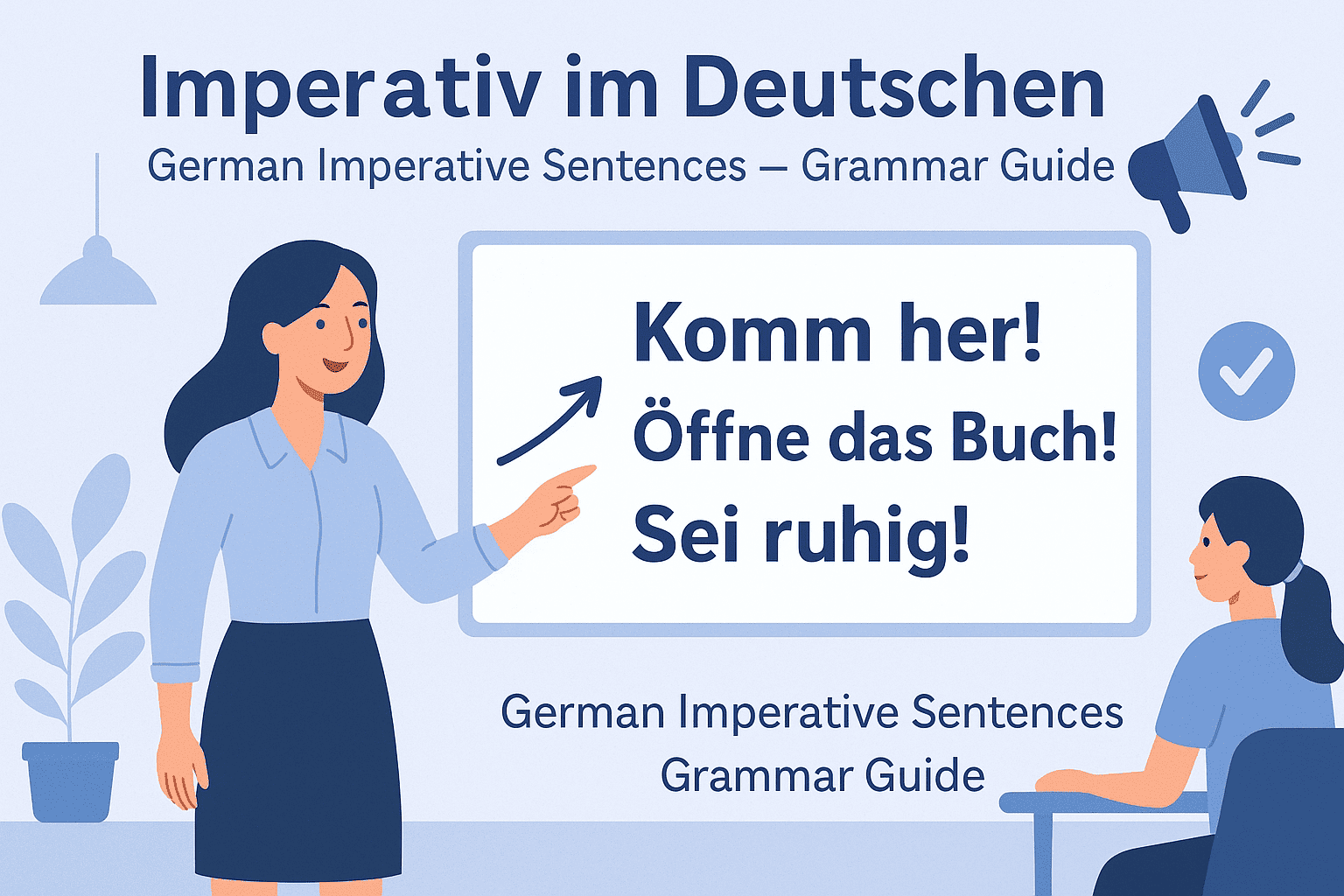
Imperative Sentences in German
Imperative sentences (Imperativsätze) in German are used to give commands, make requests, offer instructions or give advice directly to someone. Unlike English, German has different imperative forms depending on whether you're addressing someone formally or informally and whether you're speaking to one person or multiple people.
The German imperative is crucial for everyday communication, from giving directions to making polite requests. Understanding the different forms and when to use them is essential for speaking German naturally and appropriately.
The Three Main Imperative Forms in German
1. Informal Singular (du-Form)
Used when speaking to one person you're familiar with (friends, family, children):
- Mach deine Hausaufgaben! - Do your homework!
- Komm her! - Come here!
- Lies das Buch! - Read the book!
- Sei ruhig! - Be quiet!
2. Informal Plural (ihr-Form)
Used when speaking to multiple people you're familiar with:
- Macht eure Hausaufgaben! - Do your homework!
- Kommt her! - Come here!
- Lest das Buch! - Read the book!
- Seid ruhig! - Be quiet!
3. Formal (Sie-Form)
Used when speaking to one or multiple people formally (strangers, superiors, elders):
- Machen Sie Ihre Hausaufgaben! - Do your homework!
- Kommen Sie her! - Come here!
- Lesen Sie das Buch! - Read the book!
- Seien Sie ruhig! - Be quiet!
Forming the German Imperative
Basic Formation Rules
du-Form (Informal Singular)
- Take the stem of the verb
- Remove the -st ending from the present tense
- For strong verbs, sometimes the stem vowel changes
- Examples: du machst → mach!, du liest → lies!
ihr-Form (Informal Plural)
- Use the normal present tense form
- Simply use the verb as it appears with "ihr"
- Examples: ihr macht → macht!, ihr lest → lest!
Sie-Form (Formal)
- Use the formal "Sie" form from present tense
- Place "Sie" after the verb
- Examples: Sie machen → machen Sie!, Sie lesen → lesen Sie!
Special Cases and Irregularities
Verbs with Vowel Changes
Some verbs change their stem vowel in the du-form imperative:
- lesen (to read): du liest → Lies!
- essen (to eat): du isst → Iss!
- geben (to give): du gibst → Gib!
- nehmen (to take): du nimmst → Nimm!
- sprechen (to speak): du sprichst → Sprich!
Verbs Ending in -ern or -eln
These verbs often drop the -e in du-form imperative:
- ändern (to change): Ändere/Änder das!
- handeln (to act): Handle/Handel schnell!
- klingeln (to ring): Klingle/Klingel an der Tür!
sein (to be) - Highly Irregular
- du-form: Sei ruhig!
- ihr-form: Seid ruhig!
- Sie-form: Seien Sie ruhig!
haben (to have) and werden (to become)
- haben (du-form): Hab Geduld!
- werden (du-form): Werde nicht nervös!
Adding "bitte" for Politeness
Position of "bitte"
"Bitte" (please) can be placed in different positions to make commands more polite:
- Beginning: Bitte, komm hierher!
- Middle: Komm bitte hierher!
- End: Komm hierher, bitte!
- Formal: Kommen Sie bitte herein!
Negative Imperative Forms
Using "nicht" and "kein"
To form negative commands in German:
- du-form: Mach das nicht! - Don't do that!
- ihr-form: Macht das nicht! - Don't do that!
- Sie-form: Machen Sie das nicht! - Don't do that!
- With kein: Iss kein Fleisch! - Don't eat meat!
The "wir" Imperative (Let's...)
Forming Suggestions
To suggest doing something together (equivalent to "Let's..." in English):
- Gehen wir ins Kino! - Let's go to the cinema!
- Essen wir zu Abend! - Let's eat dinner!
- Machen wir eine Pause! - Let's take a break!
- Spielen wir Fußball! - Let's play soccer!
Imperative with Separable Verbs
Word Order Rules
With separable verbs, the prefix goes to the end:
- anrufen (to call): Ruf mich an! - Call me!
- aufstehen (to get up): Steh früh auf! - Get up early!
- zumachen (to close): Mach die Tür zu! - Close the door!
- Formal: Machen Sie das Fenster auf! - Open the window!
Imperative with Reflexive Verbs
Reflexive Pronoun Placement
With reflexive verbs, the reflexive pronoun changes position:
- du-form: Setz dich! - Sit down!
- ihr-form: Setzt euch! - Sit down!
- Sie-form: Setzen Sie sich! - Sit down!
- Other examples: Wasch dir die Hände! - Wash your hands!
Punctuation and Tone
Exclamation Marks
German imperative sentences typically end with exclamation marks:
- Komm sofort her! - Come here immediately!
- Sei vorsichtig! - Be careful!
- Hör auf! - Stop it!
Periods for Polite Requests
Very polite requests can use periods instead:
- Kommen Sie bitte herein. - Please come in.
- Reichen Sie mir bitte das Salz. - Please pass me the salt.
Common Usage Contexts
In Everyday Conversations
- Gib mir das Buch! - Give me the book!
- Hilf mir bitte! - Help me please!
- Warte einen Moment! - Wait a moment!
- Sag die Wahrheit! - Tell the truth!
In Instructions and Manuals
- Drücken Sie den Knopf. - Press the button.
- Lesen Sie die Anleitung. - Read the instructions.
- Warten Sie 5 Minuten. - Wait 5 minutes.
- Berühren Sie nicht die heiße Oberfläche. - Don't touch the hot surface.
In Public Signs and Notices
- Bitte nicht rauchen! - Please don't smoke!
- Hunde anleinen! - Leash your dogs!
- Langsam fahren! - Drive slowly!
- Ruhe bitte! - Quiet please!
Regional Variations
Southern German and Austrian Usage
In southern regions, the imperative often adds -e:
- Standard: Komm her!
- Southern: Komm(e) her!
- Standard: Sag mir!
- Southern: Sag(e) mir!
Common Mistakes to Avoid
Mistake 1: Wrong Form for the Situation
Using du-form when Sie-form is appropriate:
- Wrong: Gib mir das Dokument! (to a superior)
- Correct: Geben Sie mir das Dokument!
Mistake 2: Incorrect Verb Form
Using the wrong imperative form:
- Wrong: Les das Buch!
- Correct: Lies das Buch!
Mistake 3: Forgetting Reflexive Pronouns
Omitting necessary reflexive pronouns:
- Wrong: Setz!
- Correct: Setz dich!
Practice Exercises
Exercise 1: Choose the Correct Form
Select the appropriate imperative form for each situation:
- 1. To a friend: (Mach/Machen Sie) deine Hausaufgaben!
- 2. To a group of friends: (Kommt/Kommen Sie) mit!
- 3. To your boss: (Schreib/Schreiben Sie) den Bericht!
- 4. To children: (Seid/Seien Sie) leise!
- 5. To strangers: (Geb/Geben Sie) mir die Zeitung!
Exercise 2: Convert to Imperative
Rewrite these sentences as imperative commands:
- 1. Du sollst das Fenster öffnen. (to a friend)
- 2. Ihr müsst schnell sein. (to friends)
- 3. Sie können hier warten. (formal)
- 4. Du musst dein Zimmer aufräumen. (to a child)
- 5. Sie sollen den Brief lesen. (formal)
Exercise 3: Make It Polite
Add "bitte" to these commands in natural positions:
- 1. Komm hierher.
- 2. Geben Sie mir das Buch.
- 3. Macht die Hausaufgaben.
- 4. Sei pünktlich.
- 5. Öffnen Sie das Fenster.
Answers
Exercise 1 Answers:
- 1. Mach
- 2. Kommt
- 3. Schreiben Sie
- 4. Seid
- 5. Geben Sie
Exercise 2 Answers:
- 1. Öffne das Fenster!
- 2. Seid schnell!
- 3. Warten Sie hier!
- 4. Räum dein Zimmer auf!
- 5. Lesen Sie den Brief!
Exercise 3 Answers:
- 1. Komm bitte hierher. / Bitte, komm hierher.
- 2. Geben Sie mir bitte das Buch. / Bitte, geben Sie mir das Buch.
- 3. Macht bitte die Hausaufgaben. / Bitte, macht die Hausaufgaben.
- 4. Sei bitte pünktlich. / Bitte, sei pünktlich.
- 5. Öffnen Sie bitte das Fenster. / Bitte, öffnen Sie das Fenster.
Tips for Mastering German Imperative
Learning Strategies
- Practice with real-life scenarios
- Learn common verb irregularities
- Pay attention to formal vs. informal contexts
- Practice with reflexive and separable verbs
- Listen to native speakers in different situations
Memory Aids
- Remember that du-form often drops the -st
- ihr-form is the same as normal present tense
- Sie-form puts the verb first, then "Sie"
- Strong verbs often have vowel changes
- Always consider your relationship with the listener
Conclusion
The German imperative is a fundamental aspect of the language that allows for direct communication through commands, requests and suggestions. Mastering the three main forms - du, ihr and Sie - is essential for appropriate communication in different social contexts.
Remember that the choice between formal and informal imperative depends entirely on your relationship with the person you're addressing. When in doubt, it's always safer to use the formal Sie-form, especially with strangers or in professional settings.
Key Takeaways
- Three main forms: du (informal singular), ihr (informal plural), Sie (formal)
- Verb stem changes for many strong verbs in du-form
- Use "bitte" to make commands more polite
- Pay attention to reflexive and separable verbs
- Consider social context when choosing the form
- Practice with real examples from daily life
With regular practice and attention to context, you'll soon be using German imperative sentences naturally and appropriately in any situation.

 ▼
▼
 Deutsch
  Artikel Quiz
 German Grammar